Property from an Esteemed European Collection
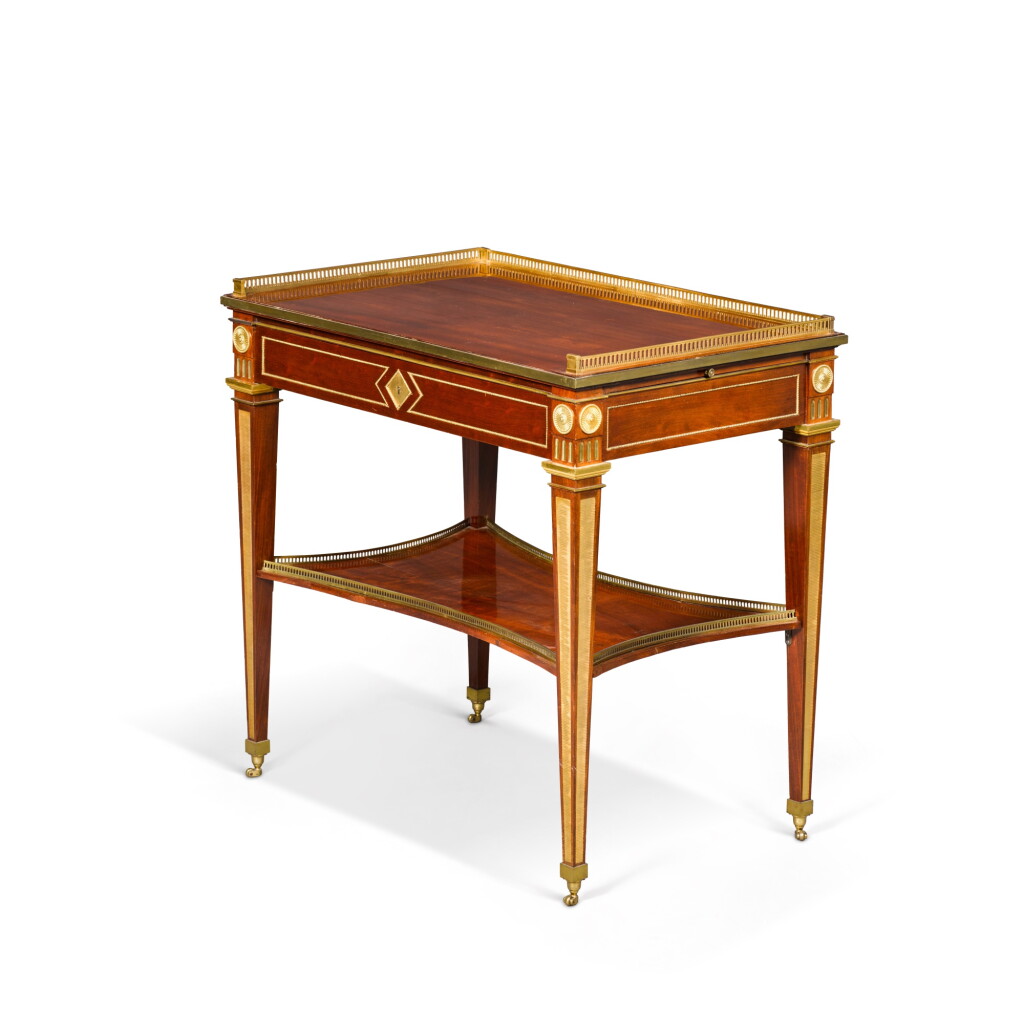
A German gilt-bronze mounted mahogany table à écrire, circa 1780-1790, attributed to David Roentgen
Lot Closed
November 12, 02:47 PM GMT
Estimate
10,000 - 15,000 GBP
We may charge or debit your saved payment method subject to the terms set out in our Conditions of Business for Buyers.
Read more.Lot Details
Description
the rectangular top with three-quarter pierced gallery and stepped edge above a panelled frieze decorated "a toute faces" with beaded borders, fitted with a secrétaire drawer centred by a "mille raie" tablet and enclosing a leather-lined writting slide and two fitted drawers, each side with a further leather-lined writting slide, the fluted angles mounted with replaced circular patterae, above detachable square tapering and "mille raie" panelled legs, joined by a concave-sided undertier with pierced gallery, terminating in square brass cups and castors, with chalk inscription GK III/4
76cm high, 78cm wide, 51cm deep (closed); 29 7/8in., 30 5/8in., 20 1/8in.
Christie's, London, 1st December 2005, lot 184.
With its pearl-strung tablets, mille-raies or fluted herm legs and paterae, the group of galleried tables in this sale (lots 13, 15 and 111) typify the neoclassical style promoted by David Roentgen (d.1807), cabinetmaker of Neuwied-am-Rhein and ébéniste mécanicien to Louis XVI in the late 18th century. The tables are charming with their simple elegance, underlined by the contrast of gilt-bronze mounts and precious, figured mahogany.
A wider writing table of this form was formerly in the Berlin Schlossmuseum (illustrated in Joseph Maria Greber, Abraham und David Roentgen, Starnberg, 1980, vol.II, p.309, figs. 609 and 610). A further example incorporating a fitted frieze drawer instead of a writing surface was formerly in the collection of Robert Hirsch, sold Sotheby’s, London, 23rd June 1978, lot 595. A further example formerly with a stretcher was sold at Christie’s, London, 7th December 1995, lot 24.
David Roentgen (1743-1807) received Master in 1780
Born in Neuwied as the son of the cabinet-maker Abraham Roentgen (1711-1793), David Roentgen (1743-1807) was one of the greatest ébénistes of his age. David joined his father's workshop in 1757 and officially took control in 1772. The workshop became highly successful under his leadership as he combined a talent for woodwork, mechanical technology and design with a sound instinct for business and marketing.
Their workshops were first located in Neuwied, Rhineland. Very quickly, as a shrewd businessman, David Roentgen had the ambition to sell his furniture in Paris where he travelled to for the first time in 1774. In 1779, he returned to Paris accompanied by a large number of pieces of furniture of his own making. These were very successful, especially with the royal family, Louis XVI and Marie-Antoinette who then granted him the title of Ebéniste-mécanicien du Roi et de la Reine.
Based in Paris on rue de Grenelle, while retaining his workshops in Neuwied, Roentgen was subject to the obligation to stamp his works. It is therefore surprising to find very little furniture bearing his stamp. Building on his Parisian successes, Roentgen turned to Europe's second most powerful kingdom, Russia. So in 1783, thanks to a letter of recommendation from Grimm, who described him as "the best cabinetmaker-mechanic of the century," Roentgen introduced himself to Catherine the Great. This was the beginning of a vast series of orders for sumptuous mahogany furniture that he delivered to both the Empress and Russian aristocrats close to her. In this effervescence, a school inspired by the master's work was founded in St. Petersburg, under the direction of one of its former workers, Christian Meyer.
You May Also Like