
Property of a Private British Collector
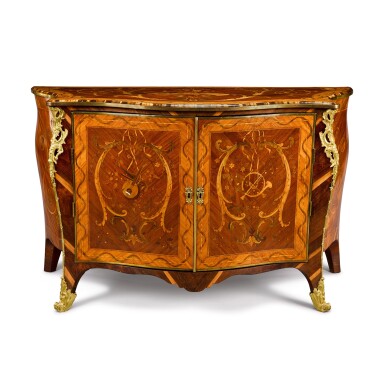
A George III padouk, tulipwood, marquetry and gilt-metal-mounted commode, circa 1770, attributed to Pierre Langlois
Lot Closed
November 12, 01:40 PM GMT
Estimate
50,000 - 80,000 GBP
We may charge or debit your saved payment method subject to the terms set out in our Conditions of Business for Buyers.
Read more.Lot Details
Description
the laburnum-banded shaped and eared top centred by a marquetry musical trophy enclosed by foliate tendrils and a ribbon-and-stave border, the panel doors with conforming borders and matching trophies featuring a lute and bugles including an ivory piece, and enclosing one adjustable shelf, the sides also with marquetry panels of urns and foliate tendrils, the angles with chute mounts terminating in sabot feet
86.5cm high, 145.5cm wide, 59.5cm deep;
2ft. 10in., 4ft. 9 ¼ in., 1ft. 11 ⅜ in.
Likely commissioned for Croome Court, Worcestershire.
all illustrations of the other commode in the pair, sold at Sotheby's New York in 1996
P. Macquoid, ‘English Furniture in Sir George Donaldson's Collection – III’, Country Life, 23rd February 1918, p. 195, fig. 3
P. Macquoid and R. Edwards, Dictionary of English Furniture, rev. ed., Wappingers’ Falls NY, 1954, p.117, fig. 18
Probably the commode illustrated in E. A. B. Barnard, "The Coventrys of Croome', Worcestershire Archaeological Society Transactions, 1943, p.38, pl. III
This lusciously inlaid commode incorporates numerous trophies of musical instruments, suggesting that they were commissioned by a cultivated patron of the arts or were even intended to furnish a room in which music was performed. The commode is evidently the pair to another that sold at Sotheby’s New York, 11th October 1996, lot 181 ($65,750) – the form, marquetry and mounts all match up precisely, leaving only the blonde stripes of the cross-banding to differentiate the two examples. The Sotheby’s 1996 commode – and so, by conclusion, likely the present lot as the pendant to it – has provenance tracing back to Croome Court in Worcestershire, a splendid example of a collaboration between Capability Brown and Robert Adam.
This commode was one of numerous intricate commodes that were make in the ‘French manner’ in the 1760s and 1770s and are usually attributed to the Pierre Langlois, a craftsman of Huguenot origins; this type of ‘commode’, unlike the typically English chest of drawers, was often serpentine or bombé in form, used panel doors as a primary focus of the ornament and incorporated the glamorous gilt-bronze mounts so typical of Louis XV case furniture. The pendant to the present lot is well documented in academic literature on the history of furniture, due in large part to its place in the collections of Sir Donaldson and the Duveen Brothers: for example, the commode was pictured in the seminal text The Dictionary of English Furniture, and is discussed in both The Connoisseur and Country Life.1 Other commodes in this style tend to have been made for the prestigious patrons, such as the ‘Craven Commodes’ that were make for the 6th Baron Craven and sold at Sotheby’s London, 30th November 2001, lot 96 and was also attributed to Langlois. A series of 1976 articles focusing on Langlois gives a comprehensive list of examples,2 but the most historically important and relevant to the present commode are the example in the Royal Collection (RCIN 39224) the one formerly at The Chantrey, Elstree,3 two from the Leverhulme collection4 and the ones at West Wycombe Park, Buckinghamshire.5 The most significant, though, is also from Croome Court and is on display in in the Metropolitan Museum of Art, New York (59.127), facing the reassembled Croome Court Tapestry Room in the adjacent gallery. Other important pairs of Langlois commodes at auction include the pair sold Sotheby’s New York, 7th April 2004, lot 193 ($534,400) and the pair sold at Christie’s London, 15th April 1999, lot 100 (£98,300).
The 6th Earl of Coventry preserved the old foundations and walls of the older seventeenth-century building at Croome Court, the building’s Palladian façade suffuses it with the serene orderliness of mid-eighteenth-century classicism. The house was the first significant commission for Lancelot ‘Capability’ Brown, the genius behind the English landscape garden, and in typical Brown style the gardens are full of subtle visual illusions and were made possible by relocating a nearby village into a more picturesque spot. Robert Adam designed many of the rooms, including the French-inspired Tapestry Room which is now in the MET. During the twentieth century, it would serve as a Catholic boy’s school from 1950 to 1979 and then for firve years as the headquarters for International Society for Krishna Consciousness. The house now belongs to a charity called the Croome Heritage Trust, who lease the building to the National Trust.
1 P. Macquoid and R. Edwards, Dictionary of English Furniture, rev. ed., Wappingers’ Falls NY, 1954, p.117, fig. 18; P. Thornton and W. Rieder, ‘Pierre Langlois, Ebéniste. Part 4’, The Connoisseur, April 1972, p.265, note 9; P. Macquoid, ‘English Furniture in Sir George Donaldson's Collection – III’, Country Life, 23rd February 1918, p. 195, fig. 3.
2 Thornton and Rieder, op. cit., and also its preceding instalment , ‘Pierre Langlois, Ebéniste. Part 3’, pp.176-187.
3 M. Harris and Sons, A Catalogue and Index of Old Furniture and Works of Decorative Art, Part III c.1770 to c. 1840, London, [n.d.], p.357, cat. F 13417. Later sold Sotheby’s Parke Bernet, 22nd February 1975, lot 130.
4 Thornton and Rieder, op. cit., p.260, fig.7 (when with Howard Antiques) and another sold Sotheby’s London, The Leverhulme Collection, 26-28 June 2001, lot 128
5 Thornton and Rieder, op. cit, p.262, figs. 12 and 13.
You May Also Like


