View full screen - View 1 of Lot 2. Ins violett (Into Violet).

The Cindy and Jay Pritzker Collection

Wassily Kandinsky

Ins violett (Into Violet)

Auction Closed

November 20, 11:43 PM GMT

Estimate

700,000 - 1,000,000 USD

Lot Details

Description

The Cindy and Jay Pritzker Collection

Wassily Kandinsky

(1866 - 1944)


Ins violett (Into Violet)

signed with artist’s monogram and dated 25 (lower left); dedicated Der verehrten Frau E. Reichelt herzlichst Kandinsky (on the artist's mount); titled Violett, dated 1925 and numbered No 188 (on the reverse of the artist's mount) 

watercolor and pen and ink on paper on the artist's mount

image: 13 ¾ by 8 ¾ in.   35 by 22.2 cm.

mount: 19 ⅜ by 13 ⅝ in.   49.3 by 34.5 cm.

Executed in January 1925.

Elfriede Reichelt, Breslau (acquired directly from the artist in exchange for photographs in April 1926)

Galerie Jacques Benador, Geneva (acquired by 1956)

Heinz Berggruen, Paris (acquired by 1956)

Hanover Gallery, London (acquired in 1956 and until 1958)

Heinz Berggruen, Paris (acquired by 1958)

Mr. and Mrs. Peter Bensinger, Chicago (acquired by 1959)

Linda Olin, Chicago (until 1982)

Richard Gray Gallery, Chicago

Acquired from the above on 10 November 1982 by the present owner

Dresden, Graphisches Kabinett Hugo Erfurth and Erfurt, Angermuseum, Kunstverein, Sieben Bauhausmeister, 1925

Paris, Berggruen & Cie., Klee et Kandinsky: une confrontation, 1959, n.p., illustrated (titled Violett)

New Haven, Yale University Art Gallery, Paintings, Drawings and Sculpture Collected by Yale Alumni, 1960, no. 199, p. 192, illustrated (titled Violet)

The artist’s handlist, I, no. 188

John Prossor, “An Introduction to Abstract Painting,” Apollo, vol. LXVI, no. 392, October 1957, fig. II, p. 76, illustrated (titled Violett)

Vivian Endicott Barnett, Kandinsky Watercolours, Catalogue Raisonné, vol. II, Ithaca, 1994, no. 750, p. 145, illustrated

1925 marked a creative apogee in Wassily Kandinsky’s involvement at the Bauhaus. In June of the same year, mounting political pressures forced the school to relocate from its original location in Weimar to Dessau. Kandinsky quickly found inspiration in the industrial city and the functionalist aesthetic of the school’s new building which its founder Walter Gropius designed. In July of the same year, Kandinsky began work on his second seminal text Punkt und Linie zu Flache (Point and Line to Plane), begun in July and completed in November of the same year. Executed in January, Ins violett at once offers a beautifully articulated compendium of the theories between color and form, point and line, and Kandinsky's overarching ideation on the notion of correspondence, which he continued to expand on in his teachings at the Bauhaus. It anticipates the profoundly generative impulse which would come to characterize his artistic output of the period.


Throughout his eleven year tenure as a teacher at the Bauhaus, Wassily Kandinsky’s watercolors were a formative means of theoretical and methodological experimentation. His work within the medium was prolific; according to his personal handlists, Kandinsky executed 183 watercolors between 1922 and 1926 alone. It was not until 1924, however, that each entry was recorded with its own unique title, rather than one that positioned it as a preparatory work for a culminating oil painting. This indication that Kandinsky had begun to understand his watercolors as independent to his larger format works, and equal in importance, is deeply felt in the luminous Ins violett (Into Violet).


Within the elegantly balanced composition, Kandinsky creates a world contained unto itself—one whose component parts are familiar, and exist within our lived reality, but which are relieved of the representational meaning that we ascribe to them. At first glance, there is a distinctly hieratic arrangement to these elements: the totemic form floating at right, the ascending stack of blocks at left, and the stepped diagonal between them, all of which impart a sense of architectural rigidity to the whole. At the same time, the structural integrity of that arrangement is immediately destabilized by the magnetic pull of the various diagonals. The title, Ins violett (Into Violet), serves as yet another instruction to the eye, a directive which draws the viewer’s gaze to the wash of violet in the upper register, conferring on the whole the suggestion of a vertical ascent. Without the aid of contextual or spatial moorings, each of these elements becomes untethered from its physical placement within the composition and is released into a rhythmic oscillation, alternately receding away from and projecting out of the surface. The transparency of their coloration calls into flux the geometry of their outline, particularly in the areas where intermingling forms give way to new shapes in their point of contact. To the uninitiated viewer, the behavior of these forms and colors offers perhaps the most explicit articulation of Kandinsky's theories in practice.


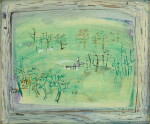
A defining feature of his Dessau period was precisely this overlapping of shapes and colors, which reintroduced a sense of spatial depth that had been missing from his earlier Bauhaus works. One cannot help but ascribe physical properties to these elements, which makes comparison to his earlier figurative compositions a particularly apt point of reference for the innovations that Ins Violett (Into Violet) reveals. In his 1909 landscape, for example, the beginnings of Kandinsky’s theorization on the psychological quality of color is present, which he so brilliantly translates in the present work (see fig. 3).


Though not yet entirely liberated from its figurative subject, and still conceived within a representational framework, the Fauvist brushstrokes simultaneously evoke their real-world counterpart through the simplest of formal means and begin to behave independently of the objects they describe. Yet, just more than fifteen years later in 1925, any semblance of narrative is removed from the elements within the composition. Whereas in Houses in Murnau, Kandinsky elicits an emotional response through means of expression and the frenetic energy of its articulation, within Ins violett, he removes any qualifier from his brushstrokes. Color is relieved of its descriptive obligation and form of its representational obligation. If one imagines the row of houses lining the hillside as equivalent to the two scalloped diagonal lines, or even further to the curlique, the transformation which Kandinsky’s work underwent within the intervening period becomes aboundingly clear. Whereas the color yellow as used to describe the sunlit facades of the structures is inextricably linked to the sentimentality of the time of day which Kandinsky depicts in the landscape, we are here left to consider the behavior of color itself as a subject.


The aesthetic theories governing many of Kandinsky's compositions throughout his career derived from his 1911 treatise, Concerning the Spiritual in Art, in which he praised the power of color and its influence on the viewer. Like many of his contemporaries working in Russia at the time, Kandinsky was deeply influenced by the principles of Suprematism. Founded by Kazimir Malevich, and based on the notion of the supremacy of pure feeling in the pictorial arts, Suprematism rejected nature in favor of a geometric abstraction reduced to its most fundamental form (see fig. 4).


Kandinsky’s own theories on art were based on his tangential notion of an “innermost necessity,” communicated between artist and viewer through the perceptual effects engendered by different pairings of shape and color. Kandinsky contended that colors carry inherent psychological effects which can be heightened or diminished when articulated within certain shapes, which also bear innate perceptual qualities. The objective of his idea of non-objectivity—a reduction of shape to its most essential form—was to remove from representation any obligation to an object beyond itself, so that those pairings can be read without the emotional meaning we attach to figurative painting. The art object and the arrangement of its formal elements thus become a means for universal, subliminal communication.


Two months after completing the present work, Kandinsky began on a major oil painting, Gel-Rot-Blau (Yellow-Red-Blue), now housed in the Centre Georges Pompidou (see fig. 5). As testament to the strength of the composition he achieved within Ins violett, the arrangement of forms is translated almost exactly onto the left-hand side of the canvas, poised in conversation with an explosion of overlapping organic shapes on the right. The rhythmic, synesthetic quality he is able to achieve through the juxtaposition and counterbalance of these opposing formal languages offers among the most visceral articulations of Kandinsky’s ability to engage each of the senses through the arrangement of elements within a work.


In April 1926, shortly after the oil painting was completed, Kandinsky gifted the watercolor to the German photographer Elfriede Reichelt in exchange for portraits she had taken of the artist and his wife, Nina. The inscription on the artist’s mount, Der verehrten Frau E. Reichelt herzlichst Kandinsky (To the esteemed Mrs. E. Reichelt, Kandinsky) serves as a poignant foreshadow of the acclaim with which Reichelt’s photography would soon come to be met (see fig. 6). Her portraits of Kandinsky from the mid-1920s in particular stand among the most recognizable of the period (see figs. 1 and 2). Ins violett offers a portrait of Kandinsky in another form—capturing within its painted surface a record of the artist at a moment of profound creative invention.