Property from the Family of Dr. Joan Feynman
Feynman, Richard P.
Autograph Letter Signed ("R.P. Feynman."), to His Mother Lucille Feynman, Announcing His First Solo Publication, 1939
Lot Closed
December 13, 08:11 PM GMT
Estimate
6,000 - 9,000 USD
Lot Details
Description
FEYNMAN, RICHARD P.
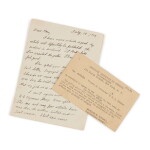
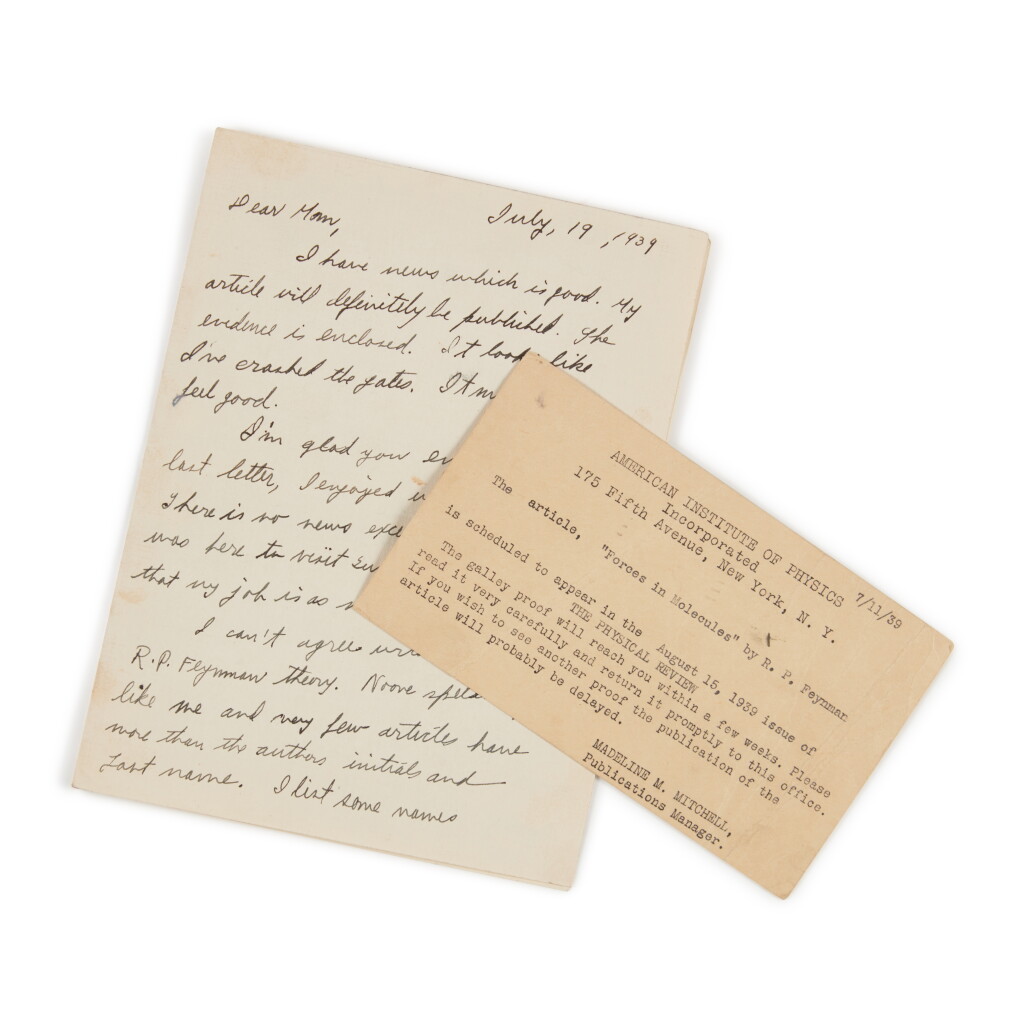
Autograph letter signed ("R.P. Feynman."), to Lucille Feynman ("Mom"), July 19, 1939.
4 pages in ink on single folded sheet (7 x 10 1/2 in), with additional notations in pencil. Creases where previously folded, some minor stains and thumb-soiling.
[WITH]: printed announcement card from the American Institute of Physics, addressed to John C. Slater, Professor of Physics at the Massachusetts Institute of Technology, declaring the forthcoming release of "Forces in Molecules" by R.P. Feynman in the August 15, 1939 issue of The Physical Review.
A MOMENTOUS LETTER FROM RICHARD FEYNMAN ANNOUNCING THAT HIS FIRST SOLO ARTICLE AND UNDERGRADUATE DISSERTATION, "FORCES IN MOLECULES," WILL BE PUBLISHED IN THE PHYSICAL REVIEW
“Feynman’s thesis began as a circumscribed problem... It ended as a fundamental discovery about the forces acting within the molecules of any substance [and] found its way into the permanent tool kit of the physics of solids.” (James Gleick, Genius, p. 86).
This letter to his mother announces with pride ("I've crashed the gates. It makes me feel good.") the publication of Richard Feynman's first single-author article (his first publication, a letter to the editor of the Physical Review co-authored with MIT physicist Manuel Sandoval Vallarta, was published earlier in 1939 and titled, "The Scattering of Cosmic Rays by the Stars of a Galaxy.")
In "Forces in Molecules," Feynman demonstrated that:
"The force on an atom's nucleus is no more or less than the electrical force from the surrounding field of charged electrons—the electrostatic force. Once the distribution of charge has been calculated quantum mechanically, then from that forward quantum mechanics disappears from the picture. The problem becomes classical; the nuclei can be treated as static points of mass and charge. Feynman's approach applies to all chemical bonds."
(James Gleick, Genius, p. 90).
The equation associated with this discovery, now known as the Hellmann-Feynman theorem, "caused a small sensation among MIT's physics faculty" as it "permit[ted] a considerable saving of labor of calculations." The theorem remains central to the calculation of forces in molecules.
Included in this letter is Feynman's handwritten list of some of the most prominent physicists of the day, such as Erwin Schrödinger, Paul Dirac, and Hans Bethe, among others. Also included in this lot is the announcement card sent to Feynman's advisor John C. Slater by the American Institute of Physics; in "Forces in Molecules," Feynman thanks Slater who, "by his advice and helpful suggestions, aided greatly in this work."
Richard Feynman's autograph letter, dated "July 19, 1939," reads, in full:
"Dear Mom,
I have news which is good. My article will definitely be published. The evidence is enclosed. It looks like I've crashed the gates. It makes me feel good.
I'm glad you enjoyed my last letter, I enjoyed writing it. There is no news except that Putzie was here to visit Sunday, and that my job is as nice as ever.
I can't agree with your R.P. Feynman theory. No one spells Feynman like me and very few articles have more than the authors' initials and last name. I list some names I found as references in a book.
A. Sommerfield
A.E. Ruark and H.C. Urey (you've heard of him)
M. Born + P. Jordan
E. Schrödinger
L. de Broglie
C. Eckart
P.A.M. Dirac
E.W. Condon + P.M. Morse (you know him)
N.F. Mott
J. Frenkel etc. etc. etc.
I have some actual articles here written by
M.S. Vallarta
H.A. Bethe
Hans Mueller
Philip M. Morse (in again)
L.A. Young
Eva S. Haurwitz
W.P. Allis etc.
So I'm not doing anything wrong, anyway I'm lazy.
Putzie + I had our usual good time. We went to a free concert in the park of the Boston Symphony Orchestra.
She drew a picture of me which she probably will show you. I love her.
I am doing exercises every might. I suppose they will do me good. I know I am already stronger (muscularly) than I was when I started.
I am sorry to hear you had such cold weather.
Love to all,
R.P. Feynman
List
Thomas Edison
Alexander Graham Bell
Robert Fulton"
REFERENCES:
Gleick, James. Genius: The Life and Science of Richard Feynman. New York: Vintage, 1992, pp. 86, 89-90.
You May Also Like


