
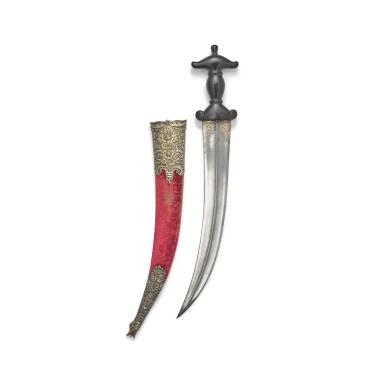
A Large Ottoman Ebony-Hilted Dagger, Turkey, 18th Century
Auction Closed
April 29, 12:32 PM GMT
Estimate
10,000 - 15,000 GBP
Lot Details
Description
the double-edged curved blade with central ridge and overlaid at the forte with gold arabesques, the ebony hilt with a baluster-shaped grip and bifurcated pommel and quillons, the velvet-covered wooden scabbard with silver-gilt chased mounts decorated with floral patterns against a stippled ground, with sculpted sea monster at the tip of the chape
59.5cm.
Philippe Missillier Collection no.104C
The ebony hilt is an Ottoman copy of a Mughal form found in jade, characterised by a bifurcated pommel and quillon and a baluster-shaped grip. A Mughal hilt of this type dated to the seventeenth century is in the al-Sabah collection (inv. no.LNS 275 HS; Salam Kaoukji, Precious Indian Weapons and Other Princely Accoutrements, London: Thames and Hudson, 2017, pp.96-97, cat.28). The form continued in use in India into the eighteenth century, appearing on a dagger formerly in the Clive collection and the Al Thani collection (Amin Jaffer (ed.), Beyond Extravagance, New York: Assouline, 2019, pp.153-4, no.123). Mughal jade hilts found their way to Ottoman workshops where they were often embellished and mounted onto blades: a sword in Dresden has an Indian hilt with Ottoman gem-settings, dated to the seventeenth or eighteenth century (inv. no.Y 143; Holger Schuckelt, Die Türkische Cammer, Dresden: Staatliche Kunstsammlung Dresden, 2010, pp.332 and 357, no.350).
You May Also Like


