
Property of a Private Estate
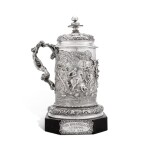
The Molyneux Cup, Liverpool Races, July 1864. A large Victorian silver racing prize tankard, Charles Frederick Hancock for Hancock, Son & Co., London, 1863
Lot Closed
December 19, 02:04 PM GMT
Estimate
3,000 - 4,000 GBP
Lot Details
Description
The Molyneux Cup, Liverpool Races, July 1864. A large Victorian silver racing prize tankard, Charles Frederick Hancock for Hancock, Son & Co., London, 1863
The sides extensively chased with a classical cavalry battle, the cover with a medieval cavalry battle, the handle formed of adult and child satyrs grappling with each other along with a marine dragon, on an ebonised wood plinth engraved 'The Molyneux Cup, Liverpool, July 1864',
46cm., 18in. high
5408gr., 173 ½oz. weighable silver
The Molyneux Cup at Liverpool Races in 1864 was won by Captain Gray’s three-year-old Windham, by Windhound. The prize of 400 sovereigns consisted of ‘a piece of plate value 200 sovs, and 200 sovs in specie by subscription of 10 sovs each . . . the winner to pay 20 sovs towards expenses of the course, &c.’ (Yorkshire Gazette, York, Saturday, 16 July 1864, p. 10e)
‘LIVERPOOL JULY MEETING . . . THURSDAY [14th] . . .
‘For the Molyneux cup, although the field was of small dimensions, the quality of the competitors was good. Fantail, owing to her favourable weight, was backed freely by her owner and the public, as were also The Clown and Moulsey. Singularly enough, Windham, who had shown high racing qualities at Chester and Newcastle-on-Tyne, was the worst favourite of the lot. Artistically ridden, however, by [Thomas] Cranshaw – the most promising light-weight of the day – Windham, after a fine race with Fantail, won by a neck, and upset the “pot” with which she was entrusted.’ (The Manchester Guardian, Friday, 15 July 1864, p. 4b)
This pattern of tankard, produced several times by Hancock’s between the 1860s and the early 1880s, was based on a pair of similar vessels, maker’s mark of Edward Farrell, London, 1824 (for which see Sotheby’s, London, 23 January 2014, lot 124), which the firm had acquired and adapted, probably in the early 1860s.
You May Also Like


