Virginia House of Delegates | The genesis of the Declaration of Independence and the Bill of Rights
Auction Closed
January 27, 03:32 PM GMT
Estimate
350,000 - 500,000 USD
Lot Details
Description
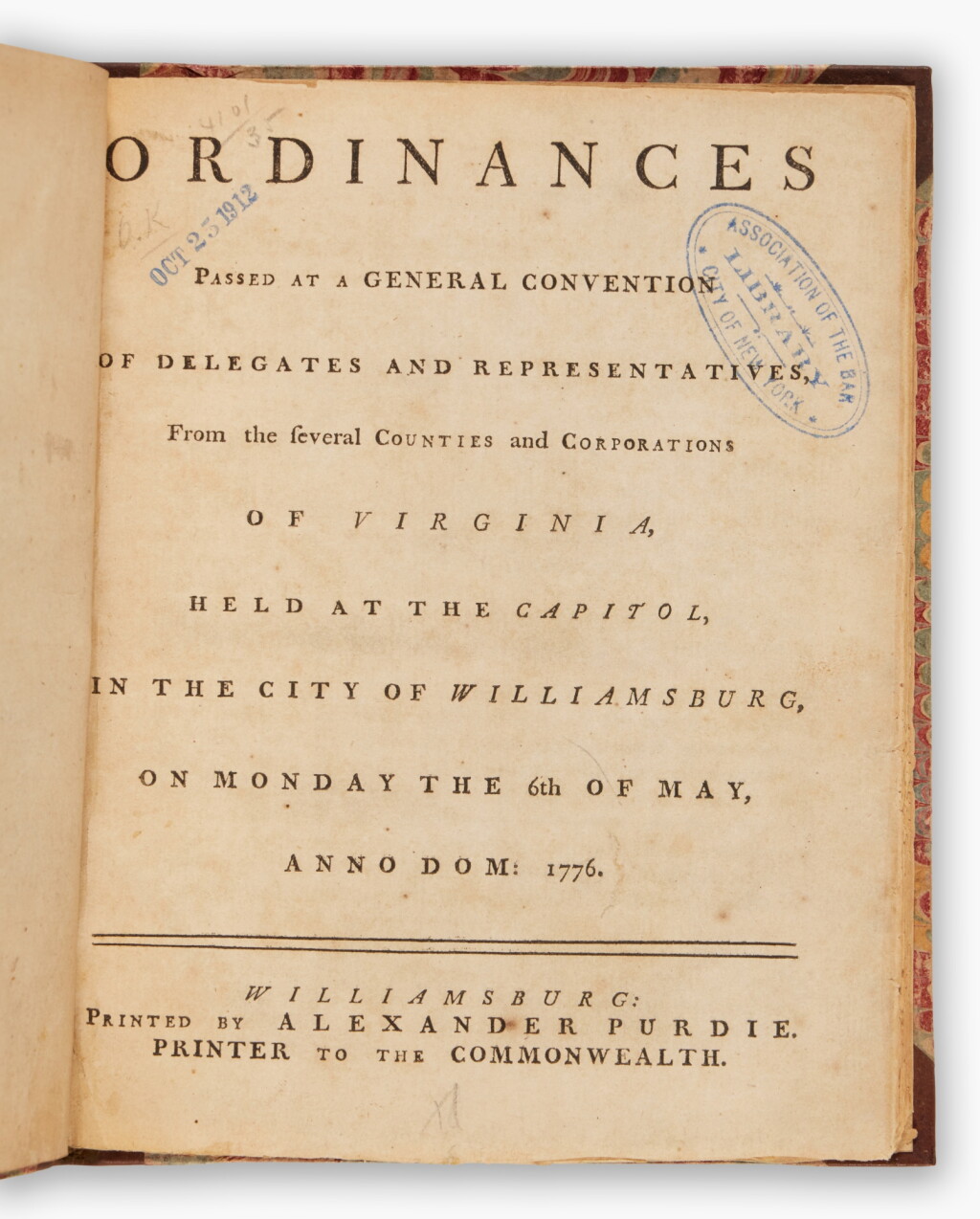
Ordinances Passed at a General Convention of Delegates and Representatives, From the Several Counties and Corporations of Virginia, Held at the Capitol, In the City of Williamsburg, on Monday the 6th of May, Anno Dom: 1776. Williamsburg: Printed by Alexander Purdie, Printer to the Commonwealth, [1776]
4to (207 x 160 mm, preserving deckle on many lower edges). Some light dampstaing at fore-edges with resultant minor fraying and very occasional restoration, fraying just touching a single letter on final leaf, a number of leaves neatly guarded, some very light browning. Handsome retrospective calf-backed marbled boards.
(accompanied by)
The Proceedings of the Convention of Delegates, Held at the Town of Richmond, in the Colony of Virginia, On Friday the 1st of December, 1775, and afterwards, by adjournment, in the City of Williamsburg. Williamsburg: Printed by Alexander Purd[ie], [1776] (bound with:) Ordinances Passed at a Convention Held in the City of Williamsburg, in the Colony of Virginia, On Friday the 1st of December, 1775. Williamsburg: Printed by Alexander Purd[ie], [1776]
2 works in one volume, 4to (214 x 162 mm). Lower fore-edge corners of first two leaves restored costing last two letters of printer's name and a tiny portion of printed rules on title-page, browned, small stain at fore-edge. Handsome, near-uniform, retrospective calf-backed marbled boards.
First edition of the Ordinances of the fifth Virginia Revolutionary Convention at Williamsburg in May and June 1776, containing the Virginia Declaration of Rights, one of the most important and influential documents in American history, as well as the Virginia Constitution. Accompanied by the Proceedings and Ordinances for the fourth Virginia Revolutionary Convention begun on 1 December 1775 and ending 20 January 1776.
The Ordinances record the legislative output of Virginia House of Delegates during the crucial period from 6 May to 5 July 1776, including the adoption of Virginia's Constitution—in which the state separately declared independence from Great Britain—and the election of Patrick Henry as the state's first governor. "When the convention adopted the new constitution on June 29, 1776, it transformed Virginia's political landscape by giving the people an unprecedented role in running their government" (CCC, p. 40). But the Virginia Declaration of Rights is the cornerstone of the Virginia Convention.
"Written primarily by George Mason and adopted on June 12, 1776, the Virginia Declaration of Rights comprised, in the words of historian Gordon S. Wood [in The Creation of the American Republic], 'a jarring but exciting combination of ringing declarations of universal principles with a motley collection' of more specific legal customs that Americans had long prized. It began by stating that 'all men are by nature equally free and independent' and that 'all power is vested in, and consequently derived from, the people.' Because of this, 'a majority of the community hath an indubitable, inalienable, and indefeasible right to reform, alter, or abolish' their government whenever they deemed the current one 'inadequate.' The similarity between these phrases and those found in the Declaration of Independence was no coincidence. Jefferson eagerly drew on Mason's drafts as he composed his own text in Philadelphia. … Importantly, the Declaration of Rights did not grant the people their rights but rather guaranteed them. Since all power came from the people, their rights were not limited to what they chose to emphasize and write down at this particular moment" (CCC, pp. 37, 40).
The sixteen points of the Declaration of Rights also allowed for the separation of the executive, legislative, and judicial branches of government; frequent free elections; elimination of hereditary offices; the right to trial by a jury of one's peers; reasonable bail; no cruel or unusual punishment; reasonable warrants for searches; freedom of the press; subordination of the military to civil authority; and freedom of religion. This final clause was introduced by James Madison: "That religion, or the duty to which we owe to our Creator, and the manner of discharging it, can be directed only by reason and conviction, not by force or violence; and therefore, all men are equally entitled to the free exercise of religion, according to the dictates of conscience; and that it is the mutual duty of all to practice Christian forbearance, love, and charity, towards each other." According to Lance Banning, Madison's contribution to the Declaration of Rights established "a standard that no society had ever recognized in its organic law" (in American National Biography).
The 1776 Ordinances is very rare: ESTC records just a dozen institutions with copies, and Rare Book Hub cites only two other copies at auction in the last century, one in indifferent condition, the other the fine Dorothy Tapper Goldman Foundation copy that was bound with The Proceedings of the Convention of Delegates for the same session (achieved $685,500.
The Proceedings and Ordinances for the fourth Virginia Revolutionary Convention are equally scarce. The delegates to that convention focused principally on improving the colony’s defenses as tensions had risen between the Virginia citizenry and militia and British and Loyalist troops. The convention enlarged the colony’s armed force from two to nine regiments, and, with the Committee of Safety, took additional steps to cooperate more closely with the other colonies and with the Continental, resulting in Continental troops being sent to reinforce the Virginians.
REFERENCES
Colonists, Citizens, Constitutions 5; ESTC W18822, W31172, W19198; Evans 15199, 15197, 14596; Sabin 100026, 100016, 100015
PROVENANCE
New York Bar Association (ink-stamps on title-pages; Doyle, 24 November 2014, lot 100)
You May Also Like