
Property from Carnegie Museum of Art, Sold to Benefit the Acquisition Fund
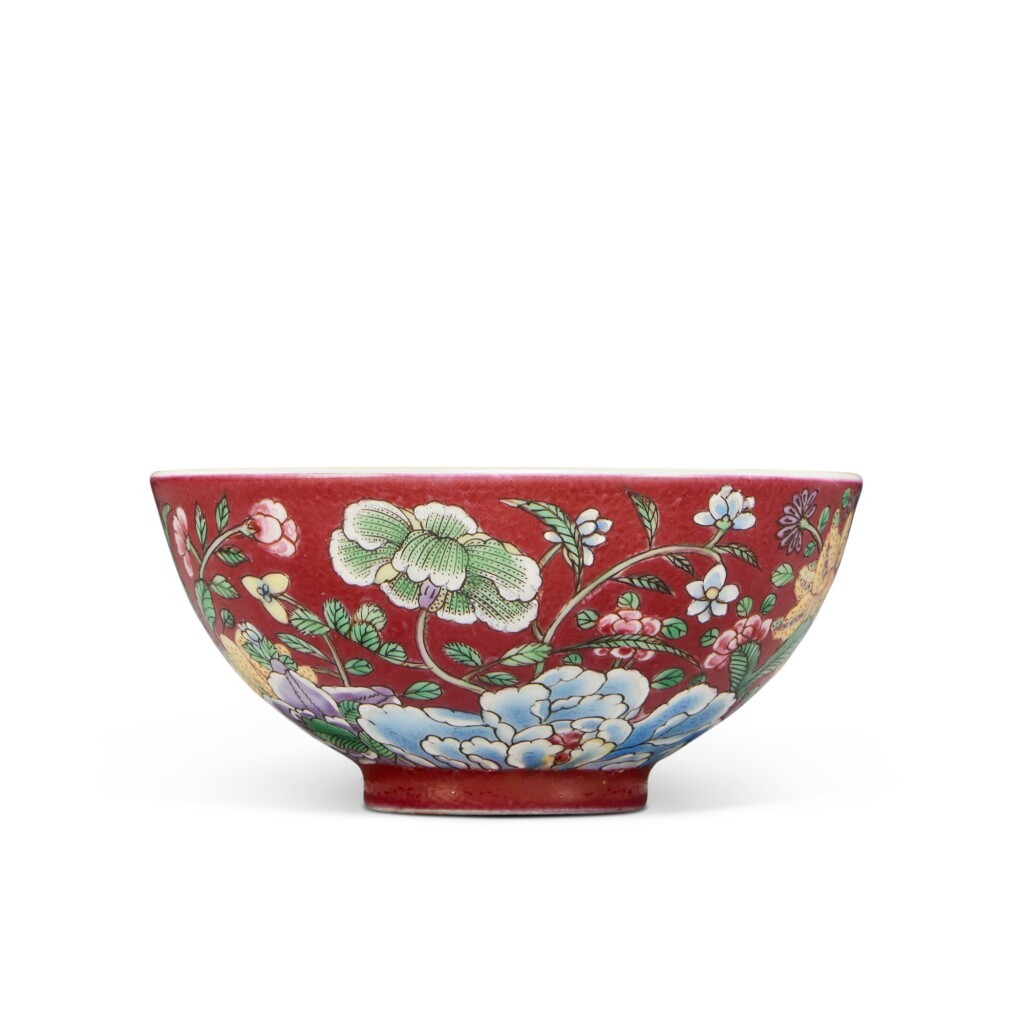
A fine and extremely rare imperial ruby-ground 'yangcai' 'floral' cup, Yongzheng yuzhi mark and period
Auction Closed
March 19, 05:41 PM GMT
Estimate
200,000 - 300,000 USD
Lot Details
Description
the base with a four-character yuzhi mark in underglaze blue within a double square
Diameter 2¾ in., 7 cm
Collection of George Hathaway Taber (1859-1940), prior to 1935, and thence by descent.
Gifted to the Carnegie Museum of Art, Pittsburgh, 1955 (accession no. 55.47.7).
Far Eastern Art, a Memorial Exhibition from the Collection of George H. Taber, Carnegie Museum of Art, Pittsburgh, 1958.
This cup is a rare and exceptionally fine example of a much coveted group of vessels, with delicate floral designs in enamel on dark red grounds, bearing the yuzhi mark of the Yongzheng Emperor.
This mark, indicating a piece was made 'for the imperial use,' was first employed in the imperial enameling workshops of Beijing during the final years of the Kangxi reign (1662–1722). Indicating a closer relationship to the imperial court than the more common nianzhi [made in the years of…] mark, pieces bearing a yuzhi mark are exceedingly rare and coveted by collectors. Unlike the more typical pink or blue enamel yuzhi marks of the Kangxi and Yongzheng reigns, however, the present example has been rendered in underglaze cobalt blue, presumably at the imperial kilns of Jingdezhen. With almost identical bowls attested with underglaze-blue nianzhi marks, the question of these yuzhi pieces continues to be debated in the scholarship. It has been suggested by some that these bowls were first fired with just their mark at Jingdezhen before being sent to Beijing to be enameled. More likely, however, this group simply represents an early cutting-edge attempt to imitate Beijing enamels directly in Jingdezhen. In his seminal work on the topic of painted enamels, Hugh Moss argues that the enamel palette of this group also supports their Jingdezhen origin, as the imperial potteries continued to follow the verdant style of the Kangxi period well into the Yongzheng reign even following the advent of famille rose enamels; see Hugh Moss, By Imperial Command, Hong Kong, 1976, p. 82.
Cups of this specific decoration and miniature size are extremely rare. Unlike most other enamel designs of this period which closely follow designs already embraced by the Kangxi court, the present design appears to have no antecedent and represents a truly novel Yongzheng innovation. Compare a pair of this size and design, preserved in the National Palace Museum, Taipei, illustrated in Porcelain with Painted Enamels of Qing Yongzheng Period (1723–1735), Taipei, 2013, cat. no. 22; another, featuring the design on a coral ground, sold at Christie’s Hong Kong, 30th October 1995, lot 717; and another almost identical cup but with a nianzhi mark, from the collection of the T. Y. Chao Family Foundation, included in Ming and Ch’ing Porcelain from the Collection of T.Y. Chao Family Foundation, Hong Kong Museum of Art, Hong Kong, 1978, cat. no. 99, sold at Christie’s Hong Kong, 27th April 1997, lot 55, and again in our Hong Kong rooms, 11th April 2008, lot 3022 (Fig. 1).
A slightly more common, though still extremely rare, variation of this floral design – derived directly from a Kangxi prototype – is also attested on Yongzheng period bowls of various sizes. Compare a slightly larger yuzhi-marked bowl of the latter design in the British Museum, London, illustrated in Hugh Moss, op. cit., pl. 5; another, larger still, preserved in the Victoria and Albert Museum, London, illustrated by Rose Kerr in Chinese Ceramics. Porcelain of the Qing Dynasty, London, 1986, pl. 93; and a Kangxi yuzhi prototype in the Palace Museum, Beijing, published in Kangxi, Yongzheng, Qianlong. Qing Porcelain from the Palace Museum Collection, Hong Kong, 1989, p. 104, pl. 87.