
A Collecting Journey: The Jane and Leopold Swergold Collection
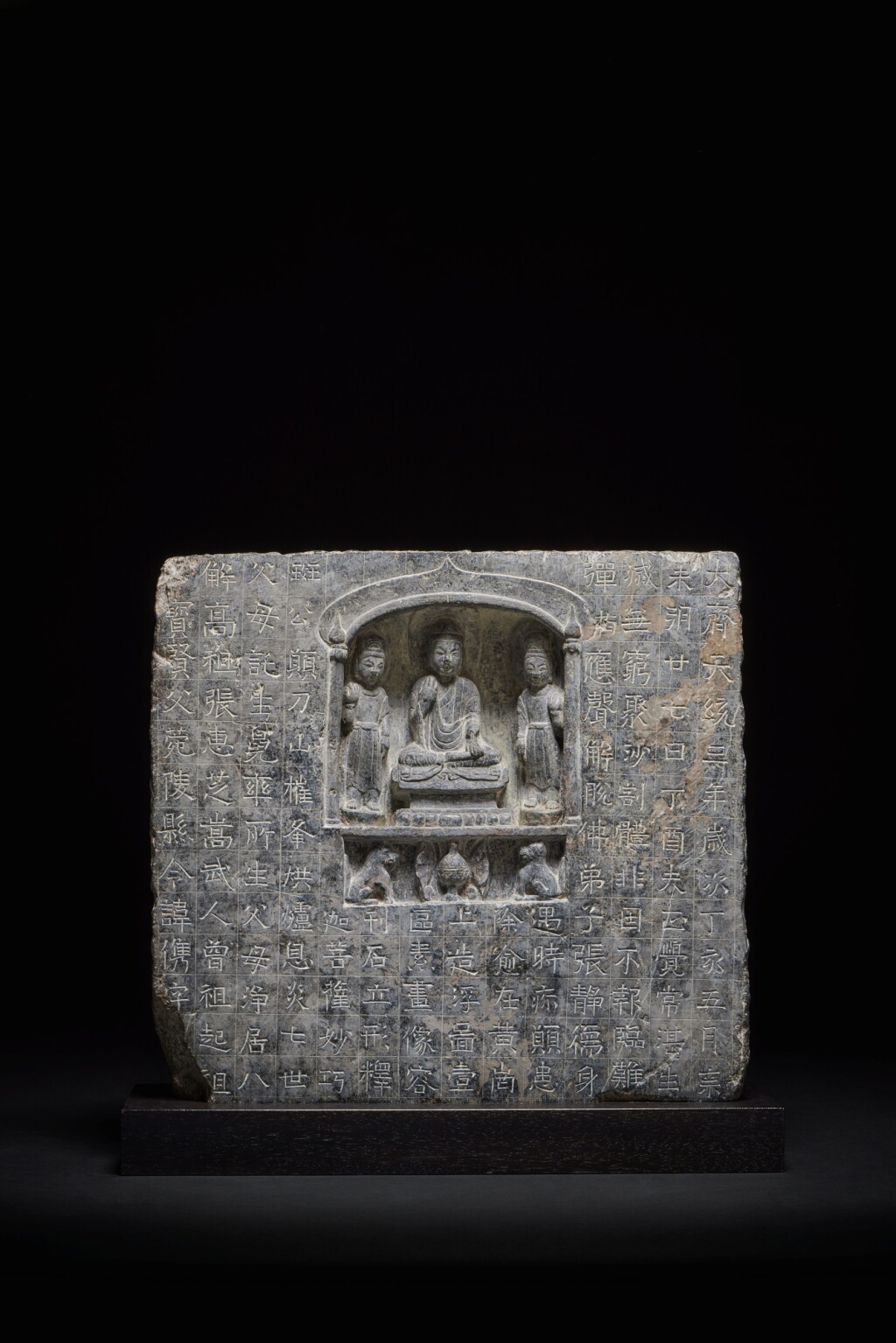
An inscribed dark gray limestone Buddhist stele, Northern Qi dynasty, dated Tiantong 3rd year, corresponding to 567
Auction Closed
March 19, 05:41 PM GMT
Estimate
80,000 - 120,000 USD
Lot Details
Description
the front with an inscription dated to twenty-seven day of the fifth month of the third year of Tiantong of the Northern Qi dynasty, stand (2)
Width 16½ in., 42 cm
Collection of Captain S. N. Ferris Luboshez (1896-1984), acquired in Shanghai before 1950.
J.J. Lally & Co., New York, March 2001.
Ink/Stone, Fairfield University Art Museum, Fairfield, 2022, cat. no. 10
Vibrantly carved with a seated Buddha flanked by two standing bodhisattvas, this stele exemplifies the gradual sculptural transition from the more regal, well-built figures of the Northern Qi (550-577) to the more plump square features of the Northern Zhou (557-581). The figures’ upright stance, fully rounded faces and light robes draping across their shoulders are characteristic of Northern Qi sculptures, when a more naturalistic approach to depictions of Buddhist deities was gradually adopted, while the oversized heads and more rhythmic rendering of the bodhisattvas’ robes betray a more stylized and dynamic depiction typical of the ensuing Northern Zhou and Sui.
As Buddhism spread across China, devotional stone stelae like the present soon became an important part of the Buddhist artistic canon, particularly after the fifth century with the formation of devotional societies. These societies, made up of lay Buddhists organized around local temples, took upon themselves various artistic projects as symbols of their devotion and were among the first to adopt stone stelae as a medium to record their faith, 'as monuments commemorating the collective groups' religious, social, and territorial identity;' see Dorothy C. Wong, Chinese Steles. Pre-Buddhist and Buddhist Use of a Symbolic Form, Honolulu, 2004, p. 43.
By the Northern Qi dynasty, the commissioning of Buddhist stelae had become an act of personal devotion, associated with the accumulation of merits for a person's future life. The turbulent years that followed the fall of the Northern Wei dynasty and the establishment of the short-lived Northern Qi and Northern Zhou dynasties, encouraged support for the teachings of the Chandragarbha Sutra, which prophesied the end of the current Buddhist era and the incarnation of the future Buddha Maitreya. This eschatological pessimism that prevailed among influential prelates of the Northern Qi, fostered the production of these stone stelae, as practitioners pleaded for salvation for them and their ancestors.
A number of closely related stelae of this type, in various sizes, are preserved in important museum collections across the world. Compare a closely related stele inscribed with a cyclical date corresponding to the year 560, carved with two seated Buddhas dressed in similarly draped robes in Matsubara Saburō, Chūgoku bukkyō chōkoku shiron [History of Chinese Buddhist sculpture], Tokyo, 1995, vol. II, pl. 384a; another, dated to the same year, ibid., pl. 384b, from the collection of Sakamoto Gorō, sold in these rooms, 8th October 2013, lot 121; and a larger stele rendered in more dramatic high relief, dated corresponding to 551, purchased from dealer C. T. Loo in 1923 and preserved at the University of Pennsylvania Museum of Archaeology and Anthropology, Philadelphia (accession no. C404).