
Property from Carnegie Museum of Art, Sold to Benefit the Acquisition Fund
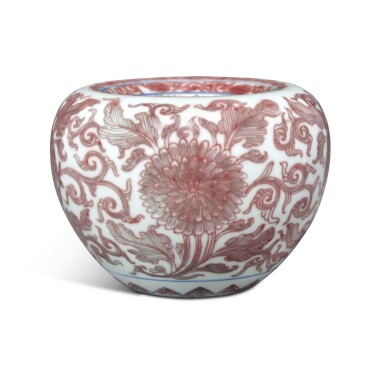
A copper-red and underglaze-blue waterpot, Mark and period of Kangxi
Auction Closed
March 19, 05:41 PM GMT
Estimate
100,000 - 150,000 USD
Lot Details
Description
the base with a six-character mark in underglaze blue
Diameter 4 in., 10 cm
Collection of Charles D. Armstrong (1861-1935), prior to 1925.
Gifted to the Carnegie Museum of Art, Pittsburgh, 1925 (accession no. 25.1.22).
Finely painted with luscious flowers in a variegated palette of grays, reds and blue, the present waterpot represents a well preserved piece of history; an homage to the creative vision and aesthetic sensibilities of the Kangxi Emperor himself.
Ascending the throne in early 1661, the Kangxi Emperor consolidated the work of his father Shizu (the Shunzhi Emperor), further unifying China and establishing a century-long period of peace, prosperity and artistic production commonly known as the High Qing era (ca. 1683-1799). Under his careful patronage, craftsmen at the imperial kilns of Jingdezhen were pushed to new limits, producing new wares with innovative forms, designs and glazes, and reviving ancient decorative techniques long since abandoned by the late Ming dynasty.
The present lot typifies this period of creativity. Skillfully painted with intricate scrolling blooms, the present waterpot’s tranquil design relies on the rich and varied tones of copper red underglaze. Copper red was, and arguably remains, one of the most challenging pigments employed by Jingdezhen artisans, who had struggled to use it since its advent in the early Ming dynasty. Although much favored for its dazzling hue, underglaze-red was virtually abandoned after the Xuande period (1425-1435) due to its frustratingly high failure rate and only revived around the 1670s on the orders of the Kangxi Emperor. Still only made in the smallest of quantities for the imperial court and the wealthiest of private buyers, these exceptional wares, experimental in nature and spellbinding in quality, continue to be treasured in important collections across the globe.
The Kangxi period also saw the innovation and formalizing of new canonical vessel forms. Building upon the experimental works of the Transitional and Early Qing periods, Kangxi era potters refined and reproduced a wide range of new forms typified by their crisp rims and subtle curving forms. The most celebrated eight (or nine) of these new designs are collectively termed the Badama (‘Eight Great Numbers’) by connoisseurs and were likely produced in complete sets, intended to adorn the studios and scholars’ desks of the imperial palace. With soft curvaceous sides that turn gently inward at the mouth, the present pingguozun (‘apple pot’) is a particularly fine example of this imperial group. Reminiscent of the cardioid shape formed by pooling sunlight, the pingguozun is not only a delight to hold and behold but also a testament to the innovation and technical precision of the imperial workshops.
Compare a number of similar waterpots of this shape and decoration preserved around the world, including one directly from the Qing Court Collection preserved at the Palace Museum, Beijing, illustrated in Kangxi. Yongzheng. Qianlong. Qing Porcelain from the Palace Museum Collection, Beijing, 1989, pl. 22; another in the Shanghai Museum, published in Underglaze Blue and Red. Elegant Decoration of Porcelain from Yuan, Ming and Qing, Hong Kong, 1993, pl. 118; and another, from the Meiyintang Collection, included in Regina Krahl, Chinese Ceramics from the Meiyintang Collection, vol. 2, London, 1994, pl. 733, where the author identifies the stylized flower sprays as peony, lotus, chrysanthemum and hibiscus.
A fourth waterpot of this type from the collection of C.P. Lin was included in the exhibition Elegant Form and Harmonious Decoration, Percival David Foundation, London, 1992, cat. no. 113, having been previously sold in our Hong Kong rooms, 28th November 1979, lot 221, and illustrated in Sotheby’s Hong Kong, Twenty Years 1973-1993, Hong Kong, 1993, pl. 88; and another, from the collection of the Xuantong Emperor (r. 1909-11), was sold in these rooms, 16th April 1983, lot 488.
Waterpots of this form were also produced in other glaze colors: compare a peachbloom-glazed example, formerly in the collection of J. Pierpont Morgan, in the National Gallery of Art, Washington, illustrated in John Ayers, ‘The Peachbloom Wares of the Kangxi Period (1622-1722)’, Transactions of the Oriental Ceramic Society, vol. 64, 1999-2000, p. 47, fig. 33; and a clair-de-lune example in the Shanghai Museum, illustrated in Kangxi Porcelain Wares from the Shanghai Museum Collection, Hong Kong, 1989, pl. 240.