Francesco Bertos
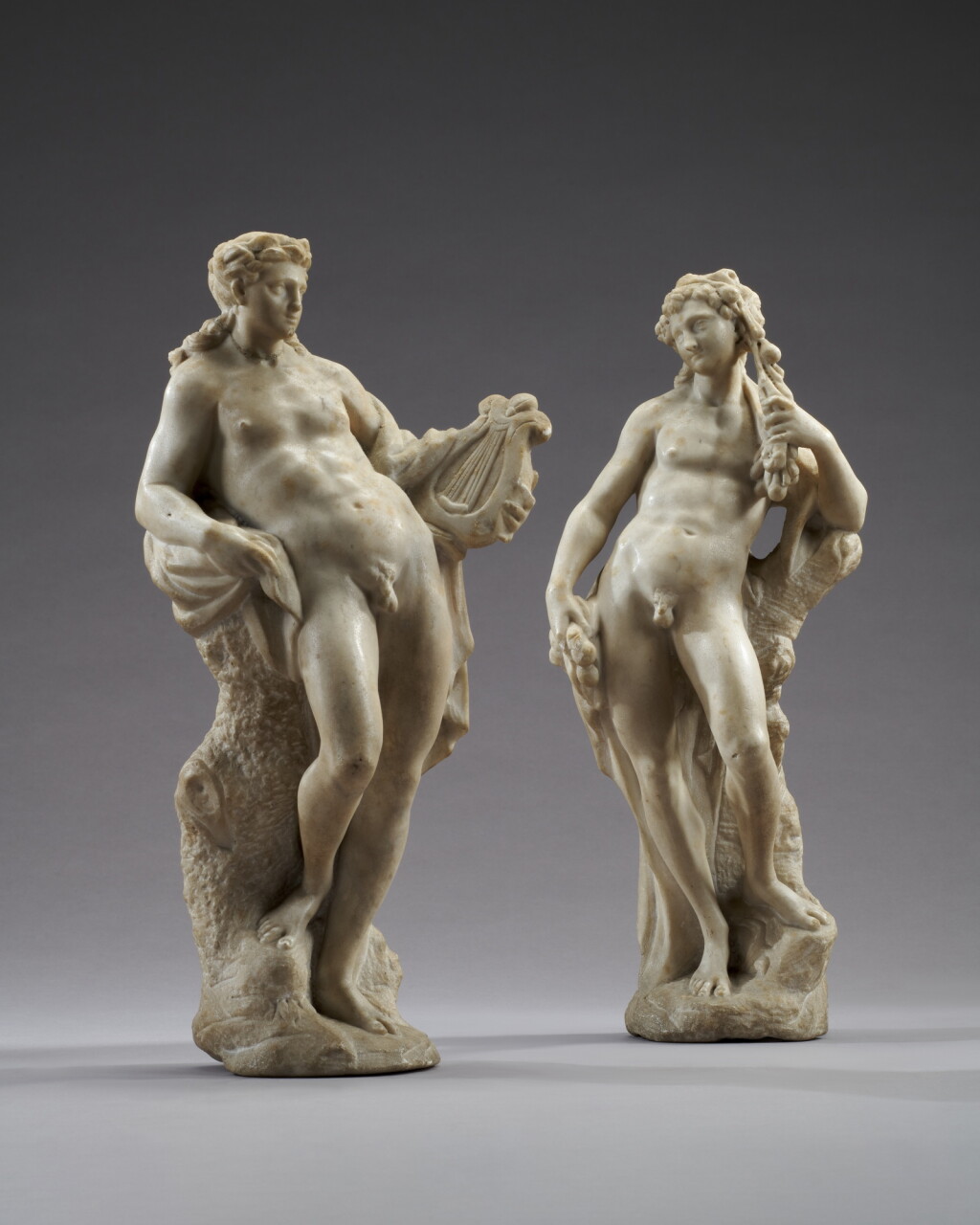
Venice, circa 1720-1730, pair of figures depicting Apollo and Bacchus
Auction Closed
September 25, 05:46 PM GMT
Estimate
8,000 - 10,000 EUR
Lot Details
Description
Francesco Bertos (active 1709-1737)
Venice, circa 1720-1730
Pair of figures depicting Apollo and Bacchus
marble; 2 elements
height: each cm 41; in. 16 ⅛
P.J. Harris Collection
Sotheby's London, 12 December 1974, lot. 197
French Auction Sale, Mobilier et Objects d'Arts, 2013, lot 181
Charles Avery, Bertos The Triumph of Motion, Turin, 2008, nos. 23-24, p. 169
Maichol Clemente in La Caduta degli Angeli Ribelli, Francesco Bertos, exhibition catalogue, Milan, 2024, no. III, p.128
These two figures are very familiar to scholars, to literature and the restricted group of specialists, but every time they were published their current location was declared unknown.
Recorded only on the basis of the photograph of the sale catalogue of Sotheby's London (12 December 1974, lot 197, described as South Netherlandish, probably Antwerp, early 18th century), they were recognized just in 2007 by the absolute eye of John Tomasso, always on the basis of their images.
They were first correctly attributed and published by Charles Avery in his monography on Bertos (2008, nos. 23-24).
Maichol Clemente in his brilliant essays, in the catalogue of the Vicenza Bertos Exhibition held at Palazzo Leoni Montanari in 2024-2025, described these two figures in depth, explaining the context, the motivations, the style, and the artistic personality of the sculptor.
At the hearth of their execution lies a shift in taste, a new fashion, and the need to satisfy the demands of an élite group of patrons and collectors at the end of the 17th century, who sought single figures evocative of the antique sculpture.
To meet this demand, Bertos drew inspiration above all from Venetian sculpture and painting of the 16th century, in particular from the poses of figures by Alessandro Vittoria, Veronese, Tintoretto and perhaps also Giambologna, whose works he may have studied during his visit to Florence in 1709-1710.
Certain stylistic elements define Bertos's artistic personality.
First and foremost is the use of contrapposto, animated with the dynamic energy of the figura serpentina, which imparts elegance to his elongated figures with their finely articulated toes.
The physiognomy of the faces is also distinctive: the pointed nose and, most tellingly, what has become Bertos's stylistic signature: the tiny, drilled hole at the center of the iris.
Special care is devoted to the contrast between the smooth, polished surfaces of the athletic bodies and the matte finish of the three trunks on which the figures lean, a contrast further mediated by the softly flowing drapery.
The elegance and dynamism of this pair of figures anticipate and foreshadow the virtuoso interlacing bodies of Bertos's masterpiece: La Caduta degli Angeli Ribelli, circa 1725-1730, Intesa Sanpaolo Collection, Gallerie d'Italia, Vicenza.
Michol Clemente (2024, n. III.4) has emphasized that Bertos seems to have carved a figure of Apollo only on a later occasion, namely the sculpture of the same subject of Galerie Sismann in Paris.
Francesco Bertos (active 1709-1739)
Bertos began his artistic formation with his uncle Girolamo, described in contemporary documents as “a Venetian marble sculptor in Ravenna.”
A letter of recommendation dated 1709, addressed to Giovan Battista Foggini, secured him a period of apprenticeship in Foggini’s Florentine workshop, where he likely acquired the techniques of bronze casting.
The turning point in Bertos’s career came with his collaboration with Giovanni Bonazza (1654–1736), who is represented in this sale by the pair of marble pagoda figures. In the 1730s Giovanni Bonazza introduced Bertos to the foremost Venetian collectors and patrons, including Johann Matthias von der Schulenburg (1661–1747), General of the Army of the Serenissima, who had led the reconquest of the Morea (Peloponnesus) under Doge Francesco Morosini (1619–1694).
In 1738 Bertos is documented as having sold two sculptures to King Charles Emmanuel III of Savoy for the Gran Galleria of the Royal Palace in Turin.
He was even proposed by Court Architect Benedetto Alfieri as Court Sculptor, but the appointment was never finalized due to Bertos’s premature death in 1739.
You May Also Like