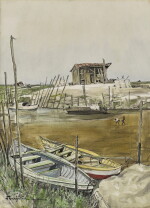
Carl Moll (1861-1945)
Küchenstillleben (Kitchen Still Life)
Lot Closed
December 10, 01:32 PM GMT
Estimate
10,000 - 15,000 EUR
We may charge or debit your saved payment method subject to the terms set out in our Conditions of Business for Buyers.
Read more.Lot Details
Description
Carl Moll
1861 - 1945
Küchenstillleben (Kitchen Still Life)
signed (lower left)
oil on board
33.6 by 23.3cm.
13¼ by 9⅛ in.
Executed in circa 1890.
This work has been authenticated by Dr. Cornelia Cabuk, Vienna and is in digital Carl Moll catalogue under Number GE 41 A.
Düsseldorfer Auktionshaus, 30 November 2024, lot 1478
Acquired from the above sale by the present owner
- A rare, intimate still life executed early in the artist’s career.
- Demonstrates Moll’s masterful handling of light and texture in a small, domestic format.
- An important precursor to the artist’s later Secessionist style and decorative work.
The present work, Küchenstillleben (Kitchen Still Life), is an atmospheric and finely rendered example of Carl Moll’s early output, executed in the oil on board format he frequently employed for intimate studies. The composition focuses on a quiet corner of a domestic setting, likely a kitchen, where humble objects, a bird, some plates, leftover bones, an open pomegranate, and perhaps copper or pewter ware, are arranged, along with a knife stuck into the table. Moll employs a restricted, earthy palette dominated by browns and creamy whites, masterfully capturing the subtle shifts in illumination as light falls across the varied textures of the objects. The small scale lends the piece an exceptional sense of immediacy and focused observation.
This still life is an early example of the style Moll developed during his early association with artists like Emil Jakob Schindler, characterized by the Austrian tradition of Stimmungsimpressionismus (Mood Impressionism). Rather than focusing purely on light registration, Moll emphasizes the emotional mood or atmosphere inherent in the scene. The handling of the paint, though precise, maintains a delicate softness. This precise, mood-driven observation established the technical foundation for the more radical, flattened perspectives and decorative rigor that Moll would champion later as a co-founder of the Vienna Secession in 1897.
Moll remains one of the most historically important figures in Viennese Modernism, not only as an artist but as a key organizer, notably co-founding the Vienna Secession and spurring the creation of the Österreichische Galerie Belvedere. His significance is continuously reaffirmed through major exhibitions, including the widely acclaimed Austrian Masterworks from the Neue Galerie held at the Neue Galerie in New York (2022) and his inclusion in the group exhibition Inspirational Beethoven: A Symphony in Pictures from Vienna 1900 at the Leopold Museum in Vienna (2020-2021).
You May Also Like