Albrecht Dürer
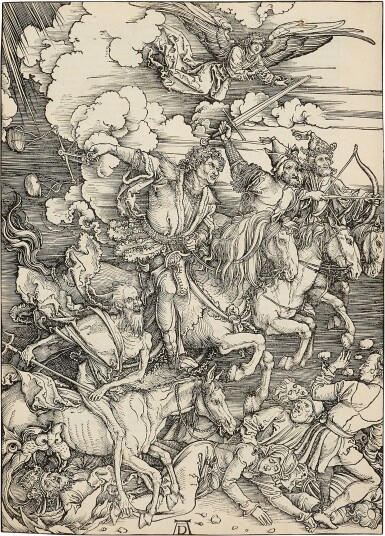
The Four Horsemen of the Apocalypse (B. 64; M., Holl. 167)
Lot Closed
December 8, 02:08 PM GMT
Estimate
70,000 - 100,000 GBP
Lot Details
Description
Albrecht Dürer
1471 - 1528
The Four Horsemen of the Apocalypse (B. 64; M., Holl. 167)
Woodcut, circa 1497-1498, from The Apocalypse, a fine, early impression from the rare German text edition of 1498, before the crack at lower left to the foot of the figure of Death, printing with great clarity and contrasts, an area of slightly uneven printing behind the top of Famine’s scales, on laid paper, framed
sheet: 390 by 278mm 15¼ by 10⅞in
The present impression is superior to the Mitchell impression in the British Museum.
The dawn of every new millennium sparks excitement, but also a great fear of the unknown. On December 31, 1999, the world held its collective breath at midnight, awaiting the Y2K computer apocalypse. Centuries earlier on the eve of 1500, European Christians anticipated a more terrifying cosmic apocalypse. Those who subscribed to The Book of Revelation believed that the year 1500 - the “half-time after the time” - would usher in the end of the world. According to this last instalment of the New Testament, the coming of the Kingdom of God was near; the earthly realm would be savagely destroyed and only the righteous would survive to see the Messianic Kingdom.
Inspired by and grappling with visions of the world’s imminent end, painter-printmaker Albrecht Dürer created fifteen woodcuts depicting the Book of Revelation’s prophecies. Printed with descriptive text verso, the series formed The Apocalypse, the first-ever illustrated book designed, published, and sold by the same artist. Of Dürer's fifteen highly accomplished illustrations, which include famous subjects such as The Apocalyptic Woman, The Four Angels Holding the Winds, The Beast with Two Horns Like a Lamb, The Four Horsemen has become the most iconic. In this dynamic composition, Death thunders out from ominous clouds, looking starved for victims on his pale, emaciated horse. He is joined by Famine, who brandishes his scales, as well as War and Plague, who lead the charge with their sword and bow. Together the Four Horsemen trample every human in their path while the reptilian maw of hell opens behind them, eager to swallow even the most pious of their prey.
Skilfully printed with rich contrasts and clarity, the present impression evokes an incredible sense of movement and three-dimensionality, heightening the immediacy of the chaotic scene. On the reverse, German text contextualises the scene and indicates that this work is from an early edition of the Apocalypse series. The subsequent translation into Latin ensured its accessibility to audiences throughout Europe, and indeed solidified Dürer as a household name throughout Western Europe. In addition to the German text, the present impression is also dated by the absence of a crack at Death’s lower leg, which is found on later impressions due to a break on the surface of the woodblock.
In contrast to contemporaneous books, The Apocalypse presented the artist’s woodcuts ahead of the writings, stressing the importance of Dürer’s artwork. A shrewd businessman, he was one of the first artists to realise the commercial advantages of the fine art print. Therefore, the Four Horsemen marks not only the beginning of Dürer’s widespread popularity as an artist, but also the revolutionary rise of the print market as a whole.
You May Also Like