
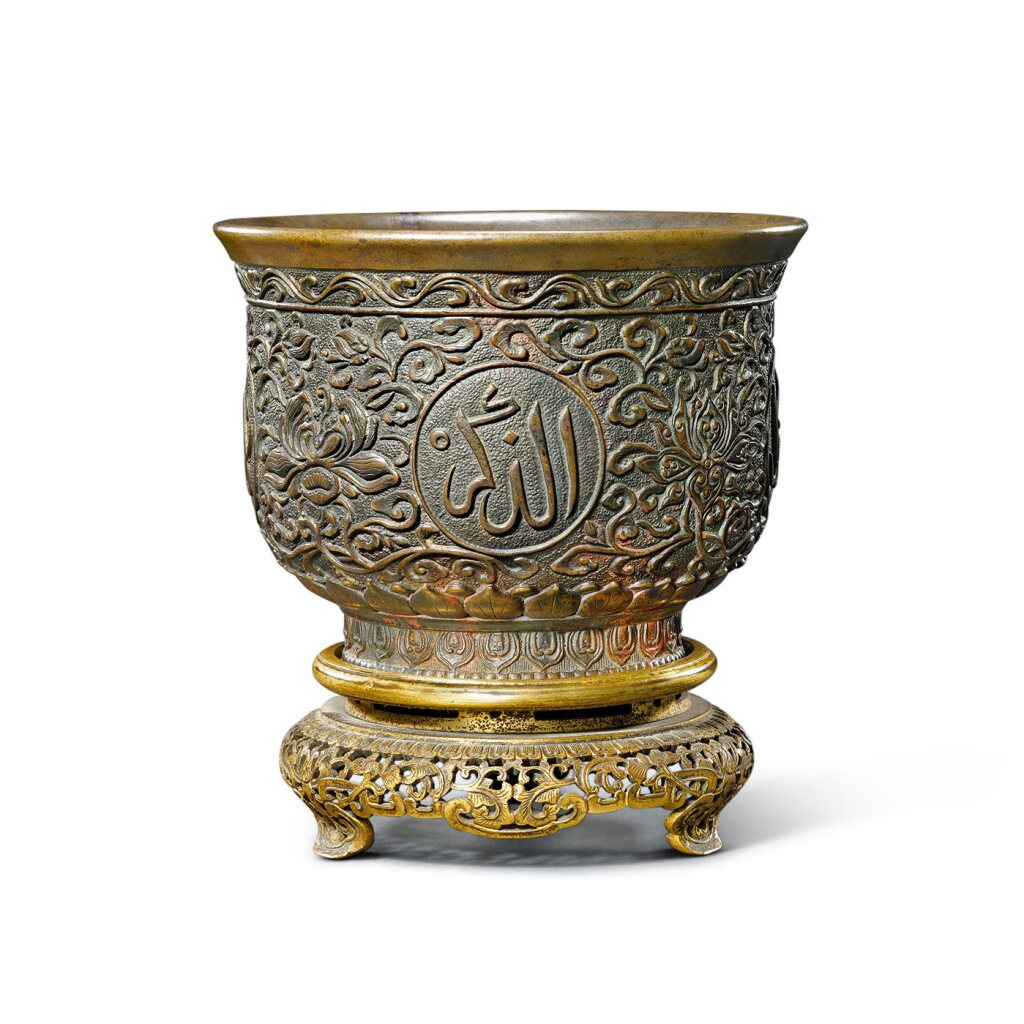
An Arabic-inscribed bronze incense burner, Mark and period of Zhengde | 明正德 銅番蓮開光阿拉伯文香爐 《大明正德年製》款
Lot Closed
April 17, 07:26 AM GMT
Estimate
1,200,000 - 1,800,000 HKD
Lot Details
Description
An Arabic-inscribed bronze incense burner
Mark and period of Zhengde
明正德 銅番蓮開光阿拉伯文香爐
《大明正德年製》款
of deep rounded form with gently curving ‘S’-shaped sides, supported on a high circular foot, the exterior cast in relief with a continuous design of four circular panels enclosing an Arabic invocation, together reading afdal al-dhikr la ilaha illa allah ('The most virtuous supplication is: There is no god but The God'), all against a ground of stylised scrolling lotus, above and below narrow bands of stylised floral scroll at the shoulder and foot, the base with a band of stylised lotus petals which are echoed, upside down, the footrim evenly serrated, the foot with a recessed rectangular cartouche enclosing a kaishu six-character Zhengde mark, gilt-bronze stand from the Qing dynasty, Qianlong period, pierced and decorated with lingzhi
h. 10.2 cm
incense burner: 1147 g; stand: 355 g
The Water, Pine And Stone Retreat Collection, acquired prior to 1975.
Sotheby's Hong Kong, 8th April 2014, lot 212.
來源:
水松石山房收藏,1975年前入藏
香港蘇富比2014年4月8日,編號212
This boldly cast incense burner is amongst the finest quality of all Zhengde reign-marked bronze wares, many of which incorporate Arabic inscriptions in their designs in keeping with the emperor's religious leanings, and one of those made in substantial cast bronze rather than beaten copper. For another Zhengde reign-marked bronze incense burner and cover with stand preserved in the Palace Museum, Beijing, of rectangular form with similar Arabic invocation and cast reign mark, see Power and Glory: Court Arts of China's Ming Dynasty, Asian Art Museum of San Francisco, 2008, cat. no. 110.
There are other forms of Zhengde reign-marked bronze incense burners, such as the Zhengde reign-marked straight-sided incense burner sold in these rooms, 4th April 2012, lot 143. However, no other bowl of this shape appears to be recorded, although given the multiple forms of incense burners in the Ming and their popularity, it seems more likely that this was intended as an incense burner and not as a bowl for some other purpose.
It is inscribed in sini script, a Chinese Islamic calligraphic form for the Arabic script, developed in the early Ming dynasty. It can refer to any type of Chinese Islamic calligraphy, but is commonly used to refer to script with thick and tapered effects, such as on the current box. It is used extensively in mosques in Eastern China, and to a lesser extent in Gansu, Ningxia and Shaanxi. Early examples of the script date to the early Ming dynasty, notably the mihrab of the Niujue mosque in Beijing. The mosque itself was founded in 996 during the Liao dynasty, but rebuilt in 1442 during the Zhengtong era.
正德皇帝尊崇伊斯蘭教,在他在位的十六年間,宮廷製造了大量以伊斯蘭紋飾作為裝飾的器物,尤其是書阿拉伯文字的器物,不僅品種豐富,且製作相當精美。如此銅香爐,造型獨特,鑄造細緻,較當時製造粗糙的瓷器更為精美,為正德朝經典之作,甚為珍罕。北京故宮博物院藏一件同樣帶正德款、阿拉伯文但作長方形的連座銅蓋爐,見《Power and Glory: Court Arts of China's Ming Dynasty》,舊金山亞洲美術館,2008年,編號110。
此爐器型獨特,未見其它類同例子的註錄。明朝玩賞香爐成風,種類繁多,此器雖作盌形,但應為焚香之器,而非以盌用。
明朝初期開發了一種漢化的阿拉伯語書法字體,以其粗線條為特徵,如此爐上的銘文可見一班,常見於華中地區的清真寺,甘肅、寧夏、陝西一帶較少。帶此字體器物最早始見於明初,北京牛街禮拜寺的壁龕尤為著名。牛街禮拜寺建於遼代統和十四年(996年),明朝正統七年(1442)進行了大規模擴建。