
An Italian Collecting Journey - Chapter II | The Online Sale
An Italian Collecting Journey - Chapter II | The Online Sale
An Italian Collecting Journey - Chapter II | The Online Sale
Please note that the results listed on this page are inclusive of any Sotheby's Premiums and exclusive of any applicable taxes and costs, unless otherwise noted.
Please note that the results listed on this page are inclusive of any Sotheby's Premiums and exclusive of any applicable taxes and costs, unless otherwise noted.

An Italian Collecting Journey - Chapter II | The Online Sale
16 March - 26 March 2026 • Milan
•
Your local time • 14:00 PM GMT

200. A North Italian fragmentary relief, probably late 12th/early 13th Century

201. An Italian carved bone triptych depicting the Virgin and Child flanked by Saints, Embriachi Workshop, Venice or Florence, partly early 15th Century

202. A central Italian spiral demi-column carved in high relief, 13th Century

203. An Italian casket, Embriachi Workshop, 15th Century

204. An Italian partially spiral marble column with capital, partly 13th Century

205. An Italian casket, Embriachi Workshop, Venice or Florence, XVI Century
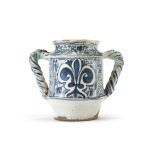
206. An Italian maiolica two-handled albarello, Florence District, circa 1450, with later handle

207. An Italian walnut and fruitwood ‘alla certosina’ casket, probably Tuscany, late 15th/early 16th century

208. A Venetian glass footed bowl, early 16th century

209. A pair of North Italian carved walnut bellows, probably late 16/early 17th century

210. An Italian basin centered by a relief medallion of the Lion of Saint Mark, Venice, in Renaissance style

211. A Venetian glass enamelled footed bowl or tazza, early 16th century

212. A Roman maiolica two-handled vase, dated 1571

213. An Italian Christ at the Column, late 16th/early 17th Century

214. An Italian silver salt cellar, Naples, 1695, maker’s mark LV

215. A pair of Italian silk and metal-thread embroidered panels, late 17th/early 18th century

216. A North Italian carved stained wood frame, Emilia-Romagna, late 17th century/early 18th century, in the manner of Carlo Antonio Lanzani

217. A Roman maiolica two-handled vase, 17th century

218. Sebastiano Conca
The Virgin and Child
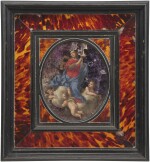
219. An Italian oval amethyst plaque painted with the Assumption of the Virgin, 18th century

220. Two silver filigree frames and deep dish, probably English, late 17th century, the large frame 18th century
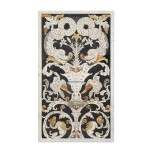
221. A South Italian inlaid marble panel, Sicily, second half 17th century

222. An Italian gold and tortoiseshell piqué casket, Naples, third quarter 18th century
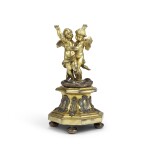
223. An Italian group of two Cupids associated on an octagonal base, Rome, probably 18th Century
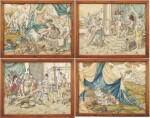
224. A set of four Italian silk, embroidered and watercolour applique panels, second quarter 18th century

225. An Italian painted tondo depicting the Adoration of the Shepherds, attributed to Jacques Stella (Lyon 1596 - Paris 1657), 17th Century

226. Attributed to Antonio Gianlisi the Younger
Still life with a sword, a pistol, flowers and other paraphernalia, displayed atop an embroidered carpet

227. Italian School, 17th century
The Adoration of the Magi

228. An Italian parcel-gilt casket, Trapani, maker’s mark GB, and assay's maker GOC, 18th century
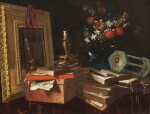
229. Master of the Vanitas Texts
A vanitas still life with a mirror, a candle, an hourglass, books, flowers in a vase and a case, all on a draped table

230. An Italian engraved bone and ebony veneered travelling writing box, Naples, late 16th/early 17th century

231. A pair of Italian black lumachella columns, 17th century

232. An Italian glass mirror, Venice, incorporating earlier 17th century elements

233. A pair of Italian carved giltwood frames in 18th century Emilia-Romagna style

234. A Venetian or façon de Venise small latticinio glass cruet, late 17th/early 18th century

235. An Italian Sicilian jasper ebonised frame, in 17th century Roman manner

236. An Italian gilt-metal mounted glass mirror, Venice, second half 17th century and later

237. A pair of Venetian lattimo glass two-handled vases, late 17th/early 18th century

238. Two Italian gilt-metal mounted ebonised wood octagonal frames, 17th/18th century

239. Two small Italian painted lapis lazuli panels

240. An Italian tortoiseshell and ebonised rectangular frame, probably 17th century

241. A Sicilian octagonal plaque depicting the Announced Virgin, Trapani, partly 17th century
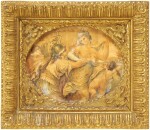
242. An Italian scagliola panel after Giovanni Battista Cipriani (1727-1785), probably first half 19th century

243. A Castelli maiolica dish, attributed to Carmine Gentili, 1725 circa
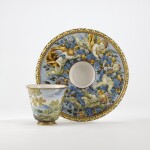
244. A Castelli maiolica cup attributed to Carlo Antonio Grue, with a trembleuse stand from the Grue family workshop, 1700 - 1715 circa

245. A Castelli maiolica vase and cover, Gentili workshop, circa 1750

246. A Castelli maiolica plate, attributed to Liborio Grue, 1750 -1750 circa

247. A maiolica dish, Saverio Grue, perhaps Naples, second half of the 18th century