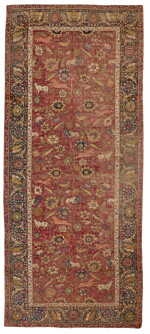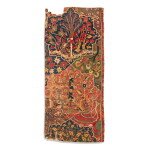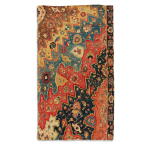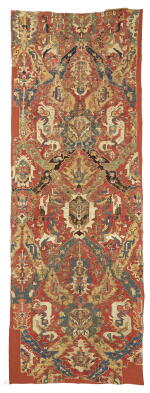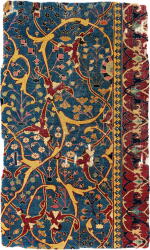
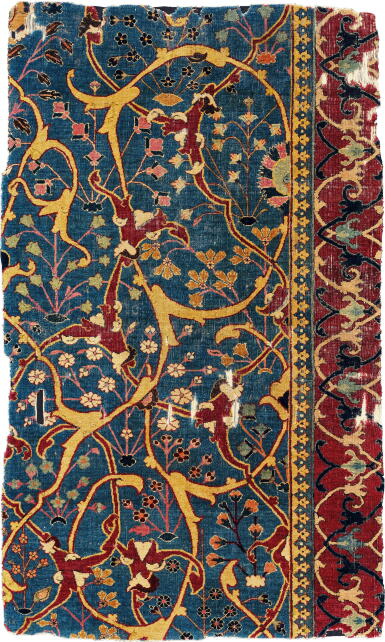
The Bernheimer Safavid 'Vase'-Technique Carpet Fragment, probably Kirman, Southeast Persia, circa 1600
Estimate
350,000 - 500,000 USD
Lot Details
Description
The Bernheimer Safavid 'Vase'-Technique Carpet Fragment, probably Kirman, Southeast Persia, circa 1600
approximately 4ft. by 2ft. 5in.
122 by 74 cm.
Bernheimer Brothers, Munich, before 1926;
The Bernheimer Family Collection of Carpets, sold Christie's, London, 14 February 1996, lot 150;
Robert P. Hendrikson, Connecticut;
Sotheby's, New York, 31 January 2014, lot 143;
Where acquired by the present collector.
The Art Club of Chicago, Loan Exhibition of Early Oriental Carpets, January 1926 , no. 21;
Hamburg, Museum für Kunst und Gewerbe, Ausstellung Orient-Teppiche, 1950, no. 77;
Hamburg, Museum für Kunst und Gewerbe; Frankfurt-am-Main, Museum für Kunsthandwerk, Persische Teppiche, 1971, no. 6;
Birmingham, Mappin Art Gallery, Sheffield City Museum and Art Gallery, Carpets of Central Persia, 1976, no. 32.
F. Sarre and H. Trenkwald, Alt-Orientalische Teppiche, Vienna, 1926-28, vol. II, reproduced pl. 8;
A. Upham Pope, Catalogue of a Loan Exhibition of Early Oriental Carpets, exhibition catalogue, The Art Club of Chicago, 1926, pp. 65-67, no. 21, reproduced p. 66;
K. Erdmann, 'Ein neuerworbene persische Teppich' in Berliner Museen, 1929, p. 8;
R. Neugebauer and S. Troll, Handbuch der orientalischen Teppichkunde, Leipzig, 1930, p. 16;
S. Troll, Zeitschrift für bildende Kunst, 1929-1930, p. 250;
Ausstellung Orient-Teppiche, exhibition catalogue, Museum für Kunst und Gewerbe, Hamburg, 1950, no. 77, pp. 68-69, reproduced pl. 25;
O. Bernheimer, Alte Teppiche des 16.-18.Jahrhunderts der Firma L. Bernheimer, Munich, 1959, reproduced pl.32;
Persische Teppiche, exhibition catalogue, Frankfurt-am-Main, 1971, no. 6, pp. 26-27;
M. H. Beattie, Carpets of Central Persia, Kent, 1976, pp. 62-63, cat. no. 32, reproduced pl. 8;
"Auction Price Guide" in HALI, no. 86, 1996, reproduced p. 133;
E. Gill, "Passion, Fashion and Greed," in HALI, no. 100, 1998, p. 165, reproduced fig. 5;
"Auction Price Guide" in HALI, no. 179, 2014, reproduced p. 135;
D. Shaffer, "Smashing records with vases" in HALI, no. 188, pp. 144-147, reproduced fig. 9.
“This is obviously a fragment of one of the greatest carpets ever woven,” wrote Arthur Upham Pope, Loan Exhibition of Early Oriental Carpets, Chicago, 1926, p.65. This quote is the first of many (see Literature above) to cite this Safavid carpet fragment as an exemplar of the pinnacle of Persian weaving under Shah Abbas (r.1588-1629). Vase technique carpets form a group that are related by their weaving characteristics rather than just their designs. These carpets have a sophisticated structure which includes three wefts between each row of knots, one of which is silk. Many of these carpets do incorporate vases in their designs, however, as in this fragment, just as many do not. All vase technique carpets share intricate design schemes executed in a rich and wide color palette being the product of court and city workshops at the height of the Safavid empire.
When offered in the Bernheimer collection auction, February 14, 1996, lot 150, the catalogue noted that this fragment had been acquired on 9 August 1937; however, it is listed in the Chicago loan exhibition cited above as being “lent by Bernheimer Brothers.” This curious discrepancy may simply be a mistaken entry in the ledger, but it does raise the question of when the Bernheimer family did acquire the piece. In the thirty years since this appearance on the market, there have been other vase-technique carpets and fragments offered, and almost all are measured against the lot here offered.
The most closely related vase-technique carpet to this lot known is a fragment in the Museum für angewandte Kunst, Vienna, (MAK no.T7346/1912). These two works share the field design of scarlet and straw-colored intertwining arabesque vinery on a Saxe blue field; however, the major border differs with blossoms interspersed into the arabesque vines on the Vienna fragment. In the known corpus of vase-technique carpets, the field is generally deep navy blue or deep crimson, while the clear Saxe blue ground of this piece is shared with four other known works: two vase carpet fragments formerly in the collection of Joseph V. McMullan now in the Metropolitan Museum of Art, (cat. nos.1970.302.4 and 1970.302.5) and two complete carpets recently sold at auction; the Béhague carpet, Christie’s London, 15 April 2010, lot 100 and the Alice de Rothschild carpet, Christie’s London, 19 April 2016, lot 101. The interplay of pale golden and crimson arabesque vinery here is shared with the McMullan fragments, however in the present lot the design is less densely filled and thus there is more space and freedom to the vinery interplay. The two recently sold intact carpets are closely related to each other as they share a field design of symmetric rows of saz leaves. All the Saxe blue ground carpets have their design executed in the wide range of vivid and saturated colors that are a hallmark of the vase-technique group.
Another vase technique carpet in the Metropolitan Museum (43.121.2) has a design of arabesque vinery at its base which after approximately 50cm (18 inches) the designer(s) then changed to the large blossom and palmette design found on most vase carpets. Interestingly, the arabesque vinery in the lower end of the carpet is a reverse of the color scheme here with blue and ivory vines playing on a deep crimson ground, rather than our blue ground with red and pale gold arabesques. This 50cm section of carpet may be the most similar in pattern to the lot here offered. Other related examples include the more recently sold fragment formerly in the collection of Paulette Goddard Remarque at Sotheby’s London 24 April 2024, lot 76 and another from the same carpet and formerly with Goddard Remarque and the Wher collections was sold at Christie’s London, 3 May 2001, lot 77. These fragments are from a carpet woven with a field design of split-leaf arabesque vinery related to our current lot yet on a deeper blue ground. All of these share a freedom and openness of design that must predate the more regular designs of lattice vase technique carpets such as the Bernheimer vase rug sold at Christie’s London, 7 October 2010, lot 100 and another sold in these rooms, 6 April 2011, lot 456, the latter dated to the late 17th century. This field pattern continues into the 19th century evolving into the Gerus design most often found on Bidjar carpets.
Of the few vase technique carpets that have survived intact and in good condition, the most notable to have appeared on the market is the record holding Bacri-Clark Kirman sickle leaf carpet sold at Sotheby’s New York, 5 June 2013, lot 12. The design of this red ground carpet contained intertwining vinery punctuated by elongated curling serrated so-named sickle leaves. At the edges of the field there are half palmettes that are strikingly similar to those on the present fragment. Other intact and renowned vase technique carpets include two mid-blue ground saz leaf carpets mentioned above as well as the Lady Dudley shrub-lattice carpet, sold at Sotheby’s London, 11 October 1990, lot 706; and the Jezoriak/Figdor/Thyssen carpet, sold at Sotheby’s London, 3 July 2013, lot 24.
As demonstrated by the lot here offered, the sophisticated designs and vibrant color palettes of these vase technique carpet fragments remain visually compelling. Other beautiful fragments include the Alice de Rothschild fragments, sold at Christie’s London 19 April 2015, lots 100 and 102, and the ex-Colville fragment sold at Christies’ London, 5 April 2011, lot 103. All these vase technique fragments include enough of the field and border patterns to display the grandeur of the original carpet.
The border of intertwining arabesque vines on the present lot is also found on other vase technique carpets such as the Lady Dudley shrub carpet, the Metropolitan Museum of Art carpet, and one of its fragments, as well as the Jezoriak/Figdor/Thyssen carpet, and the Bernheimer vase carpet. All these examples elaborate on the basic interlacing of vines found here with additions of flower heads or flowering vinery. Whether this indicates an earlier weaving date for the present fragment remains to further scholarship, however, it does show the extreme confidence of its designer.
As Daniel Shaffer noted in his article 'Smashing records with vases' cited above, vase-technique carpets and fragments are technically sophisticated weavings that are so visually successful that they continue to intrigue and captivate viewers. He finishes by quoting Arthur Upham Pope from A Survey of Persian Art, who praises vase-technique carpets thus: “for sheer lust of the eye, for the luxurious and exciting rhythms, for finesse of detail, for symphonic splendor, and above all for a magical potency by which a whole new world, splendid and bright, has been summoned out of humble materials.”
Sotheby's is grateful to Mary Jo Otsea for cataloguing the present lot.
You May Also Like