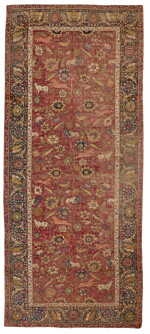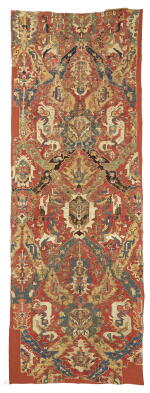
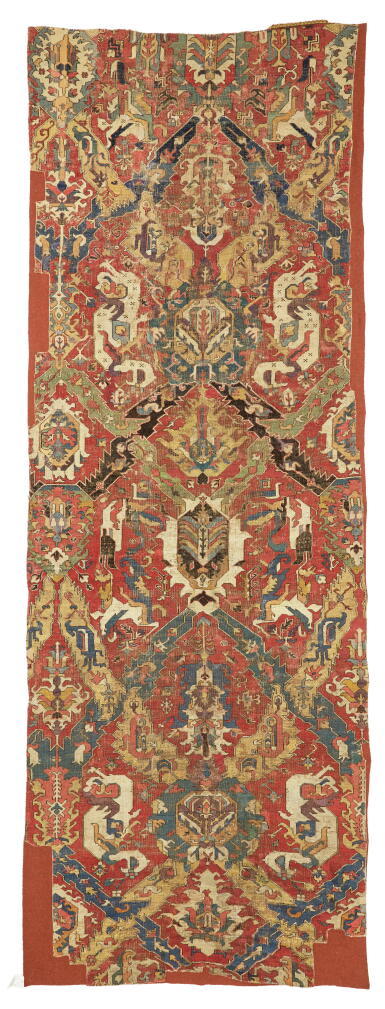
The Charles Deering 'Dragon' Carpet Fragment, probably Karabagh, South Caucasus, late 17th/early 18th century
Estimate
100,000 - 150,000 USD
Lot Details
Description
The Charles Deering 'Dragon' Carpet Fragment, probably Karabagh, South Caucasus, late 17th/early 18th century
approximately 15ft. 1in. by 5ft. 4in.
459 by 161 cm
Charles Deering (1852-1927), Chicago;
Avigdor Gallery, Boston;
The Textile Gallery, London, 1973;
Private Collection, Switzerland;
Lefevre & Partners, Catalogue of Twelve Masterpieces of Oriental Art, 2 April 1976, lot 11;
The Textile Gallery, London;
The Dharma Collection, acquired 1980s;
Christie's, London, 27 April 2017, lot 217;
Where acquired by the present collector.
Jerusalem, L. A. Mayer Museum of Islamic Art, Caucasian Carpets, 1985, no. 1.
O. Berberyan and W. G. Thomson, A Catalogue of carpets of Spain and of the Orient in the Collection of Charles Deering, Esq., London, 1924, reproduced p. 51 and p. 136;
S. Yetkin, Early Caucasian Carpets in Turkey, vol. II, London, 1978, pp. 19-20, reproduced fig. 135;
HALI, vol. II, no. 3, 1979, advertising p. 65;
R. Hasson, Caucasian Carpets, exhibition catalogue, L. A. Mayer Museum of Islamic Art: Jerusalem, 1985, pp. 23-23, no. 1;
"Auction Price Guide", HALI, issue 192, 2017, reproduced p. 126.
This powerfully drawn ‘Dragon’ carpet fragment was formerly in the collection of Charles Deering. The Deering family established the International Harvester Company, which would go on to become one of the largest corporations in the United States. Charles Deering channeled the wealth he derived from his agricultural empire into his art collection, passionately collecting works by the Old Masters alongside important and valuable carpets and tapestries that went hand-in-hand in the greatest Gilded Age collections. His collection was inherited by his two daughters who in turn donated many important works to the Art Institute of Chicago.
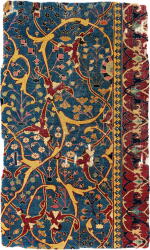
Animals and birds, both real and mythical, were popular motifs in the courtly Safavid carpets that are thought to be the prototypes for Caucasian ‘Dragon’ carpets. In his early monograph on the group (Early Caucasian Rugs, Washington D.C., 1975), Charles Grant Ellis proposed that they were more specifically based on a lost group of Kirman carpets represented by a fragment of a Kirman carpet in the Staatliches Museum für Völkerkunde, Munich, 23-50-18, illustrated in J. Thompson, Milestones in the History of Carpets, Moshe Tabibnia, Milan, 2006, fig.196, p.251, which has a narrow border and a field of strapwork with large motifs enclosing animals. For examples of Persian weavings utilizing related design elements see, with ascending animal combats and dragons, A.U. Pope, A Survey of Persian Art, London and New York, 1939, Vol.VI, pls.1182, an incomplete Northwest Persian Animal Carpet, then in the collection of John D. Rockefeller, Jr. and ibid., pl.1268a, the Figdor silk kilim; for a ‘Vase’ carpet with serrated leaf trellis, S. Yetkin, Early Caucasian Carpets in Turkey, Vol.II, London, 1978, fig. 201.
The earliest ‘Dragon’ carpet is thought to be The Graf carpet, which was found by Theodor Graf in a mosque in Damascaus, and now survives as a fragment in the Islamisches Museum, Berlin (Yetkin, op.cit., pp.8-10, fig.118). The elaborate drawing of six further carpets woven with a menagerie of highly stylized yet identifiable animal forms led Yetkin and Ellis to assign them to an early “Archaic” group. These are in the Great Mosque of Divrigi, Sivas (Yetkin, op.cit., pl.1), the Textile Museum, Washington (inv. no.R36.1.1), the Burrell Collection, Glasgow (inv. no.9.38), the Wher Collection (Yetkin, op.cit., p.11, fig.120 and Ellis, op.cit., p.14), the Brooklyn Museum (inv. no.58.130), and a carpet formerly with Stefano Bardini, Florence, reputedly now in an American collection (Ellis, op.cit., p.32). The drawing of the Deering fragment is closely related to the examples listed above and it displays a similar plethora of distinguishing motifs such as the “coat of arms” palmette flanked by dragons, a pheasant above a duck, and the back of a flaming lion (Ellis, op. it., p.14).
One motif present in the Deering carpet between the two rows of dragons would be described by Ellis as a "flaming lion and qilin" although Yetkin proposes that it is in fact a dragon and phoenix in combat, thus assigns this carpet to the ‘Dragon-and-Phoenix’ type, (the other types being ‘Archaic’ discussed above, ‘Two-Dragon’, and ‘Four-Dragon’). In this group, the dragon and phoenix form the central composition to the carpet, framed above and below by single dragon figures. Other examples of ‘Dragon’ carpets of the group are in the Kier collection; the Textile Museum, Washington; the 'Cassirer' Dragon carpet in the Thyssen-Bornemisza collection, Lugano; the Ali Pasa Mosque carpet in Tokat and the Vakiflar Hali Museum, Istanbul (S. Yetkin, op.cit. pp.16-20). Two further fragments are in the Museum fur Kunst und Gerwerbe, Hamburg and the Christian Museum, Esztergom, Hungary.
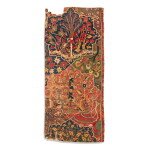
Deering clearly appreciated the strength of ‘Dragon’ carpets. Another early fragment formerly in his collection was published in HALI, issue 31, 1986, pp.98 and 99. That fragment was subsequently sold at Sotheby’s, New York, 27 September 2000, lot 35, where it was acquired by Robert Kime and recently sold, following his death, at Dreweatts, 5 October 2023, lot 411. The lot offered here bears the hallmarks of the best recorded examples with a powerful and well-spaced design, and a plethora of animals enlivened by wonderful colors.
You May Also Like