
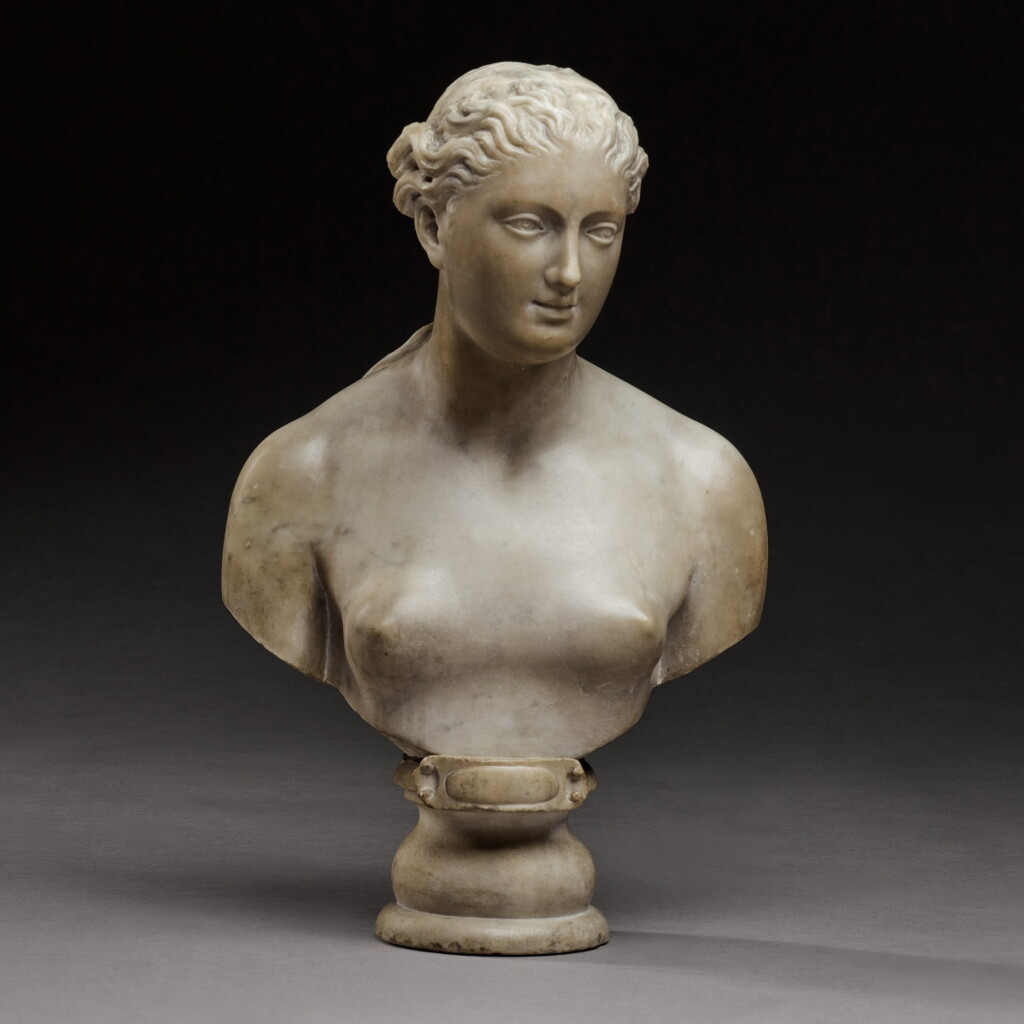
Northern Italian, circa 1530
Bust of Venus
Lot Closed
April 29, 01:18 PM GMT
Estimate
15,000 - 25,000 GBP
Lot Details
Description
Northern Italian, circa 1530
Bust of Venus
marble
43 cm., 17 in.
with Cyril Humphris, London;
J W. T. & S. M. F. Tapp, Southborough House, Surbiton, acquired from the above in 1983;
private collection, Germany
This serene bust of Venus epitomises the all’antica vocabulary of Italian sculpture in the early 16th century. During the Renaissance the ancient goddess of love was exalted as the embodiment of ideal beauty and often, of art itself. These qualities are conveyed masterfully in the present marble, which depicts the goddess nude, with gently parted lips arranged in a soft smile, and an inviting gaze. Her hair is tied loosely in a classical knot, with vibrant tresses falling down her neck whose texture is contrasted with her highly polished, smooth skin.
It is likely that the bust was inspired by ancient representations of the goddess. A notable comparison can be made with the so-called Colonna Venus, a Roman marble copy of the lost Aphrodite prototype by the classical Greek sculptor Praxiteles, housed in the Museo Pio-Clementino in Rome. If not with this same marble, the sculptor of the present bust would undoubtedly have been familiar with similar survivals from the ancient world. A possible origin of the bust could lie in the Veneto, where early 16th-century sculptors such as the Lombardo family, Giovanni Maria Mosca, and Simone Bianco created distinctive portrait and mythological sculpture adapted from classical statuary. It is in their works that the present bust finds some striking stylistic parallels, including the incised pupils, the pronounced curve of her neck, and her delicate, rounded facial features. Compare, in particular, the bust’s profile with that of a bronze bust by a follower of Antonio Lombardo illustrated in op. cit., fig. 176. Almost certainly, the author of the present bust belonged to a similar humanist milieu.
RELATED LITERATURE
A. Luchs, Tullio Lombardo and Ideal Portrait Sculpture in Renaissance Italy, 1490-1530, Cambridge, 1995
Sotheby’s is grateful to Dr Luca Annibali for proposing an attribution of the present bust to the North Italian sculptor Pietro Paolo Stella (circa 1495/1500-1552). Born in the province of Milan, Stella was first recorded as a collaborator of Giammaria Mosca in Padua, before continuing his activity in Genoa and Prague. The kneeling female figure carved by Stella for the Miracle of the Goblet relief (1529) in the Basilica of Saint Anthony in Padua closely resembles the present bust in its facial type and hairstyle. See A. Markham Schulz, ‘Paolo Stella Milanese’, in Mitteilungen des Kunsthistorischen Institutes in Florenz, vol. 29, 195, pp. 79-110, fig. 21.