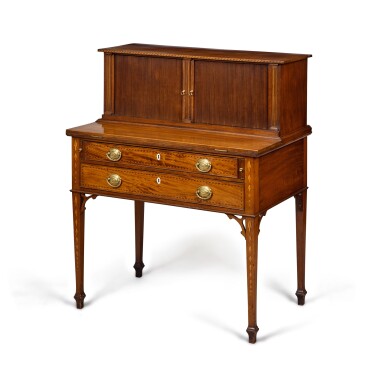
A Federal Inlaid Mahogany and Ivory-Mounted Lady's Tambour Writing Desk, attributed to John and Thomas Seymour (1771 - 1818), Boston, Massachusetts, circa 1800
Auction Closed
April 21, 08:50 PM GMT
Estimate
25,000 - 35,000 USD
Lot Details
Description
A Federal Inlaid Mahogany and Ivory-Mounted Lady's Tambour Writing Desk
attributed to John and Thomas Seymour (1771 - 1818)
Boston, Massachusetts
circa 1800
retaining its original cast-brass hardware, the rear brackets are replaced
41¼ x 34 x 20¼ in. (104.8 x 86.4 x 51.4 cm.)
Northeast Auctions, Portsmouth, New Hampshire, New Hampshire Auction, November 3, 1997, lot 567
Wolf Family Collection No. 1143 (acquired from the above)
During the Federal era, desks with tambour shutters were manufactured throughout New England, New York, and the Western Reserve in Ohio. Known today by the modern term “tambour desk,” such desks were made in a variety of forms. A sophisticated example of the form from Boston, this tambour writing desk shares a refinement of design and quality of workmanship associated with furniture made by John (1738-1818) and Thomas Seymour (1771-1849). It closely relates to a tambour secretary at Winterthur Museum labeled “John Seymour & Son, Cabinet Makers, Creek Square, Boston” that descended in the family of Thomas Gilbert Thornton (1768-1824) and his wife, Sarah Cutts Thornton (1774-1845).1 This desk and the labeled example share many details including the same overall design, use of mahogany and mahogany veneer, tambour doors flanked by pilasters, ivory key-escutcheon, desk interior with six letter holes with serpentine arches above four drawers, use of two different stringing patterns for the top board and writing flap, pierced knee brackets, and front squared tapering legs inlaid with graduated strings of three-petaled bellflowers with elongated central petals and separated by dots. Many of these same characteristics are found on a mahogany tambour secretary at Bayou Bend that is attributed to John and Thomas Seymour.2 The latter secretary similarly displays a curving transition from the square shaft to the swelled therm foot like that found on the desk offered here. The three desks appear to date from a similar period of manufacture soon after the Seymour’s arrived in Boston in 1793.
1 See Robert D. Mussey, The Furniture Masterworks of John & Thomas Seymour, Salem, 2003, cat. #3, pp. 140-1.
2 Ibid, cat. #4, pp. 142-2.
You May Also Like