Jesús Rafael Soto
Escritura pequeña
Auction Closed
December 4, 03:16 PM GMT
Estimate
100,000 - 150,000 EUR
Lot Details
Description
Jesús Rafael Soto
1923 - 2005
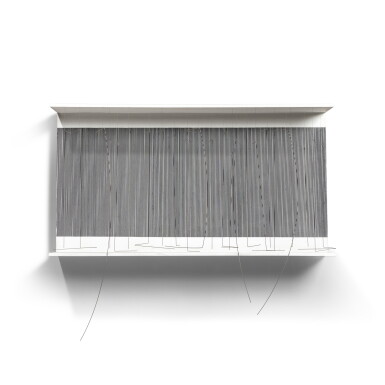
Escritura pequeña
signed, titled and dated 1967 (on the reverse)
painted wood construction with painted metal and nylon filament
48,9 x 90,5 x 16 cm ; 19 ¼ x 35 ⅝ x 6 ¼ in.
Executed in 1967.
This work is accompanied by a certificate of authenticity signed by the artist, dated 12 November 1975.
____________________________________________________________________________
Jesús Rafael Soto
1923 - 2005
Escritura pequeña
signé, titré et daté 1967 (au dos)
construction en bois peint avec métal peint et fils de nylon
48,9 x 90,5 x 16 cm ; 19 ¼ x 35 ⅝ x 6 ¼ in.
Exécuté en 1967.
Cette œuvre est accompagnée d'un certificat d'authenticité signé par l'artiste, daté du 12 novembre 1975.
Galerie Denise René, Paris
Collection Françoise Mayer and Marc Sohier, Brussels (acquired from the above in 1968)
Thence by descent to the present owner
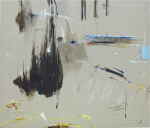
In 1967, Jesús Rafael Soto created Escrittura Pequeña, a work that highlights one of the artist’s many explorations into movement and visual perception. Soto employs transparent nylon threads holding black metal rods, set against a striped wooden background. This composition creates a unique optical vibration in which the rhythm of the vertical background is disrupted by the metal rods: as the viewer moves, they interact with the piece, provoking light and shadow effects that defy any attempt to reconstruct a stable volume or shape. The work thus becomes a hybrid exploration between sculpture and painting.
One of Soto’s primary concerns was to introduce movement into art, not merely as an optical effect, but as an essential component that requires active participation from the viewer. The piece becomes a living mechanism of slow vibration, reminiscent of a rustling forest, created through formal variations and counterpoints. The Escrituras series, to which this work belongs and which began in the 1960s, is distinguished by its exploration of a personal language, where repetitive geometric shapes become an abstract writing of endless modulations.
Born in Venezuela in 1923, Jesús Rafael Soto became the director of the Maracaibo School of Fine Arts in 1947 after studying at the Caracas School of Fine Arts. During this period, he began to experiment with a distinctive path of his own. His move to Paris in 1950 marked a decisive turning point in his career, as he joined the circle of abstract artists associated with the Salon des Réalités Nouvelles. There, he met artists like Victor Vasarely and Julio Le Parc, who introduced him to kinetic and optical art. He also connected with gallerist Françoise Mayer, who, following the lead of Denise René’s gallery, took an early interest in kinetic art, dedicating a solo exhibition to him in Brussels in 1968, followed by a group exhibition in 1970.
For Soto, kineticism goes beyond the mere physical movement of objects; it involves a reconfiguration of space and time through the viewer’s perception. He undertakes an ambitious shift of the creative charge from the artist to the viewer, whose movement animates the work, transforming it from a mere surface to a space endowed with depth. From then on, Escrittura Pequeña is no longer a monolithic piece to be appreciated from a single viewpoint imposed by the artist. Instead, it becomes a limitless, open field of visual possibilities that awaits our gaze to take shape. Furthermore, once opened, this field can never be closed, as our movement continuously renews the aesthetic experience, which multiplies infinitely.
_________________________________________________________________________________________________
Jesús Rafael Soto réalise en 1967 Escrittura Pequeña, une œuvre qui met en exergue l’une des nombreuses explorations de l’artiste sur le mouvement et de la perception visuelle. Soto utilise ici des fils de nylon transparents supportant des tiges métalliques noires, placées contre un fond en bois strié. Cette composition crée une vibration optique singulière où le rythme du fond vertical est perturbé par les tiges métalliques : le spectateur, par son déplacement, interagit avec l'œuvre, provoquant des effets de lumière et d'ombre, qui défient toute tentative de reconstruction stable du volume ou de la forme. L’œuvre devient ainsi une exploration hybride entre la sculpture et la peinture.
L’une des principales préoccupations de Soto fut d’introduire le mouvement dans l’art, non pas comme un simple effet optique, mais comme une composante essentielle qui nécessite la participation active du spectateur. L’œuvre se fait le dispositif vivant d’une lente vibration, celle d’une forêt qui bruisse, faite de variations formelles et de contrepoints. La série des Ecritures à laquelle cette œuvre appartient, débutée dans les années 1960, se distingue par son exploration d'un langage personnel, où les formes géométriques répétitives deviennent une écriture abstraite aux modulations inépuisables.
Né en 1923 au Venezuela, Jesús Rafael Soto devient directeur de l'École des Beaux-Arts de Maracaibo en 1947 après des études à l'École des Beaux-Arts de Caracas. C’est à cette période qu’il commence à expérimenter une voie qui lui est propre. Alors qu’il quitte le Venezuela pour s'installer à Paris en 1950, où il rejoint le cercle des artistes abstraits liés au Salon des Réalités Nouvelles, ce changement marque un tournant décisif dans la carrière de l’artiste. Il rencontre notamment Victor Vasarely ou Julio Le Parc, lui permettant de se familiariser avec l’art cinétique et optique. Il se rapproche également de la galeriste Françoise Mayer, qui, à la suite de la galerie Denise René, s’intéressa tôt à l’art cinétique en lui consacrant à Bruxelles une exposition monographique en 1968 puis une exposition de groupe en 1970.
Le cinétisme, pour Soto, ne se limite pas au simple déplacement physique des objets, mais repose sur une reconfiguration de l’espace et du temps par la perception du spectateur. Il procède à un ambitieux transfert de la charge créatrice de l’artiste vers le spectateur, dont le mouvement anime l'œuvre, qui n’est plus simple surface, mais espace doué d’une profondeur. Dès lors, Escrittura Pequeña n’est plus un monolithe dont l’appréciation n’est possible que depuis un seul point de vue, imposé par l’artiste : il est ce champ libre et inépuisable de virtualités plastiques n’attendant que notre regard pour prendre forme. Mieux encore, ce champ une fois ouvert ne saurait jamais se refermer, car notre mouvement même renouvelle l’expérience esthétique, qui se multiplie à l’infini.