
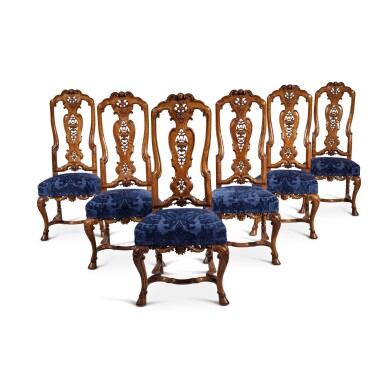
Property of Northern California Collectors
A Set of Six George I Carved Walnut Side Chairs, Attributed to Richard Roberts, Circa 1720
Lot Closed
October 16, 04:03 PM GMT
Estimate
10,000 - 15,000 USD
Lot Details
Description
probably originally with cane seats and re-railed in the 19th century
height 47 in.; width 21 in.
119.4 cm; 53.3 cm
Possibly supplied to John Hay, 4th Marquess of Tweeddale (1695-1762), Pinkie House, Musselburgh, Scotland
Possibly acquired with Pinkie House by Sir Archibald Hope, 9th Baronet Hope of Craighall (1735-1794) in 1778
Thence by descent to Sir John Augustus Hope, 16th Baronet (1869-1924) and then to his wife, the Hon. Mary Bruce, daughter of Alexander Bruce, 6th Lord Balfour of Burleigh, at Pinkie House
Sotheby's London, 11 May 1928, lot 143
Partridge Fine Art, London May 2000
Nicholas Grindley, The Bended Back Chair, Exhibition Catalogue, London 1990, no.11 (illustrated)
Tall back walnut side chairs with pierced splats and curved legs joined by a stretcher are often referred to as 'Marot' chairs, after King William III's architect and designer Daniel Marot (1661–1752), a Paris-born Huguenot who emigrated to Holland and accompanied the King to England after 1688. Marot is credited with introducing the Louis XIV style into both Holland and England, and the scrolls and pierced foliate strapwork of these chairs are similar to his engraved ornamental designs. The model, however, dates to the early Georgian period and is based on a set of 'eighteen wallnuttree chairs' traditionally believed to have been supplied by Richard Roberts in 1718 to George I's Dining Room at Hampton Court Palace, ten of which survive today in the Royal Collection at Hampton Court (one illustrated in Adam Bowett, Early Georgian Furniture 1715-1740, Woodbridge 2009, p.164 pl.4:40). Similar chairs were also produced by contemporary Dutch joiners, including an important numbered set of eighteen from the Sir James Horlick Collection now at Dyrham Park, Gloucestershire (National Trust). A similar pair recently with Mackinnon Fine Art was sold Christie's London, 10 November 2021, lot 128.
Richard Roberts (d.1733) received his freedom from the Joiners' Company in 1716 and took over from his father, the court chair-maker Thomas Roberts (d.1714), trading at the sign of The Royal Chair in Marylebone Street, Westminster. He supplied seat furniture and tables to the Royal Household between 1714 and 1729. Little is known of his other commissions or his family life, but he may have been related to the upholsterer Thomas Roberts who supplied an important group of furniture to Sir Robert Walpole at Houghton Hall starting in the late 1720s.c
Pinkie House in Musselburgh, east of Edinburgh, was originally a 16th century tower house built on the site of the Battle of Pinkie (1547), the last pitched battle between Scottish and English forces before the union of the crowns. In 1597 it became the property of Alexander Seton (d.1622), Earl of Dumferline and Chancellor of James VI, who expanded the property, notably adding the Long Gallery whose well preserved ceiling is painted with emblems and inscriptions. The house was sold to John Hay, son of the 1st Earl of Tweeddale, in 1694, the year he was created the 1st Marquess of Tweeddale, and it remained with the Hays until acquired by Sir Archibald Hope, 9th Baronet of Craighall. It remained with in the Hope family, who made numerous additions and alterations to the property over the years, until sold to the Loretto School in 1951.
When this set of chairs was sold at Sotheby's in 1928, the lot description in the catalogue proclaimed IT IS HARDLY TOO MUCH TO SAY THAT THESE CHAIRS FROM PINKIE HOUSE ARE ONE OF THE FINEST SETS OF THE PERIOD EVER SEEN IN THE AUCTION ROOM. The catalogue introduction also reiterated the family tradition that the chairs had been used by Charles Edward Stuart (1720-1788), also known as the Great Pretender or Bonnie Prince Charlie, who stayed at Pinkie House following his victory at the Battle of Prestonpans during the Jacobite rising in 1745.
You May Also Like


