
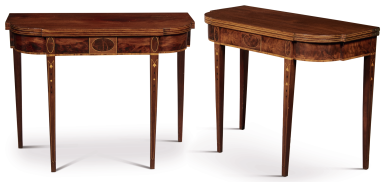
VERY FINE PAIR OF INLAID AND FIGURED MAHOGANY GAMES TABLES, ATTRIBUTED TO EDMUND JOHNSON, SALEM, MASSACHUSETTS, CIRCA 1805
Auction Closed
January 25, 06:44 PM GMT
Estimate
5,000 - 10,000 USD
Lot Details
Description
VERY FINE PAIR OF INLAID AND FIGURED MAHOGANY GAMES TABLES, ATTRIBUTED TO EDMUND JOHNSON, SALEM, MASSACHUSETTS, CIRCA 1805
back rail of table inscribed Marblehead Rebecca Lindsey; inside front rail inscribed Rebecca Lindsay.
Height 28 in. by Width 35 ¾ in. by Depth 16 ¾ in.
Rebecca Lindsay, Marblehead, Massachuestts;
Marguerite Riordan, Stonington, Connecticut.
This pair of games tables feature distinctive bellflower and black pellet inlays on the front of the tapered legs that are similar to those found on pieces labeled by the Salem cabinetmaker, Edmund Johnson. A secretary labeled by Johnson with related inlays is in the collection of Winterthur Museum (see Charles F. Montgomery, American Furniture: The Federal Period (New York, 1966), p. 223. Two other secretaries with Johnson’s label and similar bellflower inlaid decoration are known including one owned by Mrs. Walter P. Wright illustrated in Luke Vincent Lockwood, Colonial Furniture in America, Volume 1, Fig. XLVI, p. 376 and one in the collection of the Henry Ford Museum (see The Magazine Antiques: Antiques at the Henry Ford Museum (New York, 1959).
Two pieces attributed to Johnson with inlays of this type include a tambour desk illustrated in American Antiques from Israel Sack Collection, Volume VI, p. 1607 and a pembroke table illustrated in Sack Volume VII, p. 2031. The latter table has inlays that are identical to those seen here and are likely by the same hand.
Edmund Johnson worked as a cabinetmaker in Salem, Massachusetts from circa 1793 to 1811. In 1802, he purchased the schooner Friendship and land in the north field of Salem in partnership with fellow cabinetmakers George Whitefield Martin (1771-1810), Samuel Barnard and Jonathan Marston (Benjamin Hewitt, Patricia Kane, and Gerald Ward, The Work of Many Hands: Card Tables in Federal America, 1790-1820, New Haven, 1982, p. 118). A card table at the New Hampshire Historical Society with similar bellflowers and string inlay outlining the front legs was made by George Martin in partnership with Robert Choate (b. 1770) (see ibid, no. 3, p. 117). The latter was made when Martin and Choate were working together in Concord, New Hampshire, although it reflects the decorative preferences of northeastern Massachusetts, where they had both lived previously.