
Patek Philippe
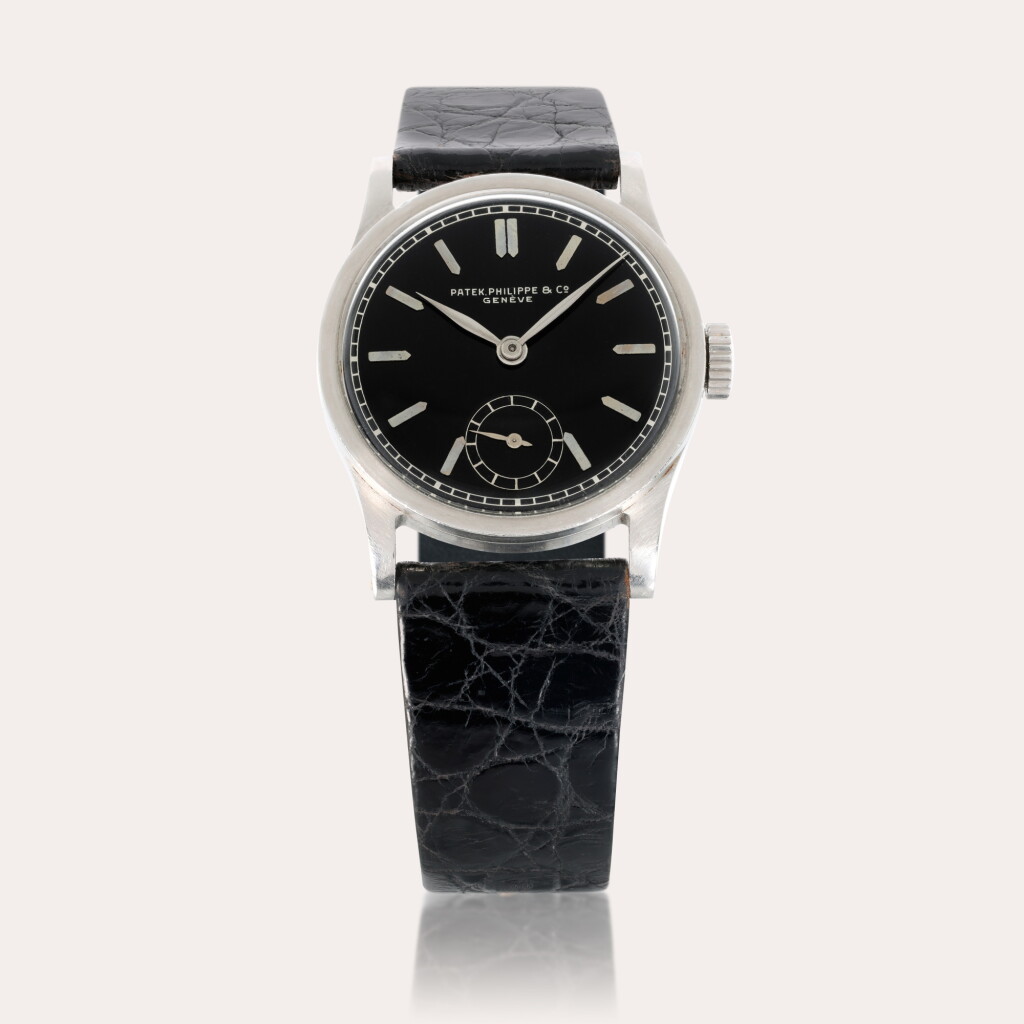
Calatrava, Reference 96 | A stainless steel wristwatch with black dial | Made in 1944
Auction Closed
November 9, 12:39 PM GMT
Estimate
15,000 - 30,000 CHF
Lot Details
Description
Dial: black
Calibre: cal. 12'''120 manual winding, 18 jewels
Movement number: 924'786
Case: stainless steel, snap-on case back
Case number: 630'233
Closure: stainless steel associated bracelet and folding clasp
Size: 31 mm diameter
Signed: case, dial and movement
Box: no
Papers: no
Accessories: Patek Philippe Extract from the Archives confirming date of sale on April 19, 1944 and associated pouch
Please note the leather strap derived from endangered species is for display purposes only and is not sold with the watch. The watch will be shipped with a Sotheby’s branded calf leather strap.
The reference 96, the original Calatrava model, was in production for over 40 years and remains the quintessential and most sought-after design in contemporary Patek Philippe collections.
Its production started in 1932, coinciding with the acquisition of Patek Philippe & Cie by Charles and Jean Stern and marking the genesis of referenced watches within the company. Crafted with a snap-on back and a 30.5 mm bezel, the initial three pieces were designed by Antoine Gerlach, a renowned Geneva master case maker. However, it is Taubert (marked FB) that was in charge of the stainless steel version, such as this lot.
The second series, to which the present model belongs, began in 1935 with the introduction of the caliber 12-120 and lasted until 1953. A total of over 10.000 of the Reference 96 have been made, with only a quarter produced in stainless steel.
The dial of this piece is particularly worth of interest. Black dials represent only a fraction of the production and are particularly sought-after by collectors. Its combination with the stainless steel case, provides the piece a strong character and presence. It has the classic lapidated indexes, called HL for Heures lapidées, and the outer rail track. The unusual leaf hands add a touch of elegance.
What further sets this example apart is its remarkable condition. The dial, hands and case are in impressive harmonious condition. The galvanic dial still has its beautiful finish and the case retains most attractive proportions. Finding a 1940's stainless steel black dial Reference 96 in such condition is a most exciting discovery. The watch was until today unknown on the auction market.
The present Patek Philippe reference 96 finds its origins within the industrial and entrepreneurial fabric of mid-20th-century Aargau, where two influential dynasties — the Meyer-Koch and Hediger-Knüchel / Schärer families — shaped key chapters of Swiss economic history.
Founded in Aarau in the late 19th century, George Meyer & Co. AG stood at the heart of the flourishing straw-weaving industry that transformed the Freiamt region into one of Switzerland’s earliest centers of proto-industrial production. Around 1900, the trade employed over 24,000 home-based workers and 4,000 factory employees across more than a hundred workshops — a scale that fueled local prosperity and an enduring export network. Within this climate of innovation and progress, Joseph Koch-Berner (1882–1939) guided George Meyer & Co. with vision and discipline, embodying the new generation of Swiss industrial leaders. His daughter, Gertrude Hediger-Koch, later presided over the Koch-Berner Foundation, extending the family’s commitment to education and cultural patronage.
Through her marriage to Oskar Hediger, the Koch lineage intertwined with another cornerstone of Swiss enterprise: the Rupperswil Sugar Refinery, jointly owned by the Hediger-Knüchel and Schärer families. Established in 1906 and relocated to its present site in 1909, the refinery grew rapidly during the interwar period, employing several hundred workers at its peak. Under the guidance of Karl Schärer (commercial director) and Jakob Kopp (technical director), it became a benchmark of Swiss agro-industrial efficiency and innovation — a symbol of precision, integrity, and longevity that mirrors the very values of Geneva watchmaking.
Passed down through these families for generations, the present watch has been preserved in remarkable condition. More than a fine example of early Calatrava design, it stands as a discreet testament to a distinctly Swiss ethos — where craftsmanship, perseverance, and continuity form the true measure of success.