Property from a European Private Collection
Jacob Marrel
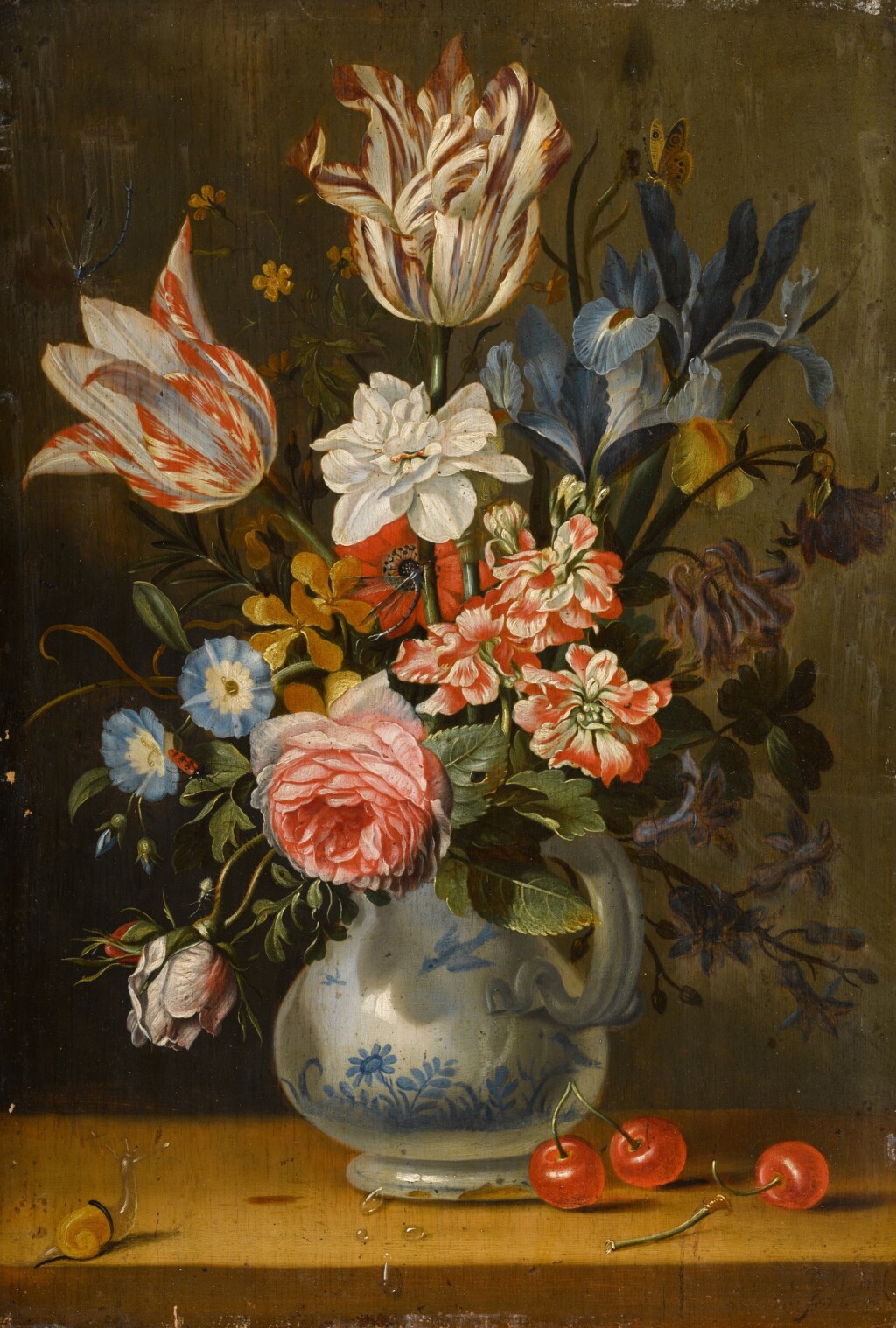
Still life with tulips, an iris, a rose, morning glories and other flowers with a dragonfly, butterfly and other insects, with cherries and a snail on a wooden ledge
Lot Closed
December 8, 02:37 PM GMT
Estimate
80,000 - 120,000 GBP
Lot Details
Description
Property from a European Private Collection
Jacob Marrel
Frankenthal 1613/14 - 1681 Frankfurt-am-Main
Still life with tulips, an iris, a rose, morning glories and other flowers with a dragonfly, butterfly and other insects, with cherries and a snail on a wooden ledge
signed and dated lower right: J Marrel / fec 1657
oil on oak panel, the reverse with two unidentified red and black wax collectors' seals
unframed: 43 x 29.3 cm.; 16⅞ x 11½ in.
framed: 54.5 x 41.1 cm.; 21½ x 16⅛ in.
Acquired by the grandfather of the present owner;
Thence by descent.
Born in Frankenthal, Jacob Marrel trained in the German centre of still life painting, Frankfurt, with Georg Flegel. He then spent the next formative years of 1632–50 in the Netherlandish city of Utrecht, studying with Jan Davidsz. de Heem (1606–84), where he also came under the influence of the Bosschaert family of flower painters and Roelandt Savery (1576–1639), who had settled in Utrecht after working for Rudolf II in Prague.
This still life, dated 1657, when Marrel had returned to Frankfurt, reflects above all the example of Ambrosius Bosschaert the Younger (1609–45) in its bright colours and broadly symmetrical, compact design. The painting is typical of Marrel’s work, not only in the inclusion of the porcelain handled jug, which appears in other paintings by the artist from this period, but also the characteristic morello cherries, which Sam Segal interprets as a reference to Marrel’s surname, serving as a form of signature.1
Having returned to Frankfurt for a period, Marrel later came back to Utrecht in 1660, where he tutored Abraham Mignon, and arranged for Mignon to continue his training in the city with De Heem. Marrel and Mignon went on to teach Marrel’s step-daughter, Maria Sibylla Merian (1647–1717), who became a naturalist and renowned still life painter herself, demand for her works rivalling those of Rachel Ruysch.
1 S. Segal, Flowers and Nature: Netherlandish Flower Paintings of Four Centuries, exh. cat., The Hague 1990, under cat. no. 195.
You May Also Like