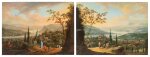
The Property of a Family
Joos de Momper
An extensive mountainous landscape with travellers on a path, with a castle and the sea beyond
Lot Closed
December 8, 02:27 PM GMT
Estimate
50,000 - 70,000 GBP
Lot Details
Description
The Property of a Family
Joos de Momper
Antwerp 1564 - 1635
An extensive mountainous landscape with travellers on a path, with a castle and the sea beyond
oil on canvas
unframed: 158.5 x 204 cm.; 62⅜ x 80¼ in.
framed: 164.5 x 209.5 cm.; 64¾ x 82½ in.
Anonymous sale, London, Christie's, 11 July 1980, lot 73;
Where acquired by the father of the present owners.
This monumental canvas by Joos de Momper has been in the same private collection in the Rhineland for the last forty-two years. Painted during the 1620s, and in a good state of preservation, Flemish landscapes of this scale and quality are rarely encountered on the art market.
In Van Dyck’s Iconographie, a series of prints of his portraits reproducing the likenesses of approximately one hundred famous nobles, scholars, and artists, the artist is described as ‘Judocus de Momper Pictor montium Antwerpiae’ (‘Joos de Momper Antwerp Painter of mountains’).1 This canvas is a record of de Momper's extraordinary abilities for capturing both the textures and feeling of mountains. Thick and bold preserved brushwork is found throughout, providing a rich variety of qualities of rock and earth. Despite the sheer size of the picture, no expense has been spared in achieving subtle colouring, which ranges from deep earthy reds to oranges, mustard yellows, greys and deep lustrous blues in the landscape and sea beyond. Following in the Flemish tradition of landscape painting, various planes of colour are employed to create a convincing and beautiful sense of depth, which allows the eye at first to enjoy the rich details in the foreground and then the landscape and sea beyond.
The drama of this particular composition is heightened by the inclusion of figures which are seen battling through the unforgiving and dramatic landscape around them. Various small scenes can be spotted that evoke emotions of pity and despair. In the middle ground is a packhorse which has just buckled under the weight of its heavy load. In the left foreground is a family of beggars, shown trying to seek the charity of indifferent travelers passing by. The sheer ambition, mood and scale of this painting prefigures the attempts of Romantic painters centuries later in capturing notions of the sublime in painted mountain ranges, subjects which attracted painters such as J.M.W. Turner, John Martin and countless others in the nineteenth century.
Klaus Ertz (see Literature) dates the work to the 1620s, observing that the figures were painted by Jan Brueghel the Younger (1600–1678), who returned to Antwerp in 1625 to take over the family workshop from his father Jan Brueghel the Elder, who died that year.
You May Also Like