Property from a Canadian Private Collection
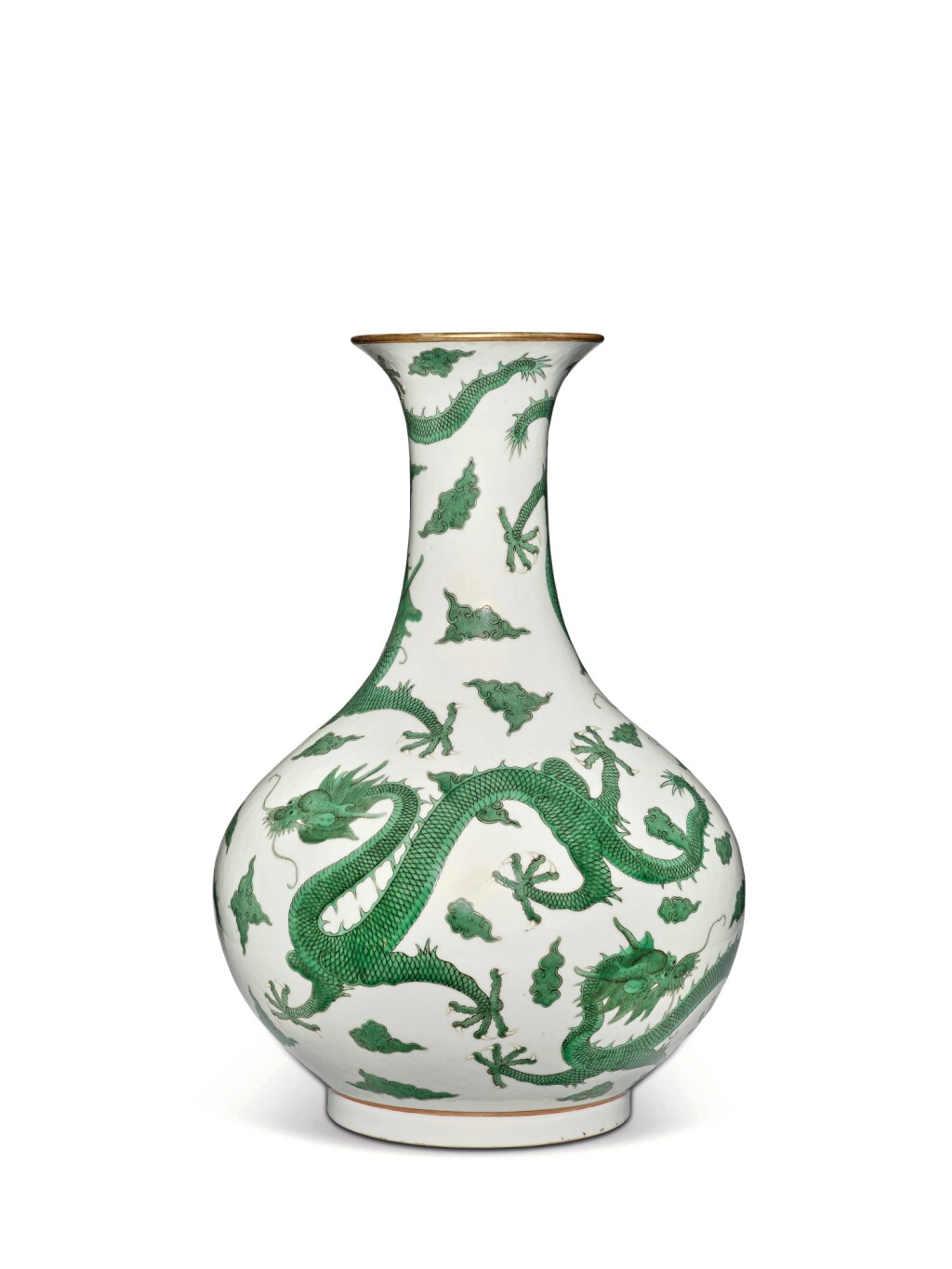
A very rare green-enameled 'dragon' bottle vase, Seal mark and period of Daoguang | 清道光 綠彩五龍戲珠紋長頸瓶 《大清道光年製》款
Auction Closed
March 23, 06:46 PM GMT
Estimate
50,000 - 70,000 USD
Lot Details
Description
A very rare green-enameled 'dragon' bottle vase
Seal mark and period of Daoguang
清道光 綠彩五龍戲珠紋長頸瓶 《大清道光年製》款
the base with a six-character seal mark in iron red
Height 11 in., 27.9 cm
Collection of Dr. P. Franklin, acquired between the late 1940s and 1950s (by repute).
P. Franklin 醫生收藏,得於1940年代末至1950年代之間 (傳)
This elegantly shaped vase with its green-enameled dragon motif represents a particularly rare example of Daoguang period (1821-1850) imperial porcelain. The pattern was first created during the Chenghua period (1465-1487) and remained popular throughout the Ming (1368-1644) and Qing (1644-1911) dynasties. Ming dynasty ceramicists typically incised the dragons on the reserved biscuit clay before enameling the animals in green; Qing ceramicists, on the other hand, painted the enameled dragons on top of a layer of transparent glaze. Among the various types of ‘green dragon’ wares produced over the centuries, such as jars, bowls and dishes, there is only one other vase known to exist, which also bears a Daoguang seal mark and is of the period. That vase, formerly in the Yiqingge Collection, is almost identical to the present example, and was sold at Christie’s Hong Kong, 29th May 2013, lot 2028. Another closely related Daoguang vase of the same form and design, but painted in black enamel, in the collection of the Seikadō Bunko Art Museum, Tokyo, was included in the exhibition Seikadō zō Shinchō tōji. Keitokuchin kanyō no bi [Qing dynasty porcelain collected in the Seikado. Beauty of Jingdezhen imperial kilns], Tokyo, 2006, cat. no. 75.
From the Kangxi period (1662-1722) onwards, green-enameled dragons chasing 'Flaming Pearls’, painted with underglaze-blue outlines and black details, can be found on covered jars; a Daoguang mark and period example is preserved in the National Palace Museum, Taipei (accession no. gu-ci-008825). Another jar of this type and period, exhibited in the Roemer Museum, Hildesheim, in 1899, was sold in these rooms, 21st March 2018, lot 549; and a pair of such jars was sold in the same rooms, 18th September 2007, lot 283. For a Kangxi precedent of this design see a jar in the Palace Museum, Beijing, illustrated in Wang Liying, ed., Gugong Bowuyuan cang wenwu zhenpin quanji. Wucai, doucai / The Complete Collection of Treasures of the Palace Museum. Porcelains in Polychrome and Contrasting Colours, Hong Kong, 1999, pl. 190.
You May Also Like