
Property from an American Private Collection
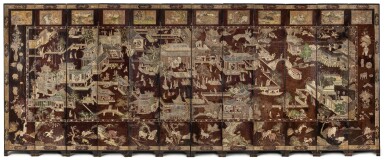
A twelve-panel lacquer 'figural' Coromandel screen, Qing dynasty, Kangxi period | 清康熙 髹漆加彩刻漢宮春曉圖十二扇屏風
Auction Closed
March 23, 06:46 PM GMT
Estimate
60,000 - 80,000 USD
Lot Details
Description
A twelve-panel lacquer 'figural' Coromandel screen
Qing dynasty, Kangxi period
清康熙 髹漆加彩刻漢宮春曉圖十二扇屏風
Height 123 in., 312 cm; Width of each panel 25 in., 63.5 cm
Sotheby Parke Bernet, New York, 5th June 1980, lot 1292.
蘇富比 Parke Bernet,紐約,1980年6月5日,編號1292
The present screen is distinguished by its finely carved details such as the architectural elements, the carefully composed groupings of women, the ornamental rockwork and the towering trees enclosed in slatted fences. For a discussion of this type of screen and illustrations of similar examples such as a twelve-panel screen in the collection of the Freer Gallery of Art, Smithsonian Institution, Washington, D.C., see W. De Kesel and G. Dhont, Coromandel Lacquer Screens, Gent, n.d., pp 48-54, pl. 31-34. Compare also a twelve-panel coromandel screen depicting the 'Spring Palace', attributed to the Kangxi period, illustrated in Robert D. Jacobsen and Nicholas Grindley, Classical Chinese Furniture in the Minneapolis Museum of Art, Belgium, 1999, no. 55, pp 159-161. A screen of the same subject matter and with flowers and birds on the reverse, like the present example, is in the Penn Museum, Philadelphia and described in John Getz, The University Museum Section of Oriental Art, Philadelphia, 1917, p. 261, no. 400. Compare also a similar screen sold in these room, 15th September 2010, lot 426.
You May Also Like


