
Property from a Viennese Family
The Monogrammist IS
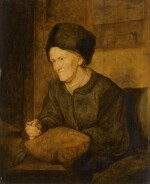
Portrait of an old lady, half-length, wearing a fur hat, sewing a cushion, with spectacles in hand and a pair of scissors to the side
Auction Closed
July 6, 10:53 AM GMT
Estimate
40,000 - 60,000 GBP
Lot Details
Description
Property from a Viennese Family
The Monogrammist IS
active 1633–1658
Portrait of an old lady, half-length, wearing a fur hat, sewing a cushion, with spectacles in hand and a pair of scissors to the side
signed indistinctly on the ledge: S
oil on oak panel
unframed: 89.2 x 73 cm.; 35⅛ x 28¾ in.
framed: 111 x 95.2 cm.; 43¾ x 37½ in.
In the possession of the great-grandmother of the present owner in Vienna by the 1920s, but apparently with Otto Schatzker, Vienna, in 1937 (according to a card at the RKD);
Thence by direct descent to the present owner in Vienna and Salzburg.
Believed by family tradition over the last century to be the work of a pupil of Rembrandt, this painting is in fact by the enigmatic and highly unusual artist known as the Monogrammist IS. As such, it is an exciting and important addition to his œuvre, which consists of a small group of works dated between 1633 and 1658, signed with the monogram ‘IS’.
Theodore von Frimmel, in 1904, was the first to publish a group of works by this hand, the earliest dated 1633, the latest 1658, thus establishing his artistic identity.1 More recently Prof. Werner Sumowski reopened the discussion over the artist's identity and likely origin, raising the possibility of him being German and having trained in Holland.2 Perhaps due to various interpretations of the clothing and the appearance of the painter's elderly subjects, it has also been suggested that he spent time in the Baltic countries or even Scandinavia. Most of the artist's portraits follow the same pattern, showing a stern-faced figure in bust- or half-length, warmly wrapped in hat and fur-trimmed coat, the sitter's expression rendered with such sophistication that their state of mind is conveyed.
This painting is rare due to its relatively large size and setting. Only a few works regarded as being by the artist show a figure in a defined interior, his bust portraits of elderly sitters being more commonplace. The painterly handling too, executed with very thinly diluted oil, which allows the briskly executed underdrawing to show through in many areas, is distinctive in this example.
Another version of this composition, bearing the signature of Christopher Paudiss (1625–1666), was recorded in the collection of the Paris based financier Jules Porgès (1839–1921) in 1921.3
1 T. von Frimmel, 'Von Monogrammisten IS', in Blatten für Gemäldekunde, I, 1904, pp. 132–33.
2 W. Sumowski, Gemälde der Rembrandt-Schüler, vol. IV, Landau-Pfalz 1983, p. 2548 ff.
3 According to a card in the Frick Art Reference Library, New York.
You May Also Like


