
Property from a Private South American Collection
Master of the Female Half-Lengths
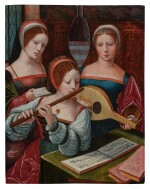
A concert with a singer, flautist, and lutenist
Auction Closed
July 6, 10:53 AM GMT
Estimate
100,000 - 150,000 GBP
Lot Details
Description
Property from a Private South American Collection
Master of the Female Half-Lengths
active in Antwerp during the first half of the 16th century
A concert with a singer, flautist, and lutenist
oil on panel
unframed: 47.3 x 37.1 cm.; 18⅝ x 14⅝ in.
framed: 66 x 56.2 cm.; 26 x 22⅛ in.
With Galerie Robert Finck, Brussels, 1953;
From whom acquired by the present collector, 1955.
Connaissance des Arts, 21, 15 November 1953, p. 6, reproduced;
M.J. Friedländer, Early Netherlandish Painting, Leiden and Brussels 1975, vol. XII, p. 100, no. 106a (incorrectly associated with version now in Los Angeles);
C. Slim, ‘Paintings of Lady Concerts and the Transmission of ‘Joussance vous donneray’’, in Imago musicae, 1, 1984, pp. 51–73, reproduced fig. 4;
L.D. Kop, ‘Eighth International Conference on Musical Iconography’, in Research Center for Music Iconography Newsletter, 5, no. 2, June 1980, p. 5.
This charming painting by the Master of the Female Half-Lengths depicts three elegantly dressed women engaged in a musical performance. The composition, which probably dates from the 1520s or 1530s, was one of the anonymous South Netherlandish painter’s most popular. Though previously overlooked in most art historical literature, this version is one of the finest.
In a wood-panelled room, three elegantly dressed women are engaged in a musical performance, an image type characteristic of the Master of the Female Half-Lengths, who is known for his eponymous depictions of beautiful young women singing, playing musical instruments, reading, or writing in domestic settings. Two women stand: at left a singer holds a sheet of music and at right a lutenist strums her instrument. Before them a flautist plays from an open partbook displaying the sixteenth-century chanson, ‘Jouissance vous donneray’, by Claudin de Sermisy with a text by Clément Marot. The women in this scene conform to the painter’s distinctive female type: they have straight, narrow noses, thin eyebrows, and downcast eyes; their hair is centrally parted and partially covered by caps; and they wear French-cut velvet-bodice gowns.
Three other versions of the composition are known: one in the Harrach picture gallery at Schloss Rohrau in Austria (inv. no. 169); another at the Hermitage, Saint Petersburg (inv. no. 435); and a third in the Los Angeles County Museum of Art (inv. no. AC1992.152.142). Though compositionally similar, they differ from one another in many details.1 The Harrach version (acquired in the late 1670s by Count Ferdinand Bonaventura von Harrach in Madrid) compares most closely to the present work. The women wear nearly identical costumes, though the lutenists’ headdresses differ, so too the women’s jewellery. The room’s wood panelling, featuring grotesques and a female figure, is most elaborate in the present painting, while a triple flute case and cap sits on the table in the foreground of the Harrach version. The present painting has remained in the same collection since the mid-1950s.
1 Colin Slim examined the nuanced differences between the various musical elements; see Slim 1984, pp. 51–73.
You May Also Like


