The Property of a Private Collector
Lucas van Valckenborch
Christ as ‘Fons Vitae’
Auction Closed
July 6, 10:53 AM GMT
Estimate
40,000 - 60,000 GBP
Lot Details
Description
The Property of a Private Collector
Lucas van Valckenborch
Christ as ‘Fons Vitae’
signed and dated lower left on the block of stone: 1592/ L / VV
oil on softwood panel, probably beech
unframed: 125.4 x 96 cm.; 49⅜ x 37¾ in.
framed: 147 x 117.9 cm.; 57⅞ x 46⅜ in.
Jacob Ludwig Hoffmann, Salzburg;
His posthumous sale ('Der Antiquitäten aus dem Nachlaß des Herrn Jakob Ludwig Hoffmann in Salzburg und aus anderem Privatbesitz'), Vienna, Dorotheum, 23–30 May 1910, lot 331;
Professor Much, Vienna (according to Wied);
By inheritance to his presumed widow, Cornelia Much, née Benndorf, Vienna (according to Wied);
Karin Krempke, Vienna (according to Wied);
Anonymous sale, Vienna, Dorotheum, 14–17 June 1966, lot 572 for 25,000 Schillings;
With Kurt Meissner, Zurich, 1970;
Anonymous sale, Lucerne, Fischer, 14–21 November 1978, lot 1885;
Private collection;
By whom offered anonymous sale ('The Property of Various Owners'), New York, Sotheby’s, 11 June 1981, lot 105, unsold;
Acquired subsequently by the present owner.
K. Goossens, ‘Een onbekend Werk van Lucas van Valckenborch’, in Festschrift für Wolfgang Krönig, Aachener Kunstblätter, vol. 41, Düsseldorf 1971, pp. 118 ff., reproduced fig. 1;
A. Wied, ‘Lucas van Valckenborch’, in Jahrbuch der Kunsthistorischen Sammlungen in Wien, vol. LXVII, 1971, p. 203, no. 51 reproduced;
I. Bergström, ‘Lucas van Valckenborch in collaboration with Georg Flegel’, in Tableau, Tijdschrift voor beeldende Kunst, vol. 5, no. 4, February 1983, 1983, pp. 325 and 327, reproduced fig. 13;
A. Wied, Lucas und Marten van Valckenborch (1535–1597 und 1534–1612). Das Gesamtwerk…, Freren 1990, pp. 164–65, no. 61*, reproduced.
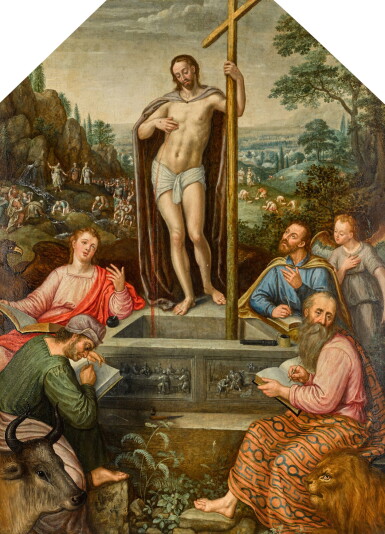
The subject of this strongly spiritual painting is something of a hybrid, depicting the resurrected Christ filling the Fountain of Life (Fons Vitae) with blood from his wound. Around the stone well are the Four Evangelists writing, and in keeping with the theme of divine sustenance, and linking the Old and New Testaments, in the distance is Moses striking the rock and the gathering of Manna. The Evangelists writing remind us that these scriptures carry the authority of the written word directly recording the events.
Lucas van Valckenborch was a peripatetic painter, and his travels are of relevance to this starkly religious painting. He was born in Leuven in Flanders, then entered the painters’ guild in nearby Leuven (Louvain), where according to his first biographer Karel van Mander he learnt to paint landscapes, before moving the short distance to Antwerp. In 1566 he and his artist-brother Marten fled the iconoclasm in Antwerp, probably for religious reasons, and in 1570 he was in Aachen. By 1576 he was back in Antwerp, and within three years, during which he is likely to have made his name as an artist, he was appointed court painter to the Archduke Matthias of Austria, governor of the Spanish Netherlands. After Matthias lost his position as Governor, Valckenborch travelled with him to Linz. His whereabouts until 1593, when he joined his brother Marten in Frankfurt, are not precisely known, but the softwood support of the present painting suggest that it was not painted in The Netherlands, and a location in Upper Austria is more likely. Alexander Wied cites Korneel Goossens in suggesting that this most Counter-Reformation of subjects was most likely not painted for the Archduke, but more plausibly for an Austrian family, church or monastery.
The stream of blood emanating from Christ’s wound was painted over in circa 1978, but the present owner had the overpainting removed, restoring it to its original appearance and meaning. The reverse also bears two later wax impressions of a John George I, Elector of Saxony reichstaler (dated 1631) and a Maria Theresa thaler (dated to 1770), an attempt it would seem to alter the painting's provenance.
You May Also Like