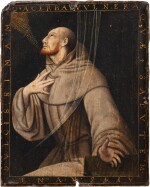

French School circa 1600 | Ecole française vers 1600
Saint Francis in Ecstasy | Saint François en extase
Lot Closed
June 15, 01:18 PM GMT
Estimate
7,000 - 10,000 EUR
Lot Details
Description
French School circa 1600
Saint Francis in Ecstasy
Oil on panel, unframed
18 x 14,5 cm ; 7⅛ by 5¾ in.
____________________________________________
Ecole française vers 1600
Saint François en extase
Huile sur panneau, sans cadre
18 x 14,5 cm ; 7⅛ by 5¾ in.
The painting is certainly by a French artist (perhaps from the north of France) of the mid-sixteenth century, or even a little later. In the almost white flesh tones, recalling stained glass or enamel, the nearly monochrome palette in shades of grey and taupe, and the delicate treatment of the cloth, the work is reminiscent of the art of Grégoire Guérard, active in the first third of the sixteenth century.
--------------------------------------------------------
Sur un panneau de petite dimension, bien conservé, le peintre a représenté avec concision et sobriété le moment où saint François reçoit les stigmates. Il a dépouillé la scène de tout pittoresque, se concentrant sur le miracle lui-même, et omettant volontairement tout détail superflu, tels que la présence des anges le soutenant, ou le crâne et le crucifix que l’on trouve parfois souvent à ses côtés. Seuls quelques rehauts d’or témoignent de l’intervention du divin, dans une vision raffinée et concentrée de cette iconographie.
Le tableau revient très certainement à un peintre français (peut-être du Nord de la France) du milieu du XVIe siècle, voire un peu plus tardif. Les tons de chair presque blancs, qui rapprochent cette œuvre de l’art du vitrail ou des émaux, la palette presque monochromatique, en camaïeu de gris et de brun taupe, la délicatesse du traitement des étoffes ne sont pas sans évoquer l’art d’un Grégoire Guérard, actif dans le premier tiers du XVIe siècle.
You May Also Like


