
Property from a Distinguished Spanish Private Collection | Provenant d'une prestigieuse collection particulière espagnole
Circle of Pieter Pourbus | Entourage de Pieter Pourbus
The Adoration of Magi | L'Adoration des Mages
Lot Closed
June 15, 01:26 PM GMT
Estimate
8,000 - 12,000 EUR
Lot Details
Description
Property from a Distinguished Spanish Private Collection
Circle of Pieter Pourbus
The Adoration of Magi
Oil on panel
76,4 x 100,3 cm ; 30⅛ by 39½ in.
____________________________________________
Provenant d'une prestigieuse collection particulière espagnole
Entourage de Pieter Pourbus
L'Adoration des Mages
Huile sur panneau
76,4 x 100,3 cm ; 30⅛ by 39½ in.
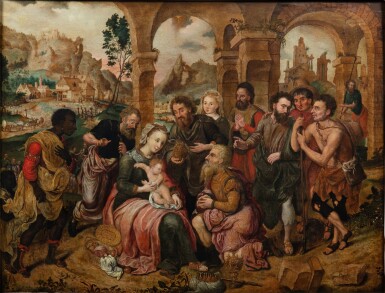
The composition creatively fuses the apparition of the miraculous star, the Adoration of the shepherds and the Adoration of the Magi, all important and popular moments in the history of Christmas. In the centre, the Virgin holds the lively child on her knee. In line with iconographic tradition dating back to the medieval period, the Magi are shown as different in age and from different continents. All three are richly attired, especially Balthazar, who is decked with jewels, with a red tunic and a cloak that seems to be sewed with gold thread. The architectural ruins symbolize the crumbling of old traditions, to be replaced by a new religion, born at the same time as Jesus.
--------------------------------------------------------
Le sujet de l'Adoration des Mages jouissait d'une grande popularité parmi les peintres flamands du début du XVIe siècle car le sujet leur donnait l'occasion de représenter les textiles, objets et personnages exotiques associés au commerce international, qui plaisaient à la classe marchande des villes comme Bruges et Anvers. L'on connaît de nombreuses variantes de cette composition dont les plus célèbres sont celles de Pieter Coecke van Aelst, notamment le tryptique du Metropolitan Museum.
La composition fusionne de manière créative l’apparition de l’étoile miraculeuse, l'Adoration des bergers et celle des Mages qui sont tous des moments importants et populaires de l'histoire de Noël. Au centre, Marie tient sur ses genoux l'enfant plein de vie et, conformément à la tradition iconographique datant du Moyen Âge, les Mages sont représentés comme étant d'âges et de continents différents. Chacun est richement vêtu, plus particulièrement Balthasar, paré de bijoux, avec sa tunique rouge et son brocard semblant cousu d’or. Les ruines architecturales symbolisent l'effondrement des anciennes traditions remplacées par une nouvelle religion naissant en même temps que Jésus.