Circle of Lorenzo Lotto | Entourage de Lorenzo Lotto
Portrait of a man | Portrait d'homme
Lot Closed
November 14, 03:12 PM GMT
Estimate
5,000 - 7,000 EUR
Lot Details
Description
Circle of Lorenzo Lotto
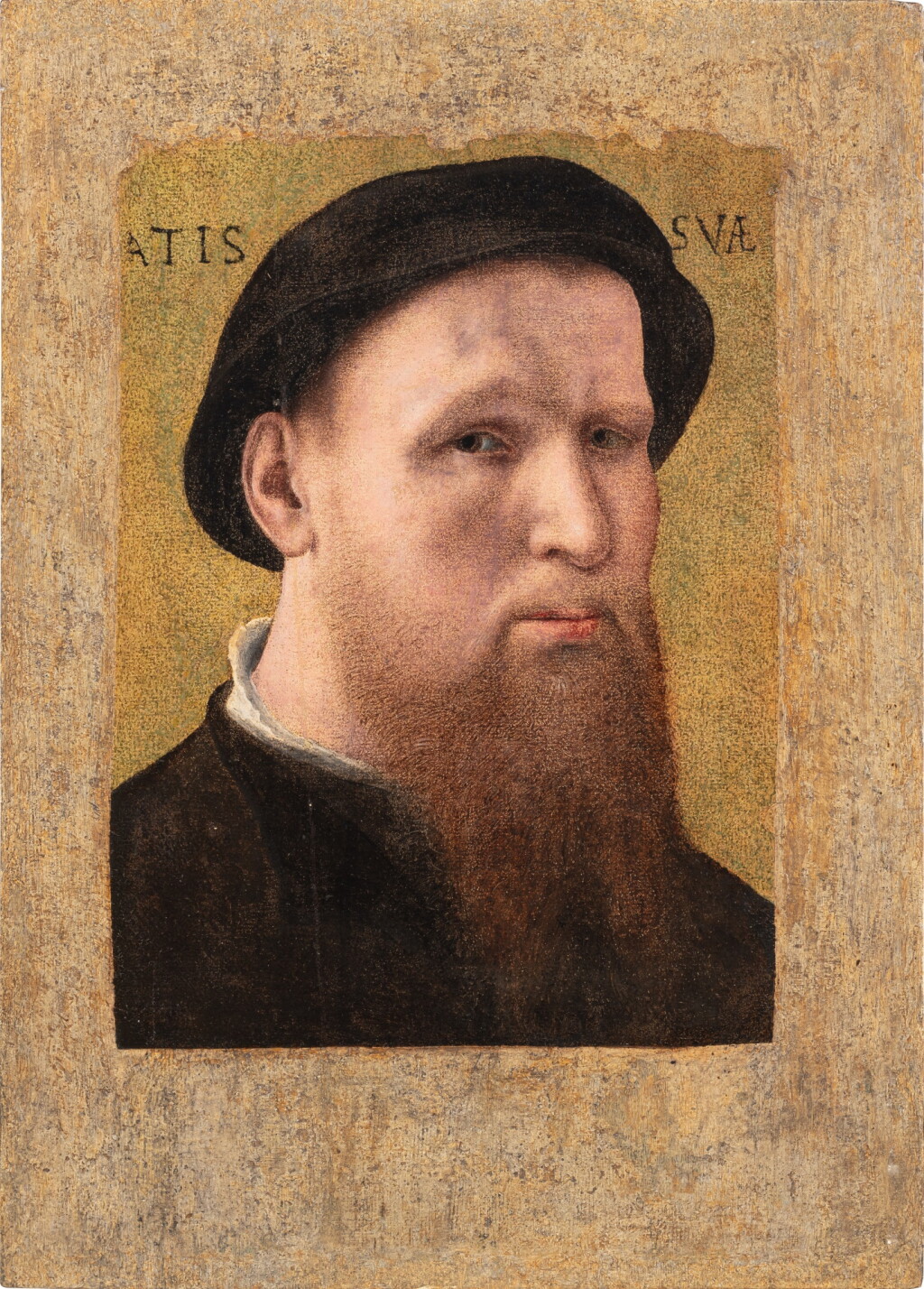
Portrait of a man
Oil on paper laid down on panel
Inscribed in the upper part ATIS… SVAE
Sheet: 25,7 x 18,4 cm ; 10⅛ by 7¼ in.
Panel: 36,3 x 25,9 cm ; 14¼ by 10¼ in.
____________________________________________
Entourage de Lorenzo Lotto
Portrait d'homme
Huile sur papier marouflé sur panneau
Inscrit en haut ATIS… SVAE
Papier : 25,7 x 18,4 cm ; 10⅛ by 7¼ in.
Panneau : 36,3 x 25,9 cm ; 14¼ by 10¼ in.
With Pietro Accorsi, Turin.
____________________________________________
Galerie Pietro Accorsi, Turin.
This bearded man, wearing a black hat and a simple black coat under which his white shirt collar is visible, seems to be looking questioningly at the viewer. Full of character, this painting is close to the manner of the Venetian artist Lorenzo Lotto. In the late fifteenth century, following in the footsteps of the Bellini brothers, Lotto produced portraits with more strongly defined features, attempting to make his models more realistic as well as to describe their characters and thus make them clearly identifiable.
The man’s clothes and the naturalistic treatment of the facial features, seeking to suggest the model’s character more clearly without idealizing it, make it possible to assign this painting to Venice in the early sixteenth century. The sheet of paper on which the portrait was painted specified the age of the sitter, but has unfortunately been cut down.
____________________________________________
Cet homme barbu, revêtu d’un simple habit noir d’où dépasse le col d’une chemise blanche, et coiffé d’un chapeau noir, semble poser sur le spectateur un regard interrogateur. Empreint de caractère, notre tableau est proche de la manière de Lorenzo Lotto. A la fin du XVe siècle, dans la lignée des frères Bellini, le Vénitien réalise des portraits aux traits plus marqués, cherchant à donner plus de réalité à son modèle, mais aussi à décrire son caractère et par là-même, le rendre parfaitement identifiable.
Le traitement naturaliste des traits, cherchant à rendre davantage le caractère du modèle, sans l’idéaliser, ainsi que les vêtements de l’homme situent ce tableau à Venise, à l’aube du XVIe siècle. Malheureusement coupée, la feuille sur laquelle est peint notre portrait précisait également l’âge du modèle.