Property from a Private Collection, UK (lots 539-555)
Cornelis Springer
Groote Kerk in Edam
Auction Closed
July 2, 04:36 PM GMT
Estimate
60,000 - 80,000 GBP
Lot Details
Description
Property from a Private Collection, UK (lots 539-555)
Cornelis Springer
Dutch
1817 - 1891
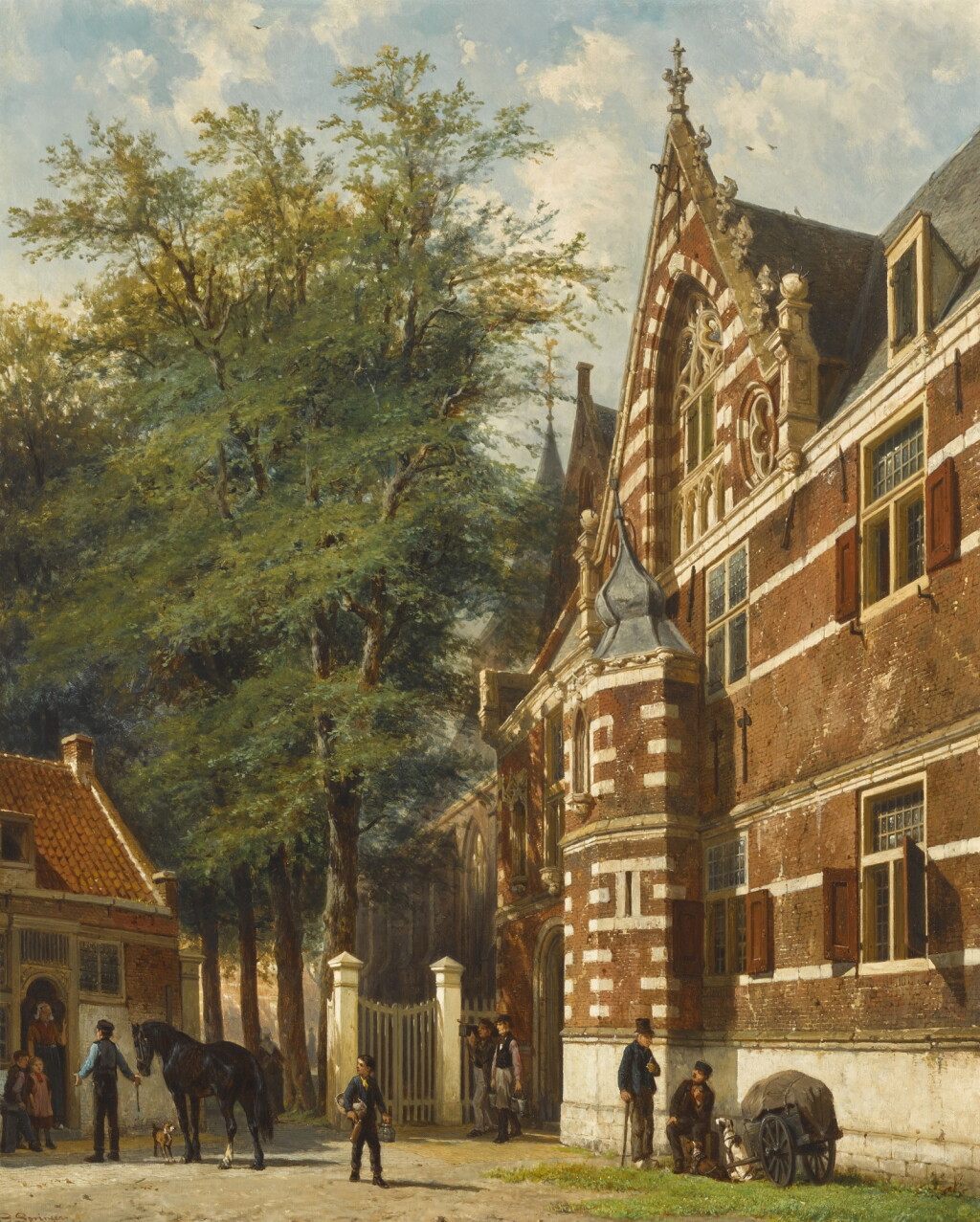
Groote Kerk in Edam
signed C Springer lower left and indistinctly authenticated by the artist with seal De ondergeteekende / verklaart dat die schilderij / voorstellende de doorgang van de Groote / Kerk te Edam, Noord Holland / door hem is vervaardigd / Amsterdam, 30 Sept.[ ... ] C Springer on a label on the reverse
oil on panel
unframed: 65.5 by 53cm., 25¾ by 20¾in.
framed: 89 by 76cm., 35 by 30in.
sold with the preparatory charcoal drawing
signed and dated C. Springer Febr. 70 lower left and inscribed Groote Kerk te Edam lower right
unframed: 65 by 55cm., 25½ by 21¾in.
framed: 86 by 75cm., 33¾ by 29½in.
(2)
Probably, The artist's atudio sale: Frederik Muller, Amsterdam, 1 December 1891, lot 6
Richard Green, London, by 1997
Acquired from the above by the previous owner (sale: Christie's, Amsterdam, 25 April 2007, lot 249)
Purchased at the above sale by the present owner
Willem Laanstra, H.C. de Bruijn and J.H.A. Ringeling, Cornelis Springer 1817-1891, Utrecht, 1984, p. 214, no. 0-5, as De Grote Kerk te Edam
The present work depicts the beautifully ornate late Gothic entrance to the Library of the Grote Kerk in Edam, its’ red and white bricks offset against the lush and verdant leaves of the trees standing next to it. The Krote Kerk was largely built in the early 15th Century and is dedicated to St Nicolas, the patron saint of sailors and mariners. In the 1530's the library was added to the church.
Like his teacher Karsen, Springer painted mainly fantasised town views (capriccio’s) in the early part of his career. From the mid-50s onwards he shifted his attention to recognisable townscapes, realising that topographical accurate scenes were much more in demand.
Springer travelled extensively in Holland, Germany and Belgium and prepared detailed architectural sketches and watercolour studies on the spot, which he would turn into finished paintings in his Amsterdam studio. After drawing a sketch on location, he would subsequently execute a black and white chalk drawing in his studio noting the measurements intended for his final oil painting, before embarking on painting the composition in oils. He usually focussed his attention on the centre of a town, rendering the late-medieval and renaissance architecture with a keen eye for historical detail. Although Springer didn’t eschew to embellish his town views to heighten picturesque effects, most of his paintings reflect the actual situation quite accurately. This certainly applies to the present work.
When painting in oils Springer would add figures to his composition studies and sometimes took the liberty to adapt architectural details according to his fancy. A patron would choose a composition based on his preparatory drawings or watercolour sketches. Springer diligently and carefully recorded his studio activities. His notebooks reveal how many days he worked on a particular composition. From 1852 onwards he also recorded all the sales of his paintings and watercolours.
The present oil painting is sold together with its preparatory drawing, which is a rare occurrence. Although Springer's drawings were the starting point for his paintings, one rarely see them together, however, seeing both works side by side affords a unique insight into the artists working methods: for this composition the positioning of the figures for example was obviously decided before he commenced work on the painting in oil, and the architectural details visible in the drawing were all transposed to the finished painting.
As in the present work, Springer’s town views usually depict an immediately recognisable part of town, rendered with a fine eye for historic and architectural detail. Richly decorated facades in particular furnished him with opportunities to show off his painterly skills. He generally populated his works with many figures to bring the views alive, while the masterful interplay of sun and shade added depth and atmosphere.
Shortly before the present lot was painted, Springer received the prestigious Royal decoration 'Commandeur in de Orde van de Eikenkroon' (Ordre de la Couronne de Chene) from King William Ill of The Netherlands in recognition of his important contribution to the fine arts of his era.
You May Also Like