Property from the Private Collection of Ali Adil Khan, Toronto
Youngo Verma
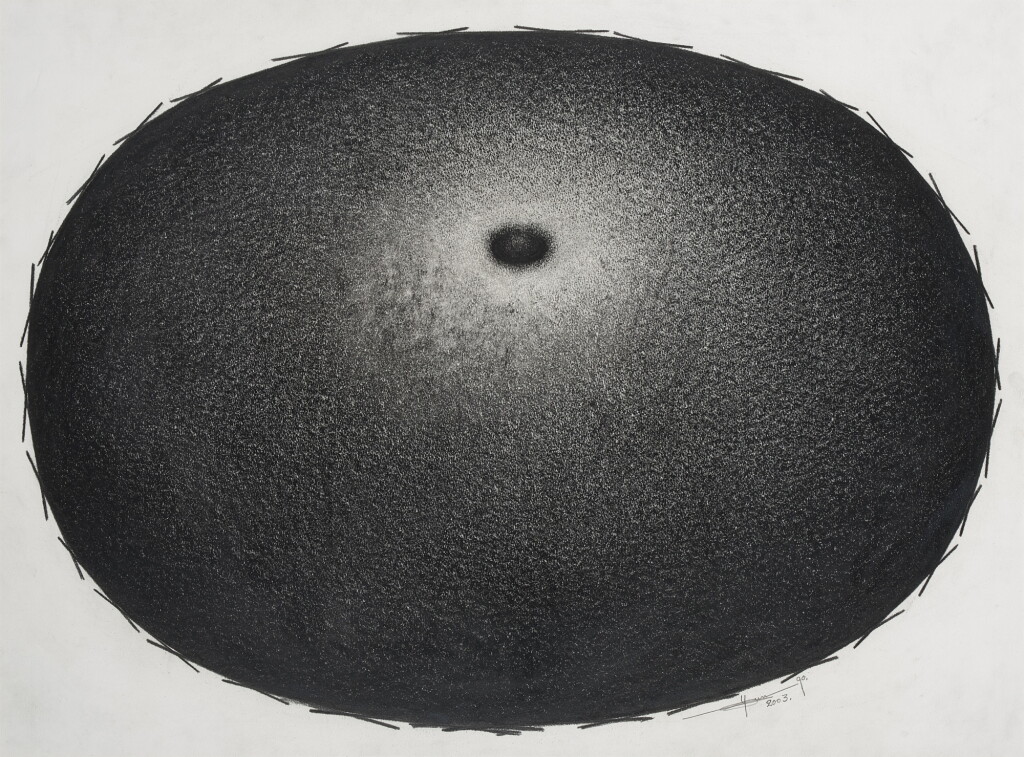
Tantra #175
Auction Closed
March 20, 05:04 PM GMT
Estimate
3,000 - 5,000 USD
Lot Details
Description
Property from the Private Collection of Ali Adil Khan, Toronto
Youngo Verma
1938 - 2014
Tantra #175
Graphite on paper laid on card
Signed and dated 'Youngo. / 2003' lower right
21 ⅜ x 29 in. (54.3 x 73.7 cm.)
Executed in 2003
Acquired from the artist, 2013
Ali Adil Khan is a Toronto based private collector and philanthropist. He holds an expansive collection of South Asian art that consists of more than 700 objects gathered over a period of two decades. In 2019, Khan established Shehla and Adil Giving for Art Foundation (SAGA) (Hyperlink: https://www.anokhilife.com/community-spotlight-saga-foundation-creates-a-platform-to-increase-awareness-on-the-global-south-asian-art-world/) to support a diverse range of visual art forms emanating from South Asia, encouraging learning, enhancing appreciation, and building community art initiatives. As part of this endeavor, in 2021, he bequeathed twenty Pakistani contemporary miniature paintings to the Royal Ontario Museum in Toronto. The bequest marked Pakistan’s 75 Years of Independence and coincided with Islamic Heritage Month at the Museum.
Khan has contributed notable reviews on South Asian art and artists for leading art journals, newspapers and websites. He has also served as an adviser to the Aga Khan Museum, the Oakville Galleries and the Art Gallery of Mississauga in Toronto. The artist, Youngo Verma was personally known to Khan; they maintained a close friendship from 2002 until Verma’s death in 2014. He organized two solo exhibitions of Verma where the current lot was exhibited.
Mississauga, Kundalini: Union of the Divine, Art Gallery of Mississauga, Canada, 2016
Born in 1938 in Haryana, Youngo Verma was a student of Bhabesh Chandra Sanyal and Krishna Shamrao Kulkarni at the Delhi College of Art before graduating in 1964. Verma began his career as a sculptor, later continuing his training at the Städelschule in Frankfurt in 1971. Inspired by the work of Constantin Brancusi, Verma was initially focused on casting and sculpting before permanently relocating to Canada, where he pivoted to painting and drawing.
During the last 40 years of his life, Verma lived and worked in solitude. His earlier paintings and drawings explored the sensual and the spiritual, using minimalism and abstraction to suggest a representation of the divine. Annual visits to India continued to influence the artist, and his work became increasingly inspired by Tantric traditions in Hinduism and Buddhism.
Neo-Tantrism emerged in the 1960s with the work of K.C.S. Paniker and his series ‘Words and Symbols.’ Several modern Indian artists developed an early language and conceptual framework for a new aesthetic, distinct from other forms of abstraction, that reformed traditional Indian esoteric idioms.
Drawn late in Verma’s life, the present lot embodies years of dedication and meditation, and is an embodiment of Tantra's aesthetic principles. The interplay between circle and oval, the origination point within an ever-expanding consciousness, is deftly portrayed in humble graphite. Shades of gray become three-dimensional, defying the limits of the paper. From the center, this abstract form emits energy in its balance between positive and negative space. To locate Tantra #125 within the Neo-Tantric canon is to notice its construction, simplicity and optical defiance.
'At a certain level the representational and iconic reach a certain limit where further internalisation becomes impossible. This the abstract and the symbolic can achieve since they have in them limitless horizons, where the mind can internalise and arrive at deeper truths. Tantra can thus achieve its aim since it goes beyond the form and concentrates on abstract symbolism.' (R. Chawla, Symbolism and Geometry in Indian Art, National Gallery of Modern Art, New Delhi)
In 2013, the Royal Ontario Museum acquired a similar work from the Tantra series, Tantra #21, and in 2021, acquired an additional 21 works from the artist’s estate. Verma’s work has been shown in important solo exhibitions that underscore his contribution to the field of Neo-Tantra and his lifelong visual exploration of the divine. In 2016, the Art Gallery of Mississauga held a posthumous retrospective highlighting Neo-Tantrism in the diaspora and Verma's profound connection to his spiritual heritage.
You May Also Like