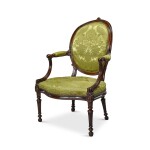
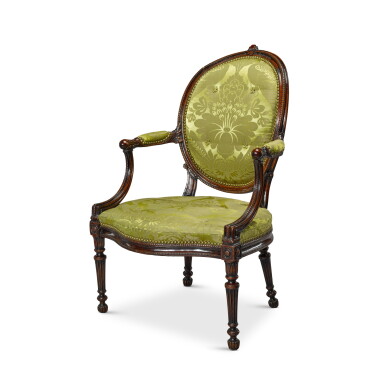
A George III stained beechwood armchair, circa 1775, attributed to John Linnell
Auction Closed
December 6, 03:29 PM GMT
Estimate
8,000 - 12,000 GBP
Lot Details
Description
A George III stained beechwood armchair, circa 1775, attributed to John Linnell
the oval gadrooned and foliate-carved back with outswept foliate-carved arms, with ball terminals, the upholstered seat above a moulded, beaded and gadrooned seat rail, on paterae-headed leaf-carved turned and fluted tapering legs, with gadrooned bun feet, originally decorated and bearing cramp cuts to the underside of the seat rail
This armchair features ball finials embraced by leaves, a motif frequently used by John Linnell. The design is documented in H. Hayward and P. Kirkham, William and John Linnell, London, 1980, Vol.II, figs. 87. Notably, a set of six chairs very similar to this design was commissioned for Harewood House in Yorkshire (ibid., p. 46, fig. 88) and Inveraray Castle for the Duke of Argyll (ibid., p. 46, fig. 89), highlighting the popularity of this style. A comparable giltwood armchair in very similar form was sold in these rooms, 16 November 1993, lot 87.
The Linnells were prominent British cabinetmakers and furniture designers during the 18th century, with commissions for notable country houses including Dukes of Beaufort for Badminton House, Sir Robert Child for Osterley Park and the Dukes of Argyll at Inverary Castle. John Linnell, son of furniture maker William Linnell, was educated in design at St. Martin’s Lane Academy. After his father’s death in 1763, he took charge of the family firm, working closely with renowned architects like Robert Adam. His chair works reflected the fashionable Louis XVI style popularized by French designers like Jean-Charles Delafosse in the 1760s and 1770s. Linnell’s designs, established his firm as a rival to other leading furniture makers of the time, including Thomas Chippendale, Ince & Mayhew, and John Cobb.
You May Also Like