Edgar Brandt
Pair of Andirons
Live auction begins on:
October 22, 02:00 PM GMT
Estimate
20,000 - 30,000 USD
Bid
13,000 USD
Lot Details
Description
Edgar Brandt
1880-1960
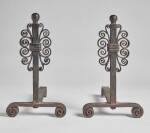
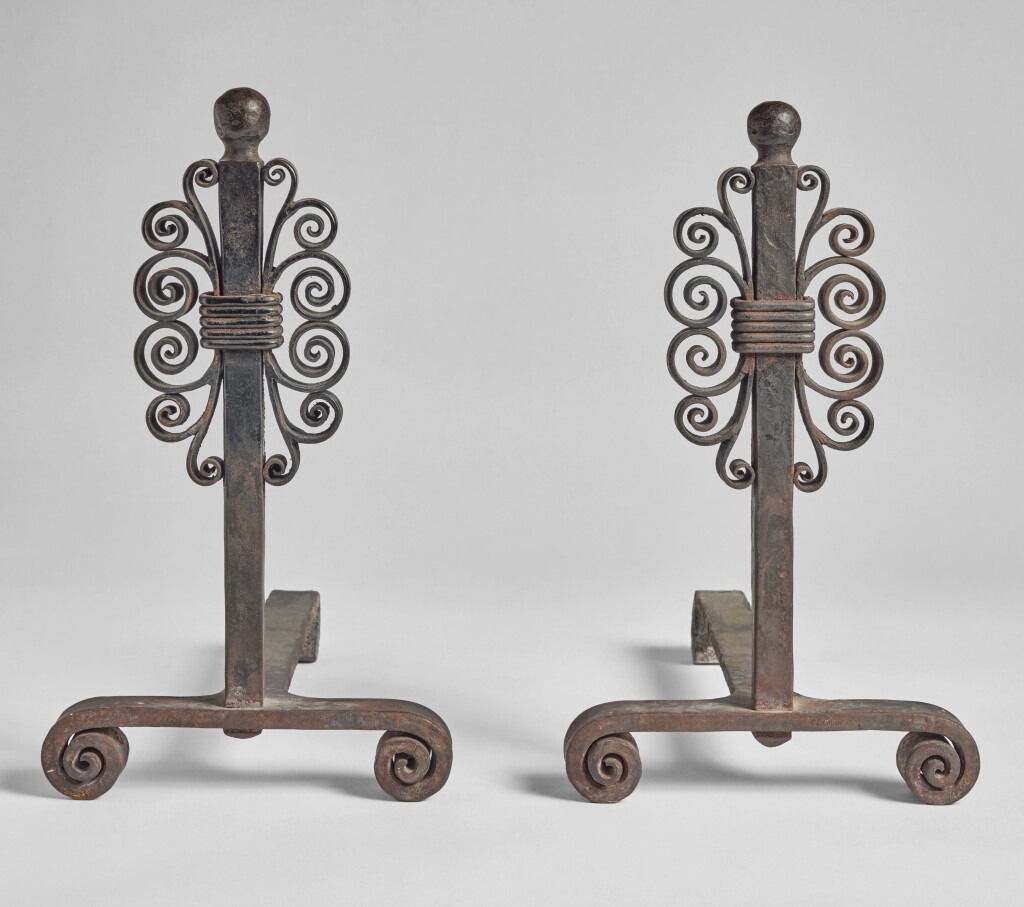
Pair of Andirons
circa 1925
each impressed EBRANDT
wrought iron
height 14 in.; width 8 ⅛ in.; depth 13 ⅝ in. each
35.6 cm; 20.7 cm; 34.5 cm
Yves Saint Laurent and Pierre Bergé, Paris;
Christie’s Paris, Collection Yves Saint Laurent et Pierre Bergé, February 23, 2009, lot 294;
Lee F. Mindel, New York;
Phillips New York, Light & Aerie: The Collection of Lee F. Mindel, FAIA, December 13, 2016, lot 282;
Where acquired by the present collector.
"At home with Yves Saint Laurent," Vogue, November, 1971, p. 158 (for a discussion of the interior)
Sotheby’s would like to thank Joan Kahr for her assistance with the cataloguing of this lot.
As Paris entered the modern age, Edgar Brandt established himself as the pre-eminent virtuoso of Art Deco ironwork, transforming wrought iron into a medium of sculptural elegance. Executed circa 1925, the present andirons exemplify his distinctive synthesis of strength and grace, distilling organic inspiration into a refined language of stylized abstraction.
The pair is defined by its commanding architectural presence and the expressive potential of its material. Substantial feet support elegant uprights animated by sweeping, vegetal-inspired details, while the dark surface gives the composition a striking graphic intensity. Brandt’s mastery of wrought iron is evident in the balance between weight and movement, resulting in an object that is both imposing and remarkably refined.
The distinguished provenance of the present pair further enhances its significance. Formerly in the celebrated collection of Yves Saint Laurent and Pierre Bergé, the andirons belonged to one of the twentieth century’s most discerning collections of French decorative arts. Their inclusion reflects the couple’s appreciation for works in which exceptional craftsmanship and modern design converge. Here, Brandt elevates an element of the hearth beyond its utilitarian purpose, creating an object of enduring elegance that captures the sophistication of 1920s Paris.
You May Also Like