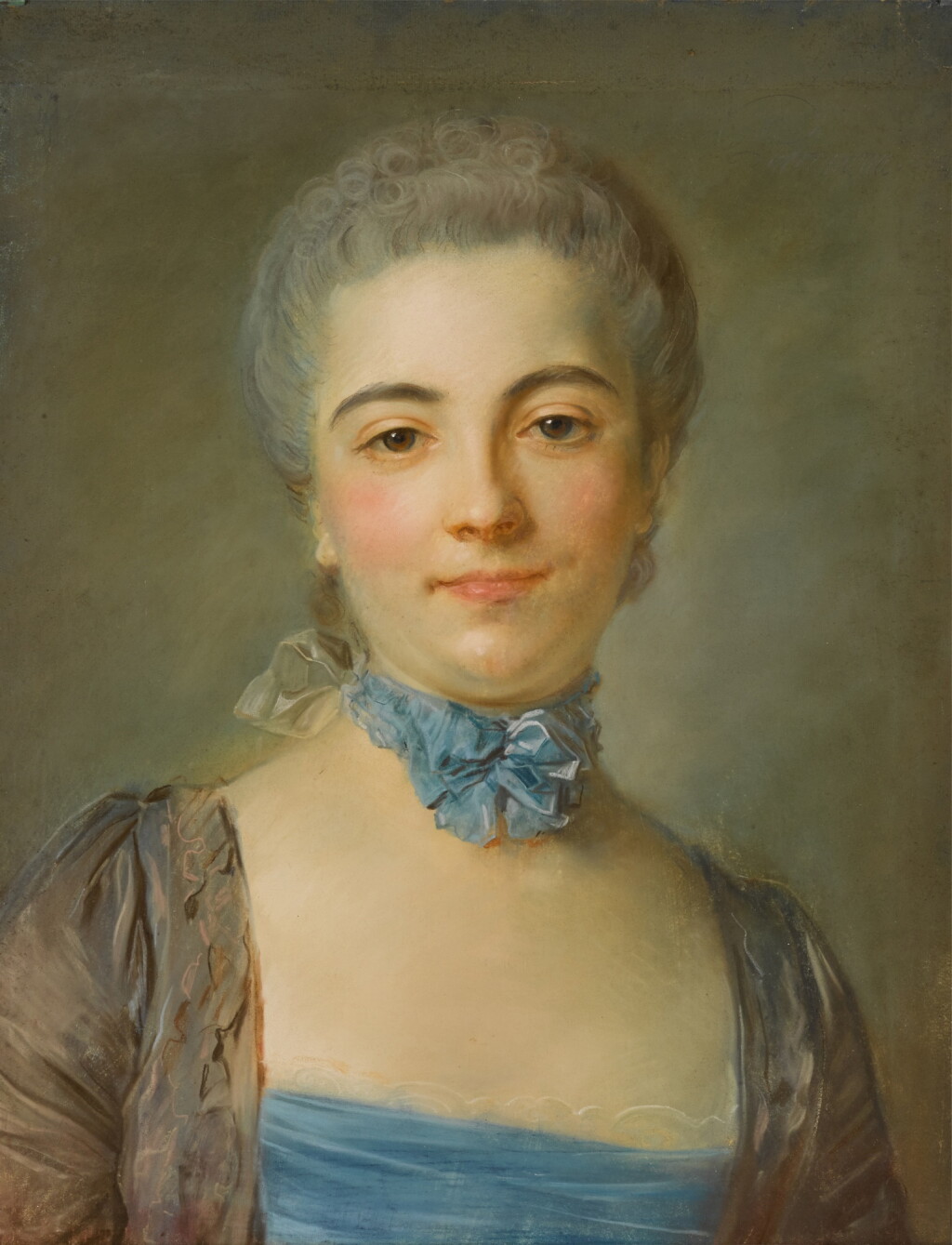
The Art of Pastel: A Swiss Private Collection
Jean-Baptiste Perronneau
Portrait of a lady, possibly La Comtesse Jacquette d'Arche, née de Loupes (1734-1777)
Auction Closed
January 25, 04:44 PM GMT
Estimate
50,000 - 70,000 USD
Lot Details
Description
The Art of Pastel: A Swiss Private Collection
Jean-Baptiste Perronneau
Paris 1715 - 1783 Amsterdam
Portrait of a lady, possibly La Comtesse Jacquette d'Arche, née de Loupes (1734-1777)
Pastel;
signed and dated, upper right: Perronneau1753 and bears inscription, in pen and brown ink, on the back of the frame: Pein par j b Perronneau peintre du Roy / recu de son academie Royalle en 1753 au mois de juin
470 by 390 mm; 18 ½ by 15 ⅜ in.
sale, Paris, Drouot, 17 November 1986, lot 59,
where acquired by Jacques-Louis Isoz
Orléans, Musée des Beaux-Arts d'Orléans, Jean-Baptiste Perronneau (1715-1783), 2017, no. 38, reproduced;
Lausanne, Fondation de l'Hermitage, Pastels du 16e au 21e siècle, 2018, cat. no. 15, reproduced p. 34;
L. Vaillat & P. Ratouis de Limay, Jean Baptiste Perroneau sa vie et son oeuvre, Paris 1909, no. 57, pl. 83;
L. Vaillat & P. Ratouis de Limay, Jean Baptiste Perroneau sa vie et son oeuvre, Paris 1923, pp. 53, 215;
J.G. Lemoine (alias Yves Jubert), 'Les modèles bordelais de Jean-Baptiste Perronneau', La Petit Gironde, 20-21 July, 1941, p. 66
Le Port des Lumières: La Peinture à Bordeaux 1750-1800, exhib. cat., Bordeaux, Galerie des Beaux-Arts, 1989, p. 67;
J. M. Marquis, 'Fréquence Pastel Une Collection de Pastels du XVIIIe siècles', in Connaissance des Arts, Supplément Suisse, March 1990, p. XIII, reproduced
The arts of France from François Ier to Napoléon Ier, exhib.cat., New York, Wildenstein 2005-2006, p. 218 (as a copy of Mme Fleuriau);
N. Jeffares, Dictionary of pastellists before 1800, London 2006, p. 397, reproduced / online edition, no. J.582.1022;
D. d' Arnoult, Jean-Baptiste Perronneau, ca. 1715–1783. Un portraitiste dans l’Europe des Lumières, Paris, 2014, no. 115 Pa, reproduced
Perronneau is regarded as one of the top two French pastellists of the 18th Century and some of his best works were produced in the 1750s. This elegant portrait of a young woman wearing a blue bow around her neck is a fine example of Perroneau’s artistic achievements of this period.
Signed and dated 1753, the sitter’s identity has been the subject of debate and remains uncertain today. Dominique d'Arnoult points out that judging by the date of the pastel, the sitter is likely to be Parisian, and explains there is no documentary evidence to support her traditional identitification as La Comtesse Jacquette d’Arche.1 Neil Jeffares does not rule out the possibility of this being La Comtesse, pointing out that her husband's job, a lawyer in the Bordeaux wine trade, may have brought the couple to Paris in 1753. D'Arnoult quashes the earlier suggestion that the pastel is another version of Perroneau’s portrait of Mme Fleuriau, arguing that their physiognomies are completely different.2
Speculation regarding the sitter’s identity aside, d'Arnoult highlights the subtle colours in her dress, ‘gris-rose ou gorge-de-pigeon' - which she says are highly characteristic of the artist.3 Neil Jeffares, in his dictionary of pastellists, has aptly described the artist’s ground-breaking achievements as a colorist in: ‘..obtaining extraordinary harmonies', e. g. 'garnets and violets against yellow grounds, or the characteristic green strokes to suggest shadows on flesh (which he usually depicts in a predominantly yellow tonality), anticipating the deconstructionist approach of Chardin and even of the impressionists.’4
As Neil Jeffares has observed, 'Perronneau’s superiority as a colorist is now widely acknowledged' and the finely balanced tonalities at play in this portrait perfectly showcase the artist's genius in creating masterful hues with the medium of pastel.5
1. D. d'Arnoult, 2017, op.cit., p. 243, no. 115 Pa
2. D. d'Arnoult 2017, referenced under no. 115 Pa (see also 167 Pa)
3. Ibid
4. N. Jeffares, Dictionary of pastellists before 1800, online edition, under Perronneau, Essay, p. 3
5. N. Jeffares, op.cit., p. 4
You May Also Like