Property from the Collection of A.M. ('Ton') van den Broek (1932-1995)
Govert Flinck
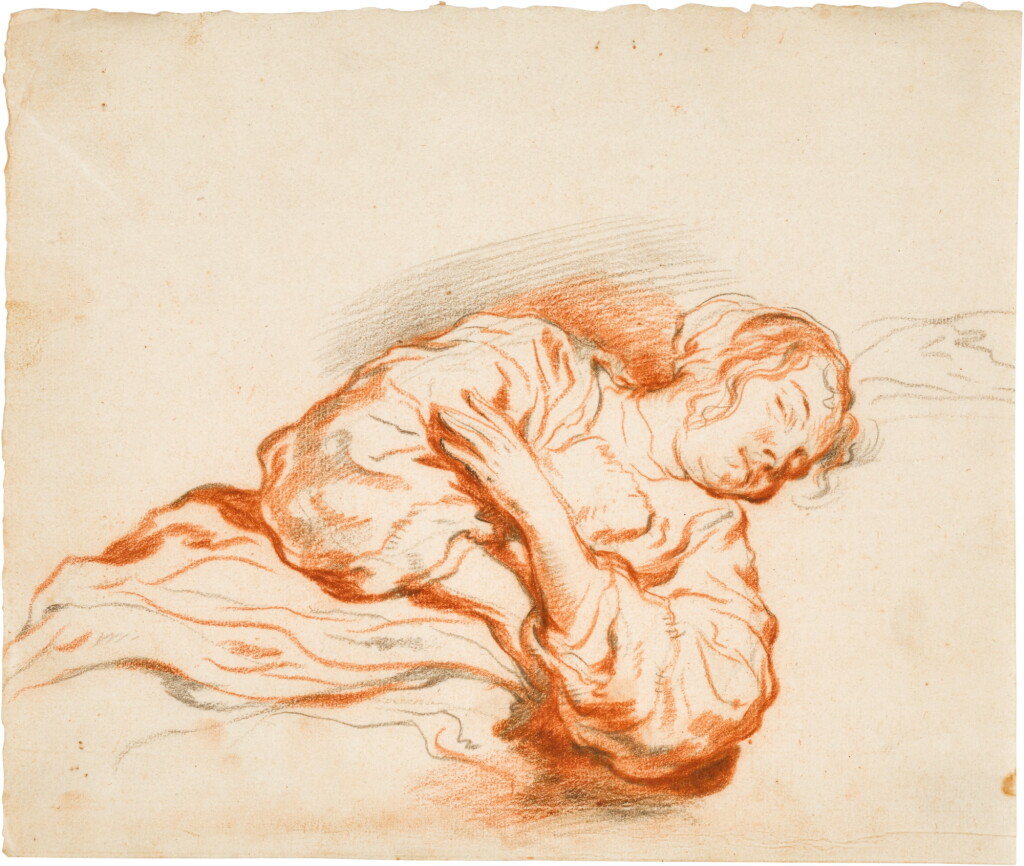
Study of a sleeping woman
Auction Closed
January 25, 04:44 PM GMT
Estimate
12,000 - 16,000 USD
Lot Details
Description
Property from the Collection of A.M. ('Ton') van den Broek (1932-1995)
Attributed to Govert Flinck
Kleve 1615 - 1660 Amsterdam
Study of a sleeping woman
Red and black chalk;
bears inscription in black chalk, verso: Backer / na / Flinck
214 by 252 mm; 8½ by 9⅞ in.
where purchased by A.M. ('Ton') van den Broek (1932-1995), Haarlem
During the 1640s and '50s, intimate and engaging studies of female figures, both clothed and nude, became an increasingly popular subject for several leading draughtsmen of the Rembrandt school. Prior to the 1994 sale, Professor Werner Sumowski suggested that this appealing study should be attributed to Gerbrand van den Eeckhout (1621-1674), comparing it in technique with a signed and dated drawing of 1652, in Coburg1, and in further notes, soon to be posthumously published (see Literature), he also referred to a Portrait of a Young Man, in Weimar.2 Both those drawings are, however, executed in black chalk, rather than the combination of red and black that we see here - a technique that refers more to Rembrandt's much earlier, Leiden period drawing style.
The Rembrandt school artists who are most frequently associated with relatively large female figure studies like this are Govert Flinck, Jacob Backer and Jacob van Loo, but of these it was only really Flinck who drew regularly in red as well as black chalk, or in a combination of the two. Seeing how the very Rembrandtesque technique of one of his earliest drawings, the signed red chalk Nude Woman as Bathsheba with King David's Letter (c.1638), in Paris3, develops by way of the Rotterdam drawing of Isaac Blessing Jacob (c.1642; red and black chalk)4, into the more familiar black and white chalk figure drawings of the late 1640s5, the present drawing fits relatively easily into Flinck's oeuvre, most probably dating from the early 1640s. Details such as the schematic, rather elongated fingers and the handling in the spiraling curls of hair also seem very typical of Flinck.
1. Sumowski, op. cit., vol.3, no.620
2. Sumowski, op. cit., no.617
3. Paris, Ecole nationale supérieure des Beaux-Arts, inv.390; Sumowski, op. cit., no.895
4. Rotterdam, Museum Boijmans van Beuningen, Koenigs Collection, inv. R 73; Sumowski, op. cit., no.862
5. e.g. Man Standing by a Table, Amsterdam, Rijksmuseum, inv. RP-T-1975-84; Sumowski, op. cit., no.873
You May Also Like