
Property from the Buzz Aldrin Family Trust
[Apollo 11]
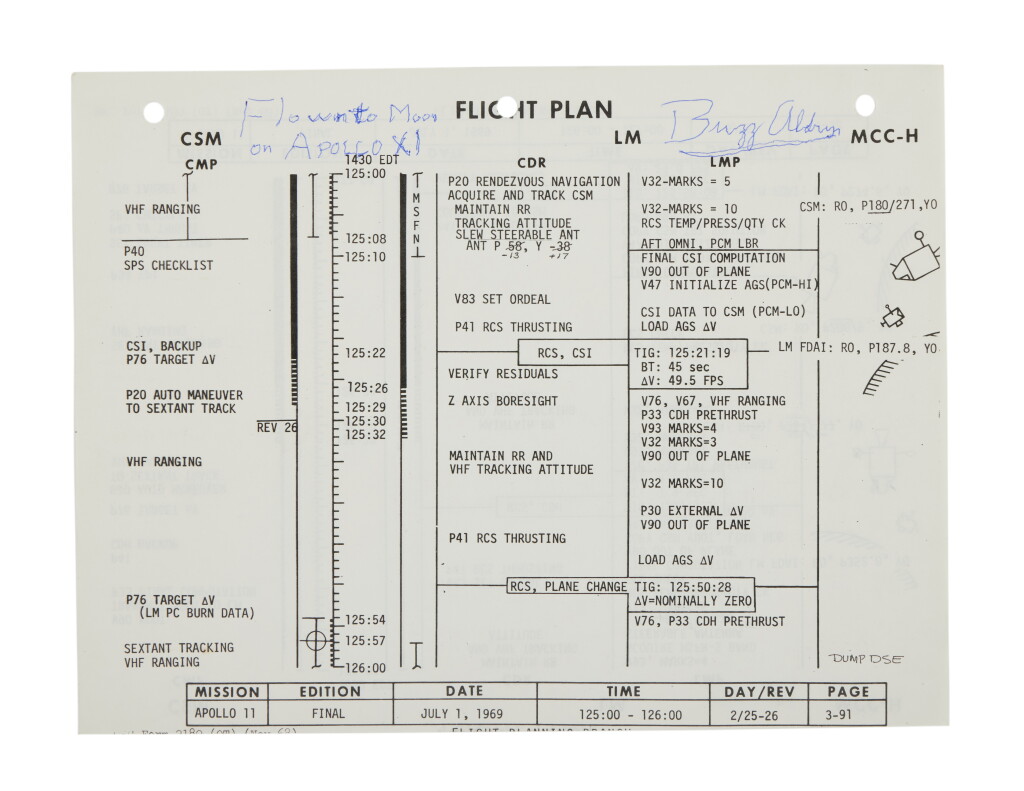
FLOWN Apollo 11 Flight Plan Sheet — A Critical Portion of the Ascent and Rendezvous Sequences
Auction Closed
July 26, 06:15 PM GMT
Estimate
20,000 - 30,000 USD
Lot Details
Description
[APOLLO 11]
FLOWN sheet from the Apollo 11 Flight Plan, Part No. SKB32100080-350, S/N 1001, p. 3-91/92, printed recto & verso. [Houston, Texas: NASA, Manned Spacecraft Center, Mission Operations Branch, Flight Crew Support Division, July 1, 1969].
10 1/2 by 8 inches. Punched at left margin. Several pre-flight manuscript notations to both sides in fine-tipped black felt pen, in an unknown hand. This lot will be accompanied by a Typed Letter Signed from BUZZ ALDRIN.
SIGNED AND INSCRIBED BY BUZZ ALDRIN IN BLUE BALLPOINT PEN: “FLOWN TO THE MOON ON APOLLO XI/BUZZ ALDRIN.”
Directly from the Personal Collection of Apollo 11 Lunar Module Pilot Buzz Aldrin
CRITICAL PORTION OF THE ASCENT AND RENDEZVOUS SEQUENCES REQUIRED IN ORDER FOR THE CREW TO RETURN HOME
BUZZ ALDRIN'S provenance letter reads, in full: "On July 16th, 1969, Neil Armstrong, Mike Collins, and I lifted off from Pad 39A at the John F. Kennedy Space Center on our journey to perform humankind's first landing on the Moon at the Sea of Tranquility.
Page 3-91 is part of the ascent and rendezvous sequence for the Apollo 11 mission. This is where Lunar Module Eagle is doing the orbital ballet that will culminate with chasing down Command Module Columbia. Apollo 11 performed a 'coelliptic rendezvous' which was performed in three stages: the Coelliptic Sequence Initiation (CSI), Constant Delta Height (CDH), and Terminal Phase Initiation (TPI). These three phases included engine burns and orbital plane changes that resulted in Eagle’s rendezvous with Columbia after liftoff from the lunar surface.
Mike Collins’s tasks were fairly passive during this period, as he was waiting for us in Eagle to maneuver to him. Mike’s job was to monitor and track the Lunar Module as it approached the Command and Service Module. Neil was flying the Lunar Module ascent stage. He had to start the rendezvous navigation program on the Lunar Module Guidance Computer (LGC), monitor the Rendezvous Radar (RR), and set up the Orbital Rate Display Earth and Lunar (ORDEAL) to measure Eagle’s altitude with respect to the lunar surface. He then entered Program 41 (P47) to prep the LM thrusters as well as monitor their firing. The box next to the 'RCS, CSI' box states the 'TIG,' or Time to Ignition, the 'BT,' or Burn Time, and 'Delta V,' or change in velocity. Neil got Eagle ready for the CDH burn to change the orbital plane to a constant height of 15 miles below Columbia. I operated the Lunar Guidance Computer. I had to enter instructions to get data relating to the orbital maneuvers that placed us slightly below Columbia so that we could catch up with the Command and Service Module prior to docking. Mission Control Center in Houston (MCC-H) monitored our progress since a lot of the maneuvers were done while out of contact. Page 3-92 is a continuation of our ascent. Neil and I worked together during the CDH and then we entered the final phase of rendezvous: the TPI, or Terminal Phase Initiation. The TPI maneuver linked us up next to Mike in Columbia just prior to docking.
This Flight Plan page 3-91/3-92 is one of the few objects carried into lunar orbit and is also a rare example of an astronaut flight-certified object used during our mission to be the first humans to land on the Moon."
REFERENCES:
NASA. Apollo 11 Stowage List. Mission AS 506 CM 107/LM-5. Houston, Texas: NASA, Manned Spacecraft Center, July 15, 1969, pp. 2 & 82, listing the complete Apollo 11 Flight Plan
CONDITION REPORT:
To request a condition report for this lot, please email science@sothebys.com
You May Also Like


