French, circa 1600 | France, vers 1600
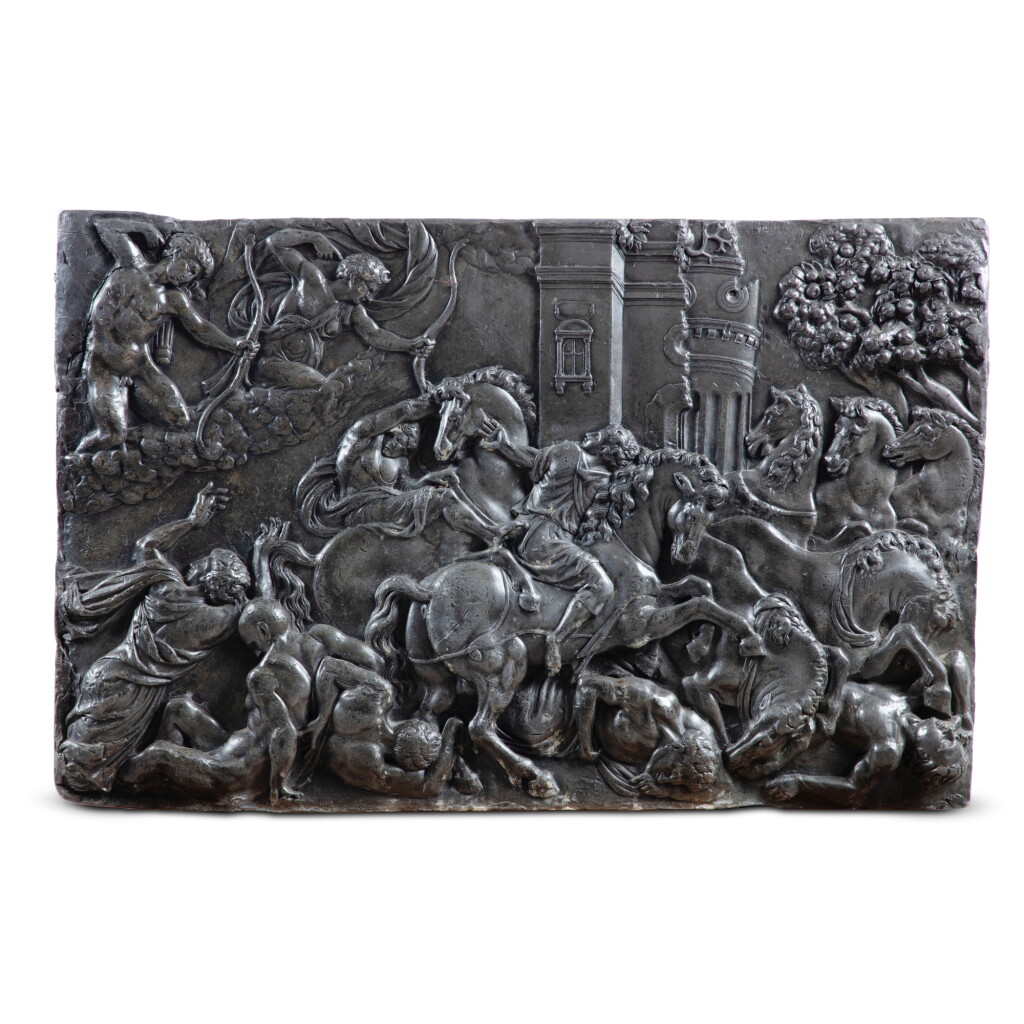
Relief with Apollo and Diana slaying the Niobids | Apollon et Diane poursuivant les Niobides
Lot Closed
November 25, 12:56 PM GMT
Estimate
15,000 - 26,000 EUR
We may charge or debit your saved payment method subject to the terms set out in our Conditions of Business for Buyers.
Read more.Lot Details
Description
French, circa 1600
Relief with Apollo and Diana slaying the Niobids
lead
the reverse incised with an S
44.5 by 70 by 4cm., 17½ by 27½ by 1⅝in.
____________________________________________
France, vers 1600
Apollon et Diane poursuivant les Niobides
relief en plomb
le revers incisé d'un S
44,5 x 70 x 4 cm ; 17 ½ x 27 ½ x 1 ⅝ in.
This dramatic composition is found in a plaster relief at the Louvre (inv. no. RF 116), which appears to have been cast from a pre-existing relief and is catalogued as Italian, 16th century. It is likely that the same relief provided the inspiration for a drawing by the Dutch Golden Age artist Jan de Bisschop (1628-1671) in the Getty Museum (inv. no. 88.GA.54), which was said by the artist to have been based on an antique relief. While this would not have been a work from classical antiquity, it is likely that the Renaissance prototype of the composition, perhaps in marble, was known to De Bisschop, and it evidently inspired the present relief in lead.
According to Greek myth, Niobe, the Queen of Thebes, boasted of her numerous children to Leto, the mother of the gods Apollo and Diana. To punish Niobe's arrogance, Leto sent Apollo and Diana to slay her daughters and sons (Niobids) with arrows.
--------------------------------------------
Cette composition dramatique se retrouve dans un relief en plâtre conservé au musée du Louvre (inv. n° RF 116), peut-être coulé à partir d'un relief préexistant catalogué comme italien, XVIe siècle. Il est probable que ce même relief ait inspiré un dessin de l'artiste néerlandais du Siècle d'or Jan de Bisschop (1628-1671) conservé au Getty Museum (inv. n° 88.GA.54), dont l'artiste a déclaré qu'il s'inspirait d'un relief antique. Bien qu'il ne s'agisse pas d'une œuvre de l'Antiquité classique, il est probable que le prototype de la composition de la Renaissance, peut-être en marbre, était connu de De Bisschop, et il a manifestement inspiré notre relief en plomb.
Selon le mythe grec, Niobé, la reine de Thèbes, se vantait de ses nombreux enfants auprès de Léto, la mère des dieux Apollon et Diane. Pour punir l'arrogance de Niobé, Léto envoya Apollon et Diane tuer ses filles et ses fils (les Niobides) à coups de flèches.
You May Also Like