
Property from a Private Collection
Theodoor van Thulden
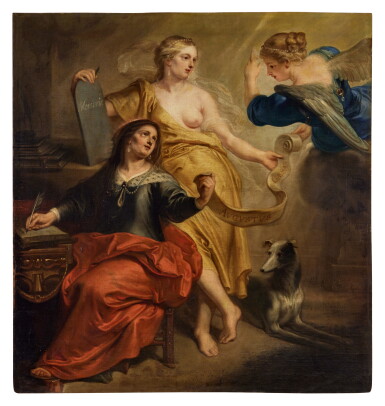
Allegory of the Glorification of Augustus Ceasar
Auction Closed
June 2, 05:22 PM GMT
Estimate
20,000 - 30,000 USD
Lot Details
Description
Property from a Private Collection
Theodoor van Thulden
Den Bosch 1606 - 1669
Allegory of the Glorification of Augustus Ceasar
signed lower right: T. van Thulden
oil on canvas laid down on panel
canvas: 49 by 46 ½ in.; 124.5 by 118.1 cm
framed: 56 by 54 in.; 142.2 by 137.2 cm
Probably commissioned by Amalia van Solms (1602-1675) for her apartments in the Oude Hof, Noordeinde Palace, The Hague, circa 1660-1661;
Probably thence by descent to her daughter, Albertina Agnes (1634-1696);
Probably thence by inheritance to her sister, Henriette Catharina van Anhalt-Dessau (1637-1708);
Probably Schloss Oranienstein, Diez, by 1726;
In the family of the present collectors, New York, since at least 1966.
Probably C. Rost, "Der alte Nassau-Oranische Bilderschatz und sein späterer Verbleib," in Jahrbücher für Kunstwissenschaft VI (1873), pp. 65, 66 ("Apotheose des Kaisers Augustus von van Thulden," as no. 2 in the transcribed list of Princess Henriette Catharina's will);
S.W.A. Drossaers and T.H. Lunsingh Scheurleer (eds.), Inventarissen van de inboedels in de Verblijven van de Oranjes en daarmede gelijk te stellen stukken, 1567-1795, The Hague 1974, vol. I (GS 147), p. 319; vol. II (GS 148), p. 224, 373;
E. Starcky, in Fondation Calvet, Dessins de la Donation Marcel Puech au Musée Calvet, Avignon, S. Béguin, M. Di Giampaolo, and P. Malgouyres (eds.), Naples 1998, p. 294.
Signed lower right, this ambitious allegorical composition by Theodoor van Thulden appears to be the long-lost painting known for centuries only through archival descriptions relating to the collections of the House of Orange. Rather than depicting Augustus himself, Van Thulden evokes the Roman emperor through the unfurling scroll inscribed “AVGUSTVS CAESAR,” presented by a winged figure descending from the heavens. At center sits a female figure traditionally understood as Livia, who appears to be writing in a book labeled “Historia”. Behind her, the personification of “Memoriae” holds an inscribed stone tablet. The composition thus transforms the glorification of Augustus into an allegory of remembrance, dynastic continuity, and immortal fame. Executed with the warm palette, fluid brushwork, and animated figural types characteristic of Van Thulden’s mature manner, the painting reflects the artist’s continued engagement with Rubensian allegory while adopting a more intimate decorative sensibility appropriate to princely interiors.
The picture is very likely identifiable with the work commissioned by Amalia van Solms, widow of Stadtholder Frederik Hendrik of Orange, for her apartments in the Oude Hof (now Noordeinde Palace) in The Hague circa 1660–1661. A black chalk drawing traditionally titled The Apotheosis of Emperor Augustus Announced to His Wife Livia and Son Tiberius (Musée Calvet, Avignon), once attributed to Rubens but now recognized as by Van Thulden, appears closely related to the present composition and may be viewed as a preparatory study. The drawing formed part of a broader series of allegorical designs celebrating the continuity and survival of the Orange dynasty following the political uncertainties of the mid-seventeenth century. Between 1660 and 1661, Van Thulden devised at least five such compositions emphasizing the preservation of the Orange lineage and the central role of Amalia van Solms as dynastic matriarch; whether the remaining designs were ever realized as finished paintings remains uncertain.
Archival references strongly support the identification of the present work with the painting formerly installed above the fireplace in Amalia’s apartments at the Oude Hof. The Dispositieboek of Amalia van Solms records in 1673 “Two large paintings on the mantelpiece, depicting the history of the wife of Emperor Augustus, done by T. van Thulden.” The composition likely also corresponds to the picture described in the 1696 inheritance inventory of her daughter Albertina Agnes as “Historijschriiever van Augustus p. van Thulden,” subsequently passing to her sister, Amalia’s only surviving daughter, Henriette Catharina van Anhalt-Dessau. By 1726, the painting was recorded in the inventory of Schloss Oranienstein at Diez as hanging above a fireplace and described as “The deification of Augustus by Van Tulde [sic], where Historia represents the portrait of Amalia von Solms, wife of the Prince of Orange.” This identification is especially compelling given the physiognomic characterization of the seated female figure, whose dignified features and prominent role within the composition suggest an idealized portrait of Amalia herself. In this dynastic reading, the glorification of Augustus serves as an allegorical parallel to the posthumous exaltation of Frederik Hendrik, whose political memory and legacy Amalia carefully cultivated after his death.