Property from a European Private Collection
Mariano Fortuny
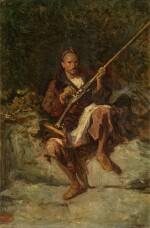
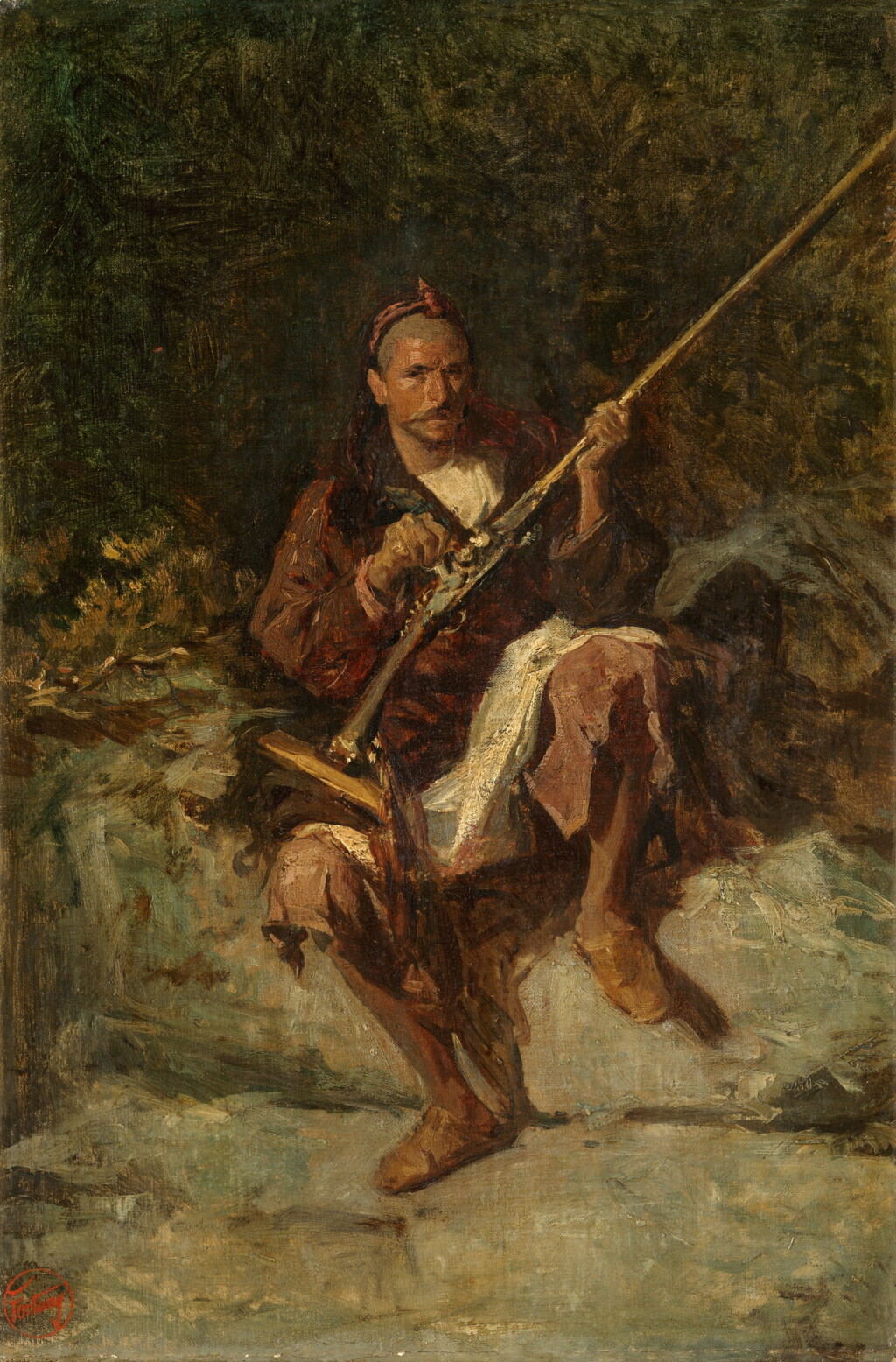
A Bashi Bazouk
Auction Closed
October 24, 01:12 PM GMT
Estimate
40,000 - 60,000 GBP
Lot Details
Description
Property from a European Private Collection
Mariano Fortuny
Spanish
1871 - 1949
A Bashi Bazouk
signed with artist's stamp lower left
oil on canvas
Unframed: 47 by 31cm., 17¾ by 12¼in.
Framed: 78.5 by 63cm., 31 by 24¾in.
Painted c. 1860-1863
The artist’s estate sale, Drouot, Paris, 24-30 April 1875, lot 105
Éduard Kums, purchased at the above sale (Kums (1811-1891) was honorary consul in Paris of the House of Saxony, Coburg and Gotha, Knight of the Order of Léopold); thence by descent until 1898
Florencio Milicua, Barcelona, by 1958
Private collection, Barcelona
Paris, The Fortuny Workshop, Posthumous works, Hôtel Drouot, 24–30 April, 1875
Antwerp, Paintings by Old and Modern Masters of the Flemish, French, Dutch Schools and tapestries from Mr. Édouard Kums museum in Antwerp, Hotel Kums, 14–15 May 1898
The Fortuny Workshop, Posthumous works, exh. cat., Paris, 1875, cat. 105, p. 39
Paintings by Old and Modern Masters of the Flemish, French, Dutch Schools and tapestries from Mr. Édouard Kums museum in Antwerp, exh. cat., Antwerp, 1898, p. 56
Carlos González López and Montserrat Martí Ayxelà, Mariano Fortuny Marsal, Barcelona, 1989, vol. II, p. 41, cat. OR.2.02.63/65, illustrated in black and white
Though this painting depicts a soldier in the costume of an Arnaut, or bashi-bazouk, from the Balkans, it appears likely, based on a preparatory drawing of the same face in the National Museum of Art of Catalonia (cat. no. 046002-D) made in Morocco in 1860-62, that the sitter was in fact North African. Indeed, the same figure reappears a year or so later in Fortuny's painting, The Arab Guard of 1863, today in Taft Museum in Cincinnati. Arnauts, or bashi-bazouks, were irregulars in the Ottoman army recruited in Serbia and Albania, then part of the Ottoman empire. The strain on the Ottoman feudal system caused by the Empire's wide expanse required heavier reliance on irregular soldiers. They were armed and maintained by the government, but did not receive pay and did not wear uniforms or distinctive badges, preferring to dress in their own distinctive local costume comprising a red tunic and white kilt.
Born in Reus, Tarragona, Fortuny was the foremost representative of the so-called Spanish School in Rome. He studied at the School of Fine Arts Barcelona, and in 1858 won a grant from the Catalan government to study in Rome for two years. Here he enrolled at the Chigi Academy and shared a studio with Tomás Moragas and later with José Taipei and Joaquín Agrasot. His first taste of the ‘Orient’ came in In 1860 when he was sent by the government of Barcelona to North Africa to chronicle the Hispano-Moroccan disputes, resulting in his seminal painting The Battle of Tetuan. Trips to Andalusia and Morocco followed in 1862 and 1865, and in 1870 he settled for a time in Granada. From this moment on Moorish and North African scenes, including of Berber warriors, became central to his artistic output.
You May Also Like