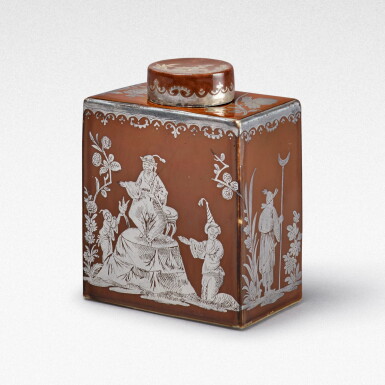
A Meissen brown-glazed Hausmaler rectangular tea canister and cover, Circa 1730-35, the decoration slightly later
Auction Closed
September 14, 05:54 PM GMT
Estimate
6,000 - 8,000 USD
Lot Details
Description
A Meissen brown-glazed Hausmaler rectangular tea canister and cover, Circa 1730-35, the decoration slightly later
decorated in silver, in Augsburg, on the front and reverse with a Chinoiserie figure seated on a circular draped dais with attendant figures, the sides with a figures facing inwards, one wearing a sword and holding a staff, the other with kneeling over beneath a palm tree, crossed swords mark in underglaze-blue.
Height: 4⅜ in.
11.1 cm
Margarethe (née Knapp, 1878-1949) and Dr. Franz (1871-1950) Oppenheimer, Berlin & Vienna (no. 315 in red);
Dr. Fritz Mannheimer (1890-1939), Amsterdam & Paris, inv. no. Por. 207 (acquired between 1936 and 1939);
Dienststelle Mühlmann, The Hague (acquired from the Estate of the above in 1941 on behalf of the Sonderauftrag Linz for the proposed Führermuseum);
On deposit at Kloster Stift Hohenfurth;
On deposit at Salzbergwerk Bad Aussee;
Recovered from the above by Allied Monuments Officers and transferred to the Central Collecting Point Munich (MCCP inv. no. 1475/8);
Repatriated from the above to Holland between 1945 and 1949;
Loaned by the Dutch State to the Rijksmuseum, Amsterdam in 1952 and transferred to the museum in 1960;
Restituted by the above to the heirs of Margarethe and Franz Oppenheimer in 2021
Franz Kieslinger, Verzeichnis der Restbestände der Sammlung Mannheimer, [S.I.], 1941, p. 21, cat. no. 120
Abraham L. den Blaauwen, Saksisch / Dresden China 1710-1740, Amsterdam, 1962, fig. 5
Siegfried Ducret, Meissner Porzellan bemalt in Augsburg, 1718 bis um 1750, Vol. 1, Brunswick, 1971, p. 29, fig. 206
Abraham L. den Blaauwen, Meissen porcelain in the Rijksmuseum, Amsterdam, 2000, p. 211, cat. no. 129
Schnorr von Carolsfeld, ibid., p. 221, speculated the painter of the Klemperer bowl was based in Dresden or Bayreuth. The style of painting seen on the abovementioned pieces has traditionally been attributed to the Hausmalern Johann Philipp Danhöfer and Christian Daniel Busch, who both worked in Bayreuth. The figures must have been inspired by engravings, which have yet to be identified.
You May Also Like