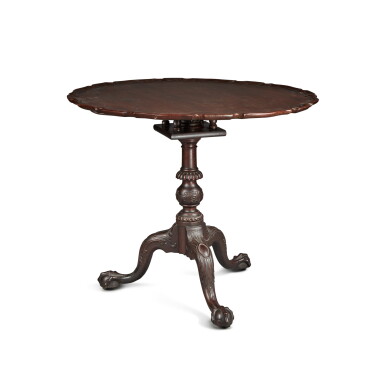
Very Fine and Rare Chippendale Carved Mahogany Pie Crust Tilt-Top Tea Table, carving attributed to the Garvan Carver, Philadelphia, Pennsylvania, circa 1765
This lot has been withdrawn
Lot Details
Description
Very Fine and Rare Chippendale Carved Mahogany Pie Crust Tilt Top Tea Table, carving attributed to the Garvan Carver
Philadelphia, Pennsylvania
circa 1765
Appears to retain its original surface, cast brass castors and turned mahogany lock ring.
Height in. by width in. by Depth in.
Previously undocumented, this tea table is a recent and important discovery of Philadelphia Rococo furniture. It survives in a remarkable state of preservation and retains its original surface, lock ring and castors.
The exceptional carving on the table is attributed to the “Garvan” carver, the most accomplished carver working in Philadelphia in the 1750s and 1760s. With his identity unknown and so-named for his exceptional carving on a high chest of drawers in the Garvan Collection at the Yale University Art Gallery, the “Garvan” carver’s work is distinctive for its masterful quality, lushness and fluidity.1 True to the Rococo idiom, he incorporated leaves, vines, shells and flowers into his vocabulary, which he articulated as if in motion with leaf tips appearing to flip back on themselves. He created rich effects of volume and shading through the use of detail cuts, particularly in the turned-over ends on the long sinuous leaves and clusters of parallel, straight cuts to shade the ends of the leaves. He consistently achieved an end result of expert carving within a well-integrated scheme. From the legacy of his surviving work, the “Garvan” carver is believed to have been working in Philadelphia in the 1750s as a young man in his early 20s learning his craft. He worked for several cabinet shops until around 1758, when he began working for what appears to have been the largest and most successful cabinet shop in Philadelphia. His latest known work in his most fully developed style dates to the 1760s. No objects made later by this carver are known.
The “Garvan” carver articulated similar carving on a number of surviving tea tables. These include: the “Acme of Perfection” table now in a private collection that sold in these rooms, January 19, 2008, lot 168;2 a tea table in the Karolik Collection at the Museum of Fine Arts, Boston;3 one at the State Department;4 one with a history in the Fisher-Fox family of Philadelphia;5 one at Winterthur Museum;6 one formerly in the collection of Stratford Hall Plantation;7 two in the collection of the Metropolitan Museum of Art;8 and one formerly in the Hennage Collection now at Colonial Williamsburg.9 For this group, he developed a template of carving motifs which he consistently used amongst the tables including a gadrooned canopy, acanthus-carved urn, guilloche ring, egg-and-dart or flowerhead-carved passages, and scrolling leaves articulated near the joint of the leg centering a cartouche and opposing C-scrolls. While all the tables share a related design vocabulary, no two are identical and some have a profusion of carving while others have less. A pole screen in the collection of Chipstone Foundation with many of these same carved motifs in also attributed to the same hand.
The carving on this tea table is most similar to that on the Fisher-Fox tea table, Chipstone pole screen, and tea table formerly at Stratford Hall. All of these pieces have the gadrooned canopy, a guilloche ring, and knee carving terminating in a single, twisted leaf. The acanthus carving on the urn of this table with C-scrolls alternating with cabochons is very similar to that found on the pole screen. The Fisher-Fox table has an urn with this same carving that also incorporates underlying acanthus leaves. The knee carving of this table centers an elongated trefoil motif that relates to the trefoil design enclosing opposing C-scrolls on the knees of the Fisher-Fox table. Similar trefoil motifs are seen on two other tables with carving attributed to the “Garvan” carver including a marble top sideboard table at Winterthur and a card table at Bayou Bend.10
1 The high chest and its companion dressing table were owned by Henry (1737-1816) and Susanna (Wanshaer) Wynkoop (d. 1776) of Bucks County, Pennsylvania, who married in 1761. The case pieces are illustrated in Gerald Ward, American Case Furniture (New Haven, CT: Yale University Art Gallery, 1988): no. 147, pp. 280-3 and no. 116, pp. 226-7/
2 Illustrated as such by William M. Hornor, Blue Book Philadelphia Furniture (Washington, D.C., 1935): pl. 223.
3 The M. and M. Karolik Collection, Museum of Fine Arts, Boston, 39.146.
4 U.S. Department of State, 82.71.
5 Sold at Christie’s, Important American Furniture, Folk Art and Prints, October 3, 2007, sale 1882, lot 94.
6 Winterthur Museum 58.2215.
7 Sold at Christie’s, Property Deaccessioned from Stratford Hall Plantation, December 4, 2003, sale 1334, lot 3.
8 Metropolitan Museum of Art 18.110.13 and one at the Metropolitan Museum of Art illustrated by Wallace Nutting in Furniture Treasury, no. 1115.
9 Colonial Williamsburg 1991-82.
10 See Joseph Downs, American Furniture (New York, 1952), cat. 359 and David B. Warren, et al, American Decorative Arts and Paintings in the Bayou Bend Collection (Houston: The Museum of Fine Arts Houston, 1998): F115, p. 67.
You May Also Like