
Property from a Private American Collection
Francis Wheatley
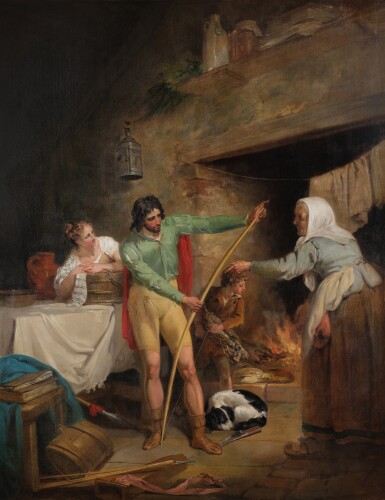
King Alfred in the house of the neatherd
Auction Closed
May 25, 07:43 PM GMT
Estimate
20,000 - 30,000 USD
Lot Details
Description
Property from a Private American Collection
Francis Wheatley
London 1747 - 1801
King Alfred in the house of the neatherd
signed and dated lower left: F. Wheatley p.x.t / 1792
inscribed on stool lower left: EN
oil on canvas
canvas: 77 by 58 ⅞ in.; 195.6 by 149.5 cm.
framed: 84 by 66 ¼ in.; 213.4 by 168.3 cm.
Commissioned from the artist by Robert Bowyer (1758-1834), London, for Bowyer's Historic Gallery;
Its liquidation sale (by public lottery), London, Peter Coxe, 29 May 1807, lot 53;
Robert Madocks, 1893;
Anonymous sale, London, Christie's, 15 March 1929, lot 52;
Where acquired by Waters;
With J. Leger, 1930, and then transferred to their New York branch;
From whom acquired by a private collector;
Anonymous sale, New York, Christie's, 4 October 1996, lot 57;
Where acquired by the present collector.
London, Berner's Street, 1792;
London, Bowyer's Historic Gallery, 1793, no. 15;
London, Bowyer's Historic Gallery, 1795, no. 21.
M. Webster, Francis Wheatley, London 1970, pp. 91, 147, cat. no. 98, reproduced p. 92, fig. 129;
R.W. Hutton, "Robert Bowyer and the Historic Gallery: A Study of the Creation of a Magnificent Work of Art," Ph.D. dissertation, University of Chicago 1992, pp. 435-438, cat. no. 6, reproduced fig. 14.
ENGRAVED
By W. Bromley, February 1795.
In 1792, the miniature painter and aspiring entrepreneur Robert Bowyer commissioned Wheatley (as well as other contemporary artists) to produce paintings illustrating David Hume's History of England. Operating under the subsidiary "Bowyer's Historic Gallery," Bowyer produced engravings after the paintings, which included two by Wheatley, the present work and the Death of Richard II (present location unknown).
The scene depicts an episode from Hume's epic in which the Saxon King has adopted the guise of a peasant in order to live with his neatherd (a tender of cattle) and his wife. In the painting, she has just discovered that Alfred absentmindedly allowed her fresh cakes to burn while toasting over the fire. The tale was intended to underscore how Alfred's mind was occupied with more lofty pursuits than warming vittles. For Hume, the incident itself was "nothing memorable...except so far as every circumstance is interesting, which attends so much virtue and dignity, reduced to such distress."1
1 Quoted in Hutton 1992, p. 436.
You May Also Like


