
Property from a Distinguished Canadian Private Collection
Jacob van Ruisdael
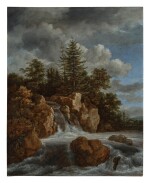
A wooded landscape with a waterfall
Auction Closed
May 25, 07:43 PM GMT
Estimate
250,000 - 350,000 USD
Lot Details
Description
Property from a Distinguished Canadian Private Collection
Jacob van Ruisdael
Haarlem 1628/29 - 1682 Amsterdam
A wooded landscape with a waterfall
signed lower left: Ruisdael
oil on canvas
canvas: 25 ⅝ by 20 ⅝ in.; 65.1 by 52.4 cm.
framed: 33 ⅜ by 28 in.; 84. 8 by 71.1 cm.
J.J. Martin, by 1832;
Mrs. West, by 1835;
Lechmere collection;
With Charles Sedelmeyer, Paris, by 1906;
With J. Goudstikker, Amsterdam, 1906;
With Galerie Gustav Ritter Hoschek von Müllheim, Prague, by 1907;
Dowager Madame van Alphen-Hovy, The Hague, by 1911;
Possibly with Jacques Goudstikker, Rotterdam and The Hague, 1915;
Returned to Dowager Madame van Alphen-Hovy, The Hague;
Her sale, The Hague, 26 September 1916, lot 117;
Anonymous sale, The Hague, Kleykamp, 6 November 1917, lot 71;
With Kunsthandel St. Lucas, The Hague (who stated when selling to the below that the painting was acquired from Mrs. Snouckaert van Schauberg-van Alphen, who inherited the painting from her aunt, Dowager Alpen-Hovy);
From whom acquired by Jhr. Th. Roell, Bilthoven, 1955;
Thence by descent to his wife, Mrs. Th. Roëll-Kessler, Bilthoven;
From whom acquired by Bob Haboldt, New York, 1984;
Anonymous sale, New York, Christie's, 11 January 1989, lot 72;
There acquired.
London, British Institution, 1832, no. 155 (lent by J.J. Martin)
Paris, Charles Sedelmeyer, 100 Paintings of Old Masters of the Dutch, Flemish, Italian, French, and English Schools Belonging to the Sedelmeyer Gallery, 1906, no. 32;
With Jacques Goudstikker, Rotterdam and The Hague, 1915.
J. Smith, A catalogue raisonné of the works of the most eminent Dutch, Flemish, and French painters, London 1835, vol. VI, 136;
Galerie Gustav Ritter Hoschek von Mühlheim in Prag. Beschreibendes Verzeichnis der alten Gemälde, Prague 1907, p. 68, cat. no. 108;
C. Hofstede de Groot, A Catalogue Raisonné of the works of the most eminent Dutch painters of the seventeenth century, based on the work of John Smith, London 1911, vol. IV, 430 or 431;
J. Rosenberg, Jacob van Ruisdael, Berlin 1928, no. 211;
S. Slive, Jacob van Ruisdael: A Complete Catalogue of His Paintings, Drawings, and Etchings, New Haven and London 2011, p. 164, cat. no. 154, reproduced in black and white (as dated circa 1670, and mistakenly as only monogrammed lower left).
Datable to about 1670, Ruisdael’s Wooded Landscape with a Waterfall is a beautiful and evocative example of a theme that the Dutch artist frequently explored throughout his career. Indeed, from the mid-1650s until the end of his life, he painted more than 150 landscapes with waterfalls, torrents, and rushing streams.1 Drawing the present composition together is the powerful waterfall that cascades over boulders into the mighty waters. Their mistily but energetically rendered surface serves to pleasingly contrast the variegated faces of the boulders and the distinct execution of the foliage that rises above them. Adding further drama to the scene are the dark billowing clouds in the sky that almost serve the mirror the aqueous protagonist that fills the foreground.
What is fascinating about Ruisdael’s proclivity towards these particular watery subjects is that almost none of them depict the characteristic flat Dutch landscape but instead show rougher, more northern settings. Indeed, many of them, like the present, betray the influence of his contemporary Allart van Everdingen (1621-1675), the Alkmaar artist who traveled to Norway and Sweden in 1644-1645 and returned to the Netherlands to paint what he had seen there. They often share the characteristics of being vertical in format, featuring rocky streams and spindly trees.
Ruisdael was undoubtedly the greatest landscape painter active in seventeenth-century Holland. In 1648, he entered the Guild of Saint Luke in Haarlem, whose members between 1645 and 1655 included several luminaries of Dutch landscape painting from whom he learned his trade, among them his uncle Salomon van Ruysdael, Pieter Molijn, Cornelis Vroom, and the aforementioned Van Everdingen. Ruisdael was almost single-handedly responsible for the new direction of Dutch landscape painting after circa 1650, which moved away from the "tonal" phase exemplified by his uncle Salomon van Ruysdael and Jan van Goyen, to one characterized by a strong color range and overtly naturalistic compositions. Ruisdael’s versatility encouraged him to experiment with all types of landscape painting: his extant oeuvre consists of over 700 paintings, which range from raging waterfalls and coastal marines, to intricate cityscapes and broad panoramas.
1. Slive 2011, pp. 154-155, for a discussion of these cascade paintings.
You May Also Like


