
Swiss
A yellow gold and enamel verge watch with date, Circa 1760
No reserve
Lot Closed
June 17, 05:16 PM GMT
Estimate
3,000 - 5,000 USD
We may charge or debit your saved payment method subject to the terms set out in our Conditions of Business for Buyers.
Read more.Lot Details
Description
Dial: gold chased scrollwork heightened with green enameled flowers centered by a scalloped white enamel chapter ring, inner ring calibrated for date, outer ring for minutes
Caliber: verge movement with balance bridge decorated with pierced scrollwork
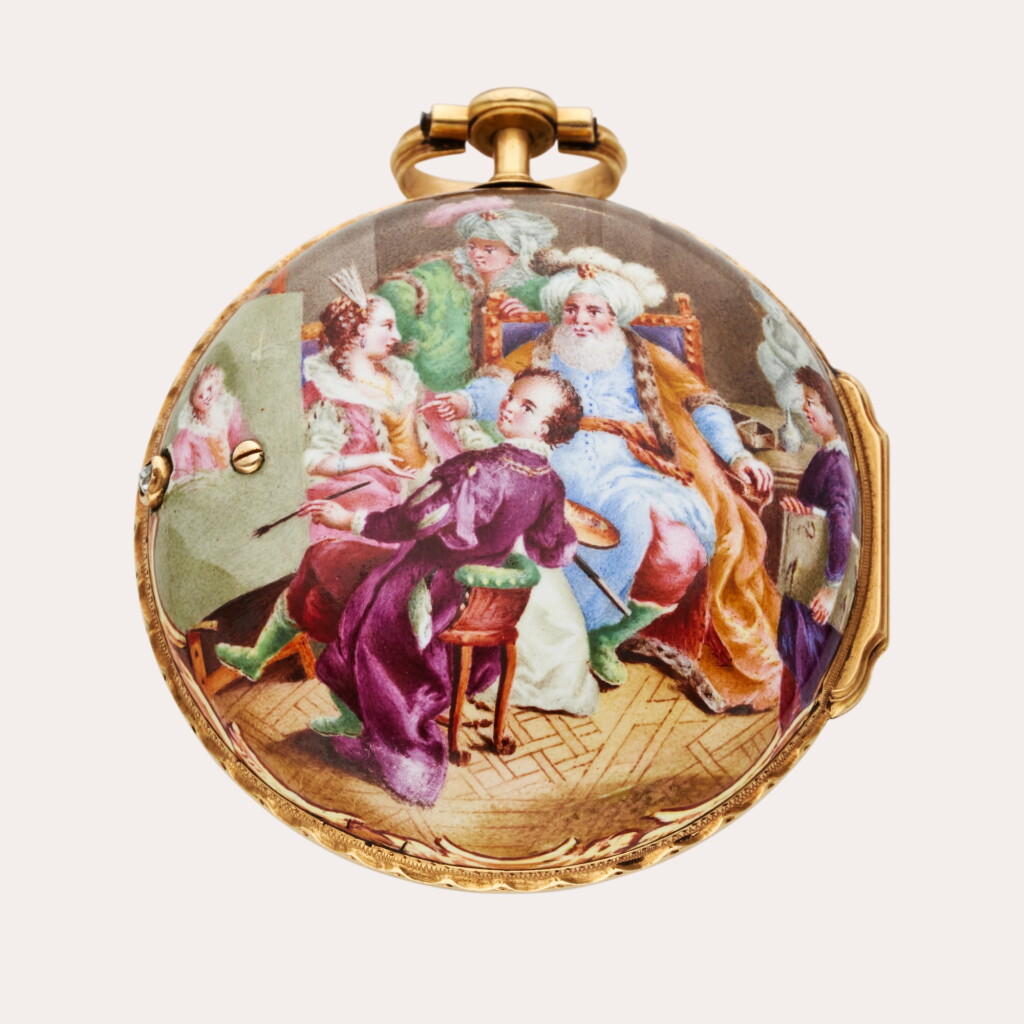
Case: yellow gold, polychrome enamel copy of the painting A Pasha Having His Mistress's Portrait Painted by Carle van Loo in 1737
Size: 47 mm diameter
Signed: case interior signed Sop; I.M. Vogel Geneve 1762
Box: no
Papers: no
Weight: approximately 79.3 g
Turquerie: An Eighteenth-Century European Fantasy by Haydn Williams, pp. 129
Tales from the Near and Far East, both fictional and factual, have long fascinated the Occident, as have tales of fortune and misadventure in 'exotic' locales of mysterious foreign lands. This fascination culminated in the rise of Orientalism and our present lot is an example of this fascination with the Orient.
The painted scene in polychrome enamel is a copy of the famous painting A Pasha Having His Mistress's Portrait Painted from 1737 by Carle van Loo (1705 - 1765). Set in an imaginary Turkish locale, the painting depicts an artist at work, the sitter a seated lady with two turbaned gentlemen and a young boy looking on. The painter looking back at the audience is the self portrait of the painting's artist van Loo. And in the background are various decorative pieces such as a vase and a classical sculpture suggesting a sophisticated high society setting. Signed 'Sop; I.M. Vogel Geneve 1762' in the case interior, the present lot is a beautiful time capsule of one of the most significant art movements between the 16th-18th centuries in Europe: Turquerie.
Turquerie or Turquoiserie specifically describes the intrigue in Turkish customs and fashion where imitations of different elements in Ottoman art and culture were in vogue in Western Europe from the 16th to 18th centuries. Many Western European countries were fascinated by the faraway and relatively obscure culture of the Ottoman ruling class, which was the center of the Ottoman Empire. This phenomenon gathered steam through trade routes and increased diplomatic relationships between the Ottoman and the European nations, exemplified by the Franco-Ottoman alliance in 1715, and the publication of the first European version of Les mille et une nuits (The Thousand and One Nights) in French. Ambassadors and traders often returned home with tales of exotic places and souvenirs of their adventures that rivaled the dazzling fantasy of the tales in The Thousand and One Nights.