
Property from a Private Connecticut Collection
Winfred Rembert (1945-2021)
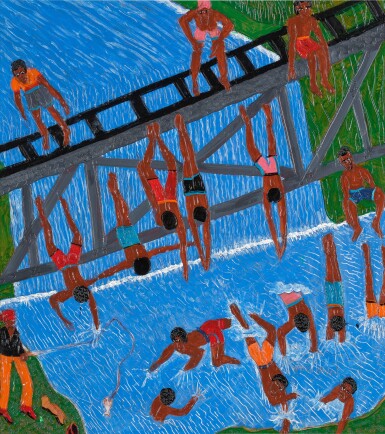
The Curvey: A Swimming Hole for Playing Hookey from School
Auction Closed
January 20, 04:11 PM GMT
Estimate
100,000 - 150,000 USD
Lot Details
Description
Dye on carved and tooled leather
Executed in 2015
signed Winfred Rembert lower right, the verso inscribed and signed The Curvey A Swimming Hole For Playing Hookey from School/ Winfred Rembert
24 ¼ in. by 21 ½ in. (61.6 by 54.6 cm)
Acquired directly from the artist as a gift by the present owner
While the artist Winfred Rembert faced hardship and oppression in many instances throughout his life, a large scope of work within his ouevre includes scenes of everyday life and recreation. The "Curvey," as Winfred recalls, was a swimming hole outside of Cuthbert, Georgia, where run-off water filled a dredged hole under a railroad bridge. The artist has stated he does not know why it was called the Curvey, but some have surmised it was due to the curved shape of the suspension bridge over the swimming hole. Rembert remembers these moments fondly saying it was not only a sanctuary from white oppression but from adults; a place where 'kids could be kids.' Some of the boys who went to the Curvey were playing hooky; others were simply not in school, but it was a place of congregation all the same, where boys could swim, relax, talk, and fish. In an environment dominated by constant stress, one can truly imagine the refuge that this watering hole offered for black teenage boys in the Civil Rights era; and Rembert depicts it as such, as a lush, cascading blue river where boys dove off the railroad bridge altogether rather than one at a time. The Curvey appears to be an oasis and a place where the everyday stressors of real life subsided.
Two additional scenes of the Curvey are published: the first entitled The Curvey, executed in 2013, in the possession of Fort Gansevoort Gallery; the second entitled The Curvey II, executed in 2014, which is in the permanent collection of the Hudson River Museum, accession number 2020.11. These scenes are noticeably different; showcasing the fact that this was a commonly visited hideaway and reliable place for fun. The composition of this Curvey, the third executed, demonstrates the improvements the artist made over time with his compositions. While the first two are portrayed from a head-on arial perspective, the subject work is depicted from an angled viewpoint, and purposefully eliminates superfluous details in order to enhance the aesthetic components of visual movement and balance.
You May Also Like


