Property from a distinguished Japanese Collection
Rembrandt Harmensz. van Rijn
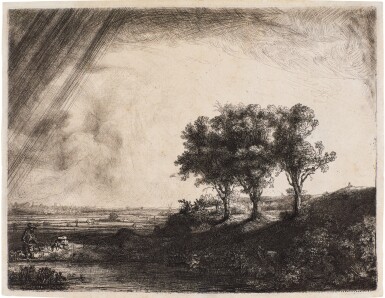
The Three Trees (Bartsch, Hollstein 212; New Hollstein 214; Hind 205)
Auction Closed
January 31, 05:59 PM GMT
Estimate
220,000 - 350,000 USD
Lot Details
Description
Rembrandt Harmensz. van Rijn
Leiden 1606 - 1669 Amsterdam
The Three Trees (Bartsch, Hollstein 212; New Hollstein 214; Hind 205)
Etching with engraving and drypoint, 1643, a very good impression of this highly important print, printing with depth, clarity and effective contrasts, the sulphur tinting in the sky pronounced, on laid paper with a Foolscap with seven-pointed Collar watermark and IP countermark, framed
plate: 215 by 281 mm; 8½ by 11 in.
sheet: 223 by 288 mm; 8¾ by 11¼ in.
Metropolitan Museum of Art, New York (L. 1943 and 1808h);
traded to M. Knoedler & Co., New York, for nine other Rembrandt prints, 1921;
with David Tunick, New York;
from whom acquired by Fujikawa Gallery, Tokyo, in 1985;
Private Collection, Japan (acquired from the above by the present owner)
Tokyo, Osaka, Fukuoka, Fujikawa Gallery, Lifetime Printings: Rembrandt, 1985, cat. 24
Christopher White in Lifetime Printings Rembrandt, op cit., p. 2 and conclusion of introduction, and cat. no. 24
Few graphic landscapes feature the same degree of technical complexity as The Three Trees. The composition’s dense, overlapping layers of etched and engraved lines, coupled with areas of sulphur tinting, demonstrate Rembrandt’s experimental approach to printmaking. Outlining the individual leaves of the trees and the thickets in the foreground with an etching needle and burin would have required incredible dexterity and patience. In sharp contrast to these bold lines in the foreground, the delicately scored drypoint lines which accent the clouds and atmosphere in the background suggest turmoil on the horizon, conjuring a sense of disquiet in the otherwise tranquil, pastoral landscape.
Since its creation in 1643, audiences have been captivated by both the technical and symbolic facets of The Three Trees. The prevailing reading of the print argues that the trio of trees is an allusion to the three crosses present at Christ’s crucifixion. By presenting the trees in this way, Rembrandt is able to conceal religious messaging in the landscape by veiling it within natural imagery. In addition to this religious reading, other scholars have argued that the trees hold nationalistic importance, as their fortitude in the face of the advancing storm symbolizes Dutch strength in the battle for independence from Spanish rule. Other smaller details within the scene, such as the fishing couple at the lower left and hidden lovers in the foreground of the image, are included for their importance in pastoral literature; these motifs would have been familiar references to Rembrandt’s contemporary audience.
You May Also Like